








- JLL’s 2026 survey of 837 senior investors finds 83% have at least one AI activity scaled or embedded, yet 43% still struggle to meet their AI goals.
- Investors aim AI at capital deployment, where results are weakest. Asset and property management ranks lower as a priority but delivers the strongest efficiency and decision-quality gains.
- Only 15% have built custom agentic workflows in every area where they use AI. JLL says that depth, not tool access, is what will separate winners.
Eighty-three percent of real estate investors have moved one or more AI activities to scale or full embedding, yet the biggest gains are not where they aimed, according to JLL’s investor AI survey.
JLL polled 837 senior decision makers at firms managing at least $1 billion, across 12 countries. Eighty percent report early benefits, and 43% still struggle to hit their goals.
Get Smarter about what matters in CRE
Stay ahead of trends in commercial real estate with CRE Daily – the free newsletter delivering everything you need to start your day in just 5-minutes
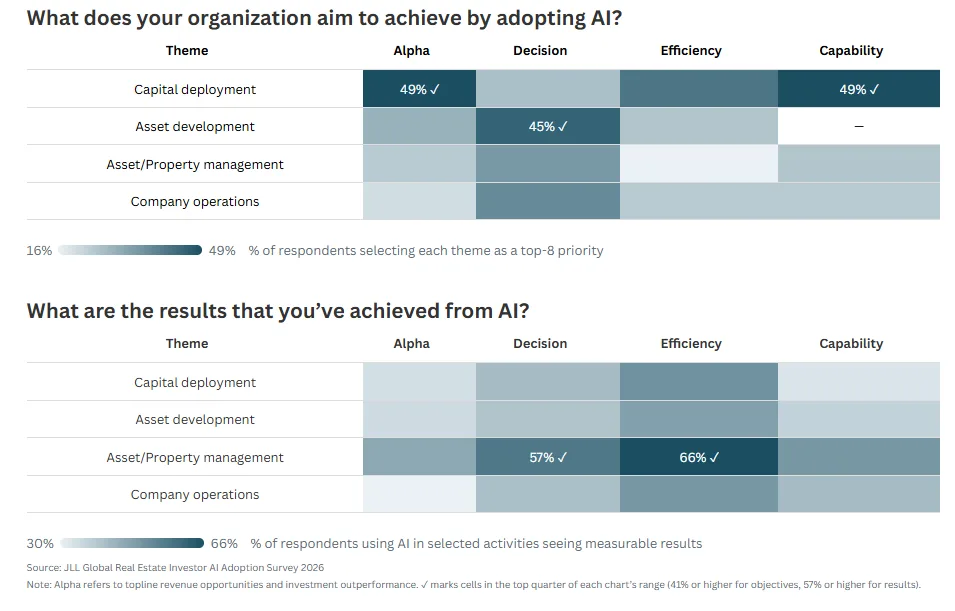
Goals and Results Don’t Match
Investors aim their top AI goals at beating the market and building proprietary analytics in capital deployment, each cited by 49%. Yet that is where results are thinnest.
Asset and property management flips the pattern. It ranks lower on priorities but posts the best marks for efficiency at 66%, decision quality at 57%, capability at 50% and outperformance at 46%.
JLL’s explanation: when everyone buys the same tools and the same market data, gains turn generic. Work gets faster, so efficiency shows up first.
Depth is thin overall. Investors see three of six benefit types per activity on average, and just 4% reach all six in any one area.
Access Isn’t an Edge
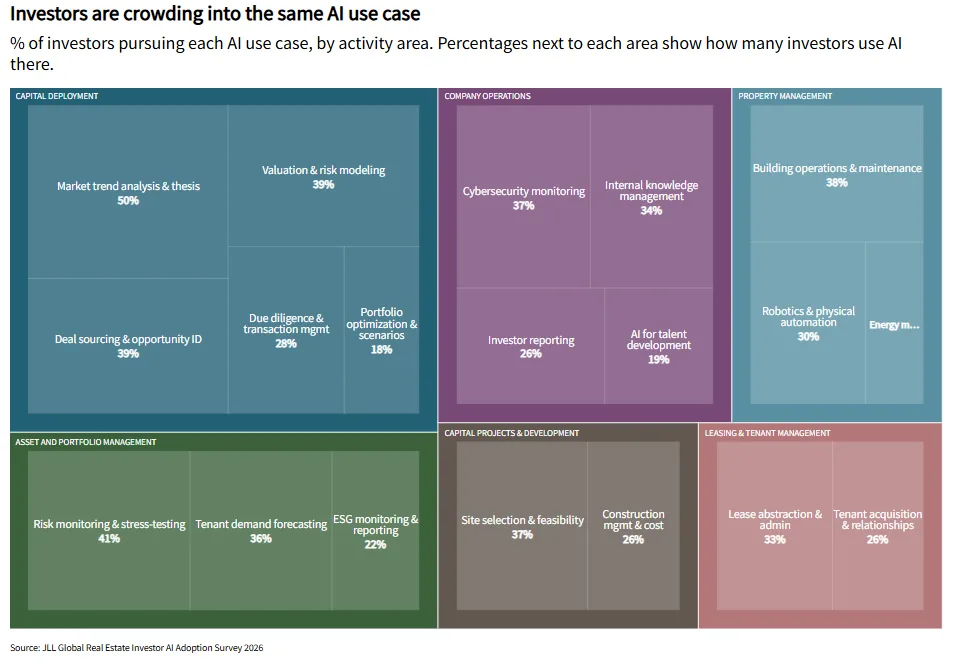
Vendor-licensed LLMs are the default tool for 81% of investors, and today’s typical investor runs seven AI use cases spread over five areas. Last year the figure was five across three areas. JLL says rollout speed no longer signals maturity.
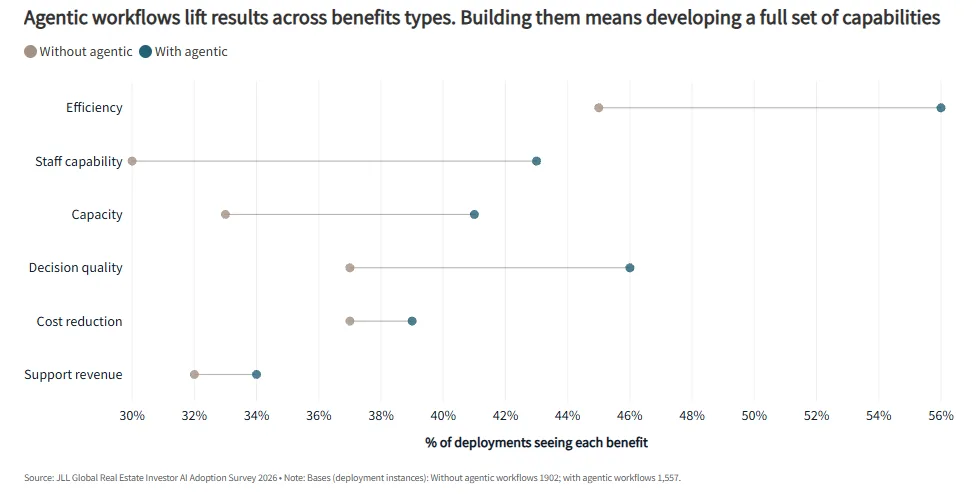
Just 15% have custom agentic workflows spanning all of their AI use cases, and one in five have built none. Deployments built that way reach four-plus benefits at more than double the rate.
Competitive pressure is building. Sixty-nine percent say AI is putting material pressure on their business, with competition the most cited worry. Adoption is near universal in data work (91%) and in capital deployment and investment management (92%), so the same tools keep landing on the same problems.
Data readiness is a dividing line: 59% of investors without AI-ready data struggle to see benefits, versus 21% of firms that do.
Where JLL Says to Spend
JLL’s first recommendation is to check each AI use case for competition. In bidding, speed gets competed away: if every buyer underwrites faster, none stands out. In asset management, efficiency flows into NOI and stays with the owner.
The second is to build, not just buy. Most are staffing up for it: nearly nine in ten (88%) have brought on AI talent or a lead, and 81% hired outside advisors. JLL’s rule of thumb is to buy core records systems, boost platforms where vendors fall short, and build the proprietary workflows that create an edge.
The third is to fund your own moat. Among investors who call talent their edge, only 24% use AI for training. Among those who cite relationships and deal access, 22% put AI money into relationship management, while 43% fund only deal sourcing.
Zoom Out
JLL has taken a measured line on AI’s effect on property demand as well. In an interview with IREI, research director Jacob Rowden said, as we reported earlier, that AI-driven office leasing carries little bubble risk because the recovery would look much the same without it.
Why It Matters
For owners and operators, the survey points the next AI dollar toward the operating side. That is where JLL sees gains stick, because they land on the owner’s own cost line and tenant base.
For deal teams, the message is harder: a faster underwriting model is table stakes, not an advantage.
What’s Next
JLL ends with a trio of questions for the next AI budget cycle. Which gains would survive if every rival used the same tool? Can we build? Is the money funding our own edge?