







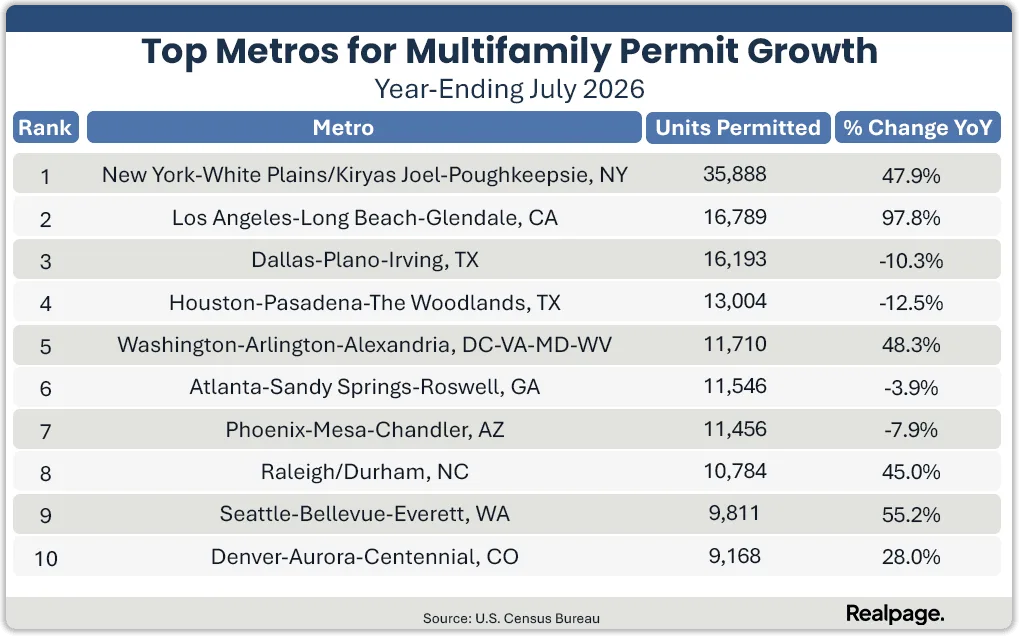
- Per the US Census Bureau, New York multifamily permitting rose 47.9% and Los Angeles nearly doubled.
- Sun Belt leaders cooled, with Dallas and Houston each down about 1,850 units. Austin and Chicago led all annual declines.
- The top 10 metros permitted 146,349 units, up 23% for the year, with appetite concentrated in high-demand markets.
Coastal Metros Lead the Permitting Rebound
New York and Los Angeles pushed multifamily permitting higher over the past year, per the US Census Bureau data reported by RealPage. New York permitting rose 47.9% to 35,888 units, an increase of 11,624 units from the prior 12 months. Los Angeles climbed 97.8% to 16,789 units, adding roughly 8,300 units. RealPage flagged both coastal metros as the clear leaders in July’s data.
Get Smarter about what matters in CRE
Stay ahead of trends in commercial real estate with CRE Daily – the free newsletter delivering everything you need to start your day in just 5-minutes
New York and Los Angeles Split on Geography
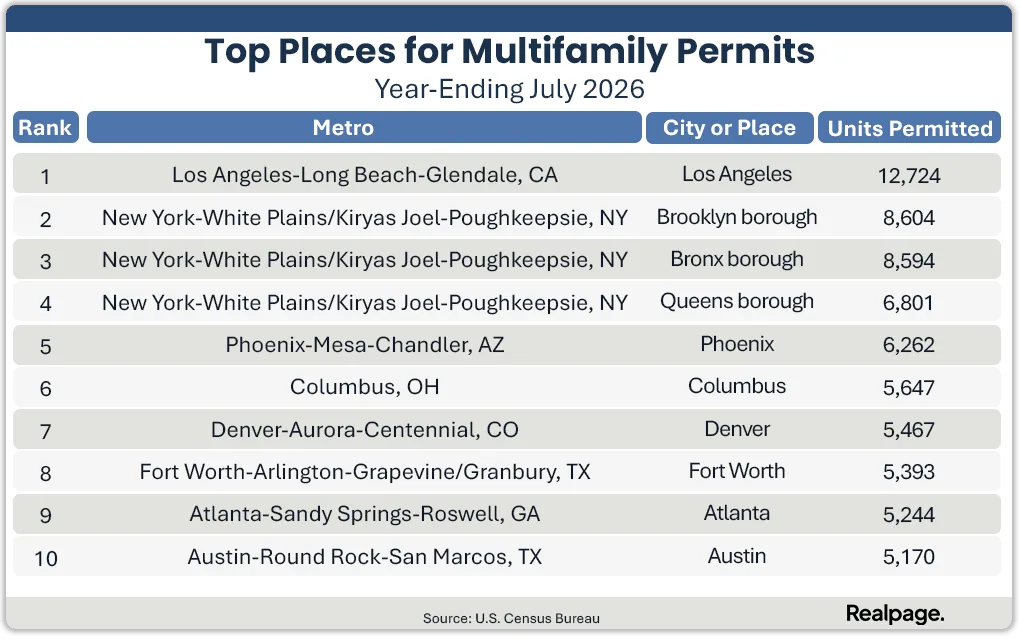
The two leaders grew in very different ways. New York spread its activity across boroughs, led by Brooklyn (8,604 units) and The Bronx (8,594 units). Queens added 6,801 units and Manhattan 3,039 units. Los Angeles concentrated its permitting in the city proper, which accounted for 12,724 units. That contrast shows how each metro is absorbing new supply.
The Details
Six of July’s top 10 metros increased annual permitting from a year earlier. Washington, DC, Raleigh/Durham, Seattle, and Denver each expanded by 2,000 to 4,000 units. Denver returned to the top 10 and replaced Miami, which fell to 15th. Other metros posted large annual gains too. They included San Jose (+4,281 units), Tacoma (+2,725 units), and Salt Lake City (+2,534 units). West Palm Beach (+2,308 units) and Tampa (+2,001 units) also gained. The top 10 together permitted 146,349 units, up 23% for the year but nearly flat for the month.
Sun Belt Permitting Pulls Back
Several Sun Belt metros that led recent supply growth retreated. Dallas and Houston each shed about 1,850 units from last July. Atlanta and Phoenix also slowed.Heavy apartment oversupply has already shifted more leverage toward renters across several Sun Belt markets.
Austin and Chicago led annual declines, down 3,921 and 3,253 units. Orlando, Miami, San Diego, Columbus, and Lakeland-Winter Haven rounded out the largest drops. The pattern marks a retrenchment in markets that recently drove much of the nation’s new supply.
Permitting by Place Tracks the Metros
Below the metro level, the city of Los Angeles and three New York boroughs topped the individual permitting list. The core cities of Phoenix, Denver, and Atlanta followed. Phoenix slipped one spot with about 5,700 units permitted for the year. Denver and Fort Worth moved up as annual permitting increased. Austin jumped six places to 10th, even as its metro total fell for the year.
Why It Matters
The split between coastal gains and Sun Belt declines signals where developers still see demand. Expansion clustered in high-demand employment and population centers such as Washington, DC, Raleigh/Durham, Seattle, and Denver. That concentration, drawn from US Census Bureau permit data, points to a more selective national pipeline. Builders appear to favor markets with steadier fundamentals over those carrying heavy recent supply.