



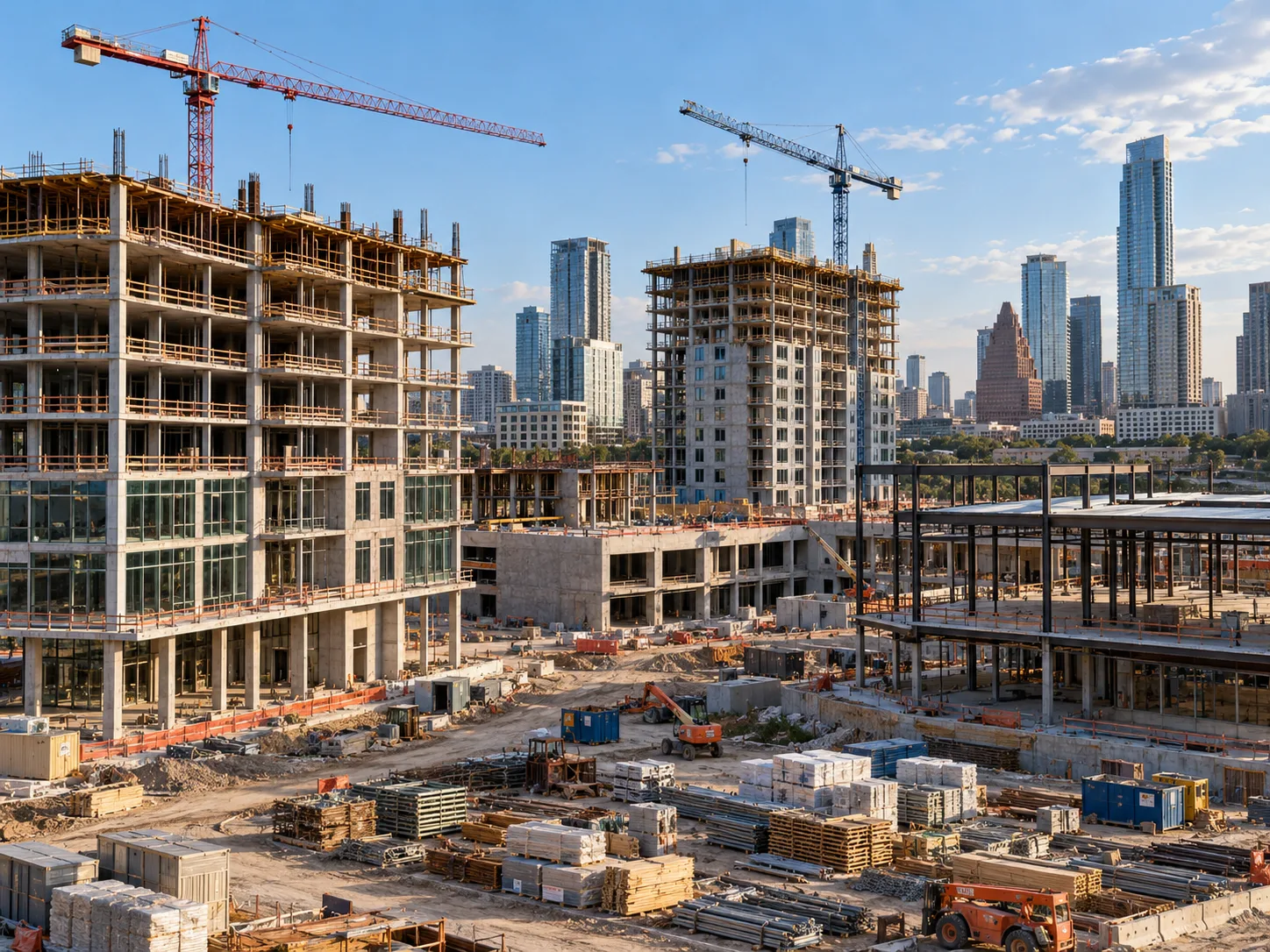
- An AGC survey found 55% of respondents delayed, canceled or scaled back at least one non-data-center project.
- Construction input prices rose 1.2% in August and nearly 9% from a year earlier.
- Developers are revisiting density, entitlements and capital stacks while private lenders and family offices fill more financing roles.
Rising construction costs and elevated borrowing rates are changing how developers get projects built. Commercial Observer reported that sponsors are redesigning plans, adjusting budgets and using broader capital stacks to preserve returns. The pressure is visible in new construction-cost and development data published in September.
An Associated General Contractors of America survey found 55% of respondents had delayed, canceled or scaled back at least one non-data-center project during the prior six months. One-third of surveyed firms named rising construction expenses as the main reason. That pressure is narrowing the set of projects that can meet targeted returns without changing scope or financing.
Get Smarter about what matters in CRE
Stay ahead of trends in commercial real estate with CRE Daily – the free newsletter delivering everything you need to start your day in just 5-minutes
Developers Redesign Projects
Construction input prices rose 1.2% from July to August. They were also nearly 9% above August 2025, according to an Associated Builders and Contractors report using US Bureau of Labor Statistics data. Those increases are pushing sponsors to change what they can control.
Rastegar Property Company adjusted the residential density at its planned 318-acre Infinity Square community in Kyle, Texas. The project includes 1,000 single-family homes, 1,400 apartments, 185K SF of commercial space and an elementary school. Rastegar increased first-phase single-family homes by 14.8% to 388 units.
The additional 50 homes will be smaller and use land initially planned for commercial space. Rastegar said smaller homes can lower builders’ absolute construction exposure while added density supports project returns. The changes illustrate how sponsors are modifying unit mix and land allocation rather than simply waiting for costs to fall.
The Details
Rastegar also took a procurement approach at its 600K SF INF1NITY Park industrial project in Austin. The project sits in a federal opportunity zone near the Tesla Gigafactory. The company pre-leased the property and secured a seven-year, $25M refinance from Aegon Asset Management in February 2026. It also ordered steel early to reduce exposure to later material-cost increases.
Developers in South Florida are revisiting entitlements as well. Day Pitney land-use partner Steven Wernick said some projects received approvals two or three years ago. Sponsors are now exploring changes to height and parking requirements to improve project economics.
Financing sources are shifting alongside design. Wernick said more private lenders and family offices are joining construction capital stacks on both the debt and equity sides. Acore Capital’s Tony Fineman also reported a recent increase in construction-loan inquiries. He said the projects reaching lenders now tend to be more attractive because higher costs and selective equity have already reduced the pipeline. T
he cost of debt is reinforcing those changes. The source notes that the Federal Reserve raised its benchmark rate by a quarter point on September 18 to a 3.75% to 4% range. The 10-year Treasury yield then moved above 5%. That backdrop makes construction loans more expensive even before material and labor costs are considered.
Why It Matters
The adjustment is not limited to project design. Construction costs are reshaping development decisions across budgets, leverage and timing. S3 Capital said multifamily borrowers are sizing loans differently and revising financial models. The lender is also stress-testing budgets and soft costs with developers.
Not every cost line is moving higher. Palladius Capital Management said lower overall activity has made some subcontractors more willing to accept reduced fees. Middleburg Communities reported total construction costs down 1% to 2% from the same period in 2025. However, the company said results vary sharply by market.
It also evaluates land basis, interest rates, taxes, fees and permitting alongside construction expenses. Palladius CEO Nitin Chexal said the credit market still has ample liquidity, despite greater selectivity. He contrasted current conditions with 2008, when credit availability froze much more broadly. That means viable projects can still find financing, but lenders and equity providers are screening them more aggressively.
What’s Next
The development market is becoming more selective rather than fully shutting down. Larger and more experienced sponsors continue to push projects forward, according to S3 Capital. Smaller or newer developers may be more likely to delay. Acore’s recent inquiry volume also suggests financing demand has not disappeared.
The next phase will depend on whether sponsors can keep redesigning projects, secure alternative capital and absorb input costs without undermining required returns. Developers will also keep testing whether softer subcontractor pricing can offset material inflation. Middleburg’s 1% to 2% annual cost decline shows that project-level results can diverge from national input-price data. Market, permitting and land-basis differences will remain decisive.