






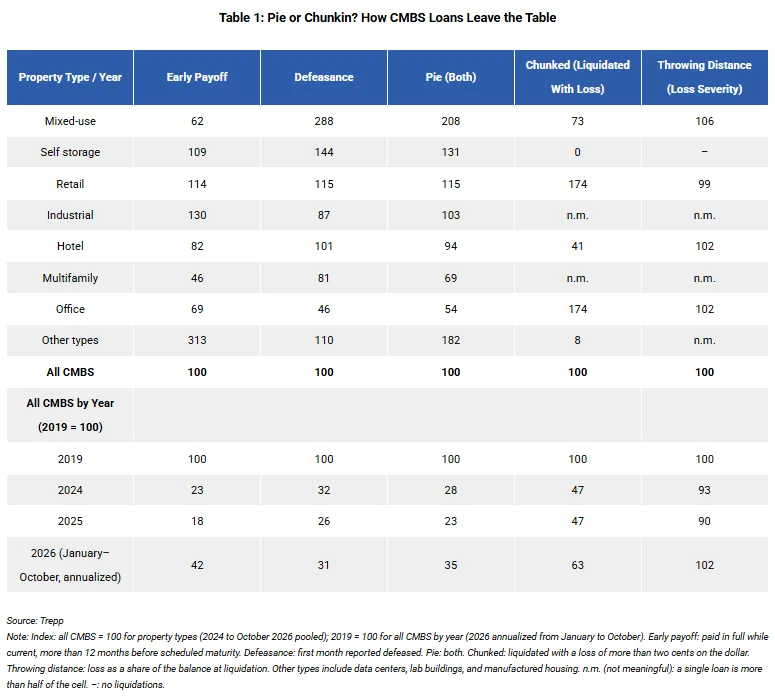
- Early CMBS payoffs in 2026 run at 42 on Trepp’s index, where 2019 equals 100, more than double 2025’s 18, while defeasance edged up to 31 from 26.
- Liquidations are at 63 versus 47 last year, the most since 2019, and loss severity at 102 is the highest since 2021, so resolving distress still costs real money.
- Office and retail loans are liquidated about 1.7 times as often as average, and the old REO route still produces the largest losses, though note sales are gaining share.
More CMBS borrowers are paying off early, and more loans are getting liquidated, according to new Trepp research by Stephen Buschbom.
Borrowers are repaying or defeasing early at the fastest clip since 2022. Meanwhile, liquidations are at a seven-year high and losses are edging up.
Get Smarter about what matters in CRE
Stay ahead of trends in commercial real estate with CRE Daily – the free newsletter delivering everything you need to start your day in just 5-minutes
How Trepp Built the Index
Every number in the report is an index. Across property types, a reading of 100 means the whole CMBS universe. On the timeline, the benchmark year is 2019, the final stretch of normal refinancing before COVID, and it equals 100.
An early payoff is a current loan repaid over a year ahead of its maturity date. Defeasance is when the borrower posts a Treasury portfolio to keep bondholders whole and frees the property from the loan.
Refinancing Works Again for Strong Loans
Trepp’s early-payoff reading for 2026 is 42, against 18 last year. Defeasance rose modestly, from 26 to 31. Combined, the score of 35 is about 1.5 times 2025 and the best since 2022, though still far under 2019.
Mixed-use scores highest at 208, but a single huge defeasance accounts for roughly half of it. Self storage (131) and retail (115) come next. Industrial scores 103 and multifamily 69. Office is last at 54, which makes sense: with values down, few owners can refinance ahead of schedule.
Liquidations Climb
Liquidations at a loss now score 63, up from 47 in 2025 and a level not seen since 2019. Loss severity, the share of balance lost, scores 102. That edges past 2019 and is the worst reading in five years.
Office and retail loans get liquidated at about 1.7 times the usual pace. Hotels see well under half that frequency, and self storage hasn’t had a liquidation since 2024. Once a loan reaches liquidation, property type matters less for the size of the loss.
The Exit Route Matters
What matters more is the resolution path. Loans sold out of REO, after a lender takes the property, lose roughly 10% more than average, and about 20% more since 2024. Note sales, foreclosure sales and discounted payoffs come in at 0.8 to 0.9 times.
The costly REO path is shrinking as a share of resolutions. Selling the note or taking a discounted payoff now carries about four times its 2019 weight, and REO is near half of its old weight.
Why It Matters
Trepp’s takeaway: strong loans can refinance or defease again, but resolving weak ones remains costly.
That split lines up with what we covered in CMBS payoff data, where just 12.79% of maturing office loans paid off on time in September, per Trepp’s Q3 review. Office sits at the back of the payoff line.
What’s Next
Watch whether note sales keep taking share from REO sales. Faster resolutions could shorten special servicing stays, which special servicing data showed stretching, with 43% of loans past two years.