







- Special servicers held $71.2B of CMBS loans in October 2026, an 11.74% rate, and 42.7% of that balance had been there two years or longer.
- Office makes up 43.6% of the book, while lodging is the most aged, with 42.2% of its balance stuck for three years or more.
- Cures rose to 16.6% of resolved balance in 2026, but liquidations hit 23.3% and seven of the year’s 36 cured loans have already returned.
Troubled CMBS loans are getting stuck. New Trepp research shows that 42.7% of the debt in CMBS special servicing has been there for at least two years.
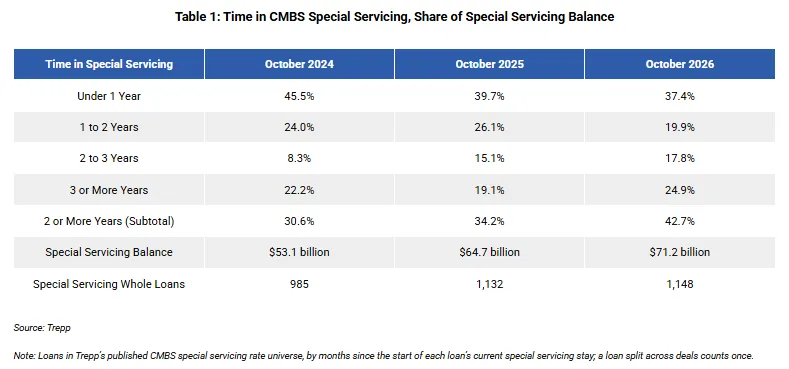
That’s $30.4B of a $71.2B total in October 2026. The two-year-plus share has climbed from 30.6% in October 2024 and 34.2% last October.
Get Smarter about what matters in CRE
Stay ahead of trends in commercial real estate with CRE Daily – the free newsletter delivering everything you need to start your day in just 5-minutes
The Big Picture
The overall special servicing rate stood at 11.74% in October. The book has grown from $53.1B in October 2024 to $64.7B last year and $71.2B now, and the loan count climbed from 985 to 1,148.
Fresh transfers are still coming in, but they’re a shrinking slice. Loans less than a year into their stay now account for 37.4% of what’s there. Two years ago they were 45.5%.
The middle is filling up instead. Loans two to three years in went from 8.3% of the balance to 17.8%, more than doubling, because office loans transferred in 2023 and 2024 sit unresolved.
By the Numbers
Roughly 25% of the total, $17.7B spread over 263 loans, has been with a servicer three years or longer. And 137 loans have passed the five-year mark, most dating to the 2020 pandemic wave.
Age and outcome go together. Of the balance that’s been in for three-plus years, 57.5% is in foreclosure or already real estate-owned.
The reverse holds too. Nearly all bank-owned debt is old: 82.8% of the REO total has spent at least two years with a servicer.
Office is the largest piece at 43.6% of the total, and 45.8% of that office debt has been in for two years or more. Lodging is the most aged: 42.2% of its balance has sat three years or longer.
The Long-Timers
Mall of America in Bloomington, Minn., is the biggest. Its $1.39B single-asset loan entered special servicing in May 2020 and remains there more than six years later, even though payments are up to date and reported occupancy is 88%.
The Starwood Mall Portfolio has fared worse. That $606.6M loan is secured by four retail properties. It came due in November 2017, transferred two years later and is now in foreclosure.
A September 2025 appraisal valued the collateral at $144.2M.
The longest stay belongs to a small one. Park Place Student Housing in Fredonia, N.Y., an $8.2M conduit loan, transferred in November 2014, or 143 months ago. The lender took title in January 2025, and the 19%-occupied property last appraised at $3.7M.
Cures Are Up, With a Catch
Some loans do get out clean. Cures, meaning loans handed back to their master servicer without a recorded loss or modification, made up 16.6% of resolved conduit and single-asset balance in 2026 through October. That’s up from 12.2% last year and 11.0% the year before.
They also happen fast, with a median stay of seven months compared with 31 months for liquidations.
The largest was 650 Madison Avenue, an $800M loan that transferred in October 2025 and was current and back with its master servicer by March 2026. The JACX, at $425M, spent six months in special servicing before going back in September.
The catch: of this year’s 36 cures, seven have already landed with a special servicer again, among them the $439.2M Starwood Regional Mall Portfolio, a separate loan from the one in foreclosure.
Why It Matters
Time in special servicing is a rough guide to how a workout ends, and the clock is running long. Liquidations reached 23.3% of resolved balance this year, their biggest share in data going back to 2022.
It lines up with other warning signs. As we covered Monday, Trepp found cash traps on $31.2B of CMBS loans in October, with office leading at 7.0% of balance.
What’s Next
Watch the two-to-three-year group. If those office loans stay put, they roll into the three-plus bucket, where most of the balance ends up foreclosed or bank-owned.
And a cure isn’t always the end of the story. Trepp’s takeaway is that leaving special servicing doesn’t mean a property’s underlying problems are fixed.