





- Bank multifamily loan delinquencies increased to 1.47% in Q1 2026, with delinquent balances rising to $9.78B, according to CRED iQ.
- Banks continued expanding their multifamily portfolios, which reached a record $665.3B despite worsening credit performance.
- Rising delinquencies paired with low charge-offs suggest lenders are still relying on loan workouts instead of recognizing losses.
According to CRED iQ’s analysis of FDIC banking data, multifamily loan delinquencies at US banks continued to edge higher during Q1 2026. The overall delinquency rate rose to 1.47%, up from 1.42% at the end of 2025, while delinquent balances climbed to $9.78B.
The increase comes as banks continue expanding their exposure to multifamily real estate. Total multifamily loans outstanding reached a record $665.3B during the quarter, creating a backdrop where growing loan volumes have helped temper the appearance of deteriorating credit performance.
Get Smarter about what matters in CRE
Stay ahead of trends in commercial real estate with CRE Daily – the free newsletter delivering everything you need to start your day in just 5-minutes
A Slow Climb Higher
The latest figures extend a trend that has been building across the multifamily lending market since interest rates began rising and operating expenses pressured property performance. While the current delinquency rate remains well below levels recorded during the Global Financial Crisis, it represents a significant increase from the sector’s recent lows.
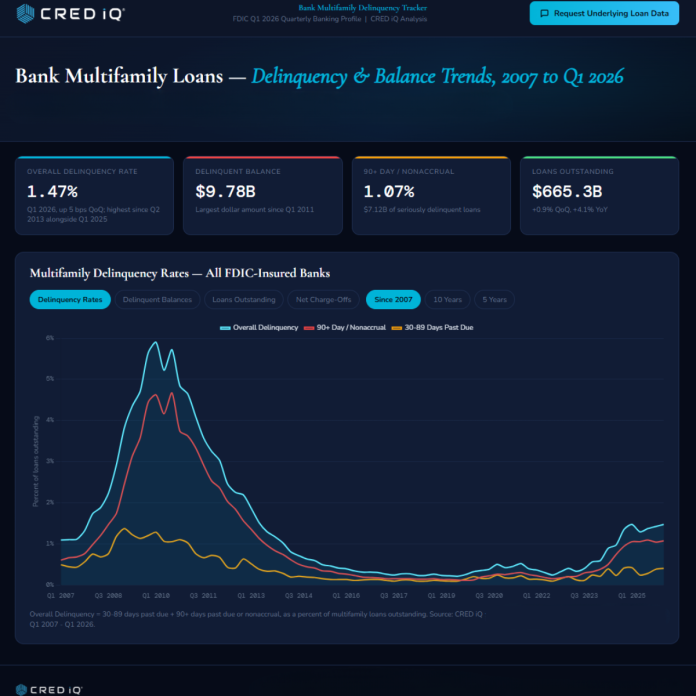
According to CRED iQ, multifamily delinquency rates bottomed at just 0.21% in Q3 2019. The current 1.47% reading is roughly seven times higher than that pre-pandemic low. The latest figure also matches the level reported in Q1 2025, making it the joint-highest reading of the current cycle.
Federal regulators have also flagged elevated multifamily loan performance issues. The FDIC’s latest banking report highlighted ongoing pressure in past-due and nonaccrual multifamily loans, indicating that the challenges are not isolated to a handful of institutions.
The Details
Several delinquency categories moved higher during the first quarter. Loans that were between 30 and 89 days past due increased to 0.40% of outstanding balances, totaling approximately $2.66B. That compares with 0.38% at the end of Q4 2025.
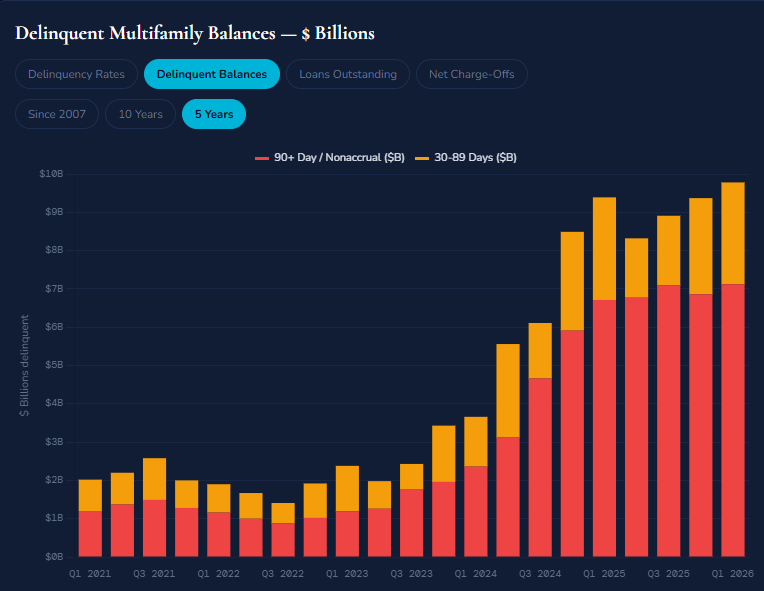
More severe distress also worsened. Loans categorized as 90 or more days delinquent or placed into nonaccrual status rose to 1.07% of balances, up three basis points from the previous quarter. Dollar volume within that category increased to $7.12B from $6.86B.
Combined, those segments pushed total delinquent multifamily balances to $9.78B. CRED iQ noted that delinquent balances increased by approximately $415M during the quarter alone, reaching the highest dollar amount since Q1 2011.
Growing Portfolios Mask Stress
Despite rising delinquencies, banks have not pulled back from multifamily lending. Outstanding multifamily loan balances grew 0.9% quarter over quarter and 4.1% year over year to reach a record $665.3B.
That growth has helped soften the impact of rising delinquency rates. Larger loan portfolios mean delinquent loans represent a smaller percentage of total balances than they otherwise would. However, the underlying dollar figures tell a different story.
CRED iQ noted that today’s multifamily portfolios are roughly 3.5 times larger than they were in early 2007, when FDIC-insured banks held approximately $192B in multifamily loans. As a result, comparing percentages alone can understate the scale of current distress. While the delinquency rate remains far below the 5.90% peak recorded during Q1 2010, today’s delinquent balance totals are approaching levels not seen in more than a decade.
Why It Matters
The latest data reinforces a trend emerging across commercial real estate lending. Credit stress continues to build, but realized losses remain limited.
According to CRED iQ, the multifamily net charge-off rate measured just 0.11% annualized in Q1 2026. That compares with 0.13% for full-year 2025. Rising delinquencies have not translated into large losses. Instead, banks continue working with borrowers through extensions and loan modifications instead of recognizing write-downs.
That strategy has become increasingly common across commercial real estate lending. Similar patterns have emerged in the CMBS market, where lenders continue extending maturities and restructuring loans to avoid forced losses.
Still, unresolved distress can build over time. Delinquent balances are nearing $10B and continue to rise. Pressure could increase if interest rates remain elevated. Refinancing also remains difficult for many borrowers. Oversupplied apartment markets could add further strain. While current data does not point to a broad credit crisis, it does show that multifamily credit quality continues to deteriorate gradually.
What’s Next
The next several quarters will determine whether multifamily loan performance stabilizes or weakens further. First-quarter data often reflects seasonal patterns, making Q2 results an important test for the broader trend.
Investors and lenders will watch whether delinquent balances continue to outpace portfolio growth. They will also monitor charge-off activity for signs that banks are becoming less willing to extend troubled loans.
For now, multifamily lending remains a growth business despite rising credit pressure. The next round of FDIC data will show whether portfolio growth continues to offset deterioration or whether lenders begin recognizing larger losses as troubled loans move through the system.