




- Retailers are accelerating AI adoption across shopping, fulfillment, and store operations, with physical stores becoming increasingly critical to e-commerce logistics.
- Landlords and developers are redesigning retail assets around 5G, fulfillment space, and AI-ready infrastructure as tenant technology demands intensify.
- Traditional retail metrics like occupancy cost ratios are losing relevance as stores generate value through online fulfillment, customer acquisition, and retail media revenue.
Retail real estate is entering a new operating era as AI moves from experimental technology to core infrastructure. A new Spring 2026 report from Colliers outlines how retailers, landlords, and developers are reshaping stores around AI-powered shopping, fulfillment, and operational automation.
The shift is happening quickly. Nearly half of consumers now use AI for product recommendations, while consumer adoption of AI agents is projected to jump from 19% to 46% by the end of 2026, according to Colliers and IHL Group data. At the same time, 85.1% of US retail sales still happen in physical stores, reinforcing that brick-and-mortar locations remain central to retail growth rather than casualties of digital commerce.
Get Smarter about what matters in CRE
Stay ahead of trends in commercial real estate with CRE Daily – the free newsletter delivering everything you need to start your day in just 5-minutes
AI Is Rewriting the Retail Playbook
Retailers are no longer treating AI as a side experiment. The report found that nearly 40% of major US retailers already use AI shopping assistants, while top-performing retailers increased IT spending by 52% over the past five years versus just 13% among slower-moving peers.
That investment gap is translating into measurable financial performance. According to IHL Group data cited by Colliers, retailers deploying technologies like geolocation, mobile store tools, and retail media networks are seeing significantly stronger sales and profit growth than competitors. Macy’s, for example, reported that customers using its AI-powered shopping assistant spend roughly 400% more than other shoppers.
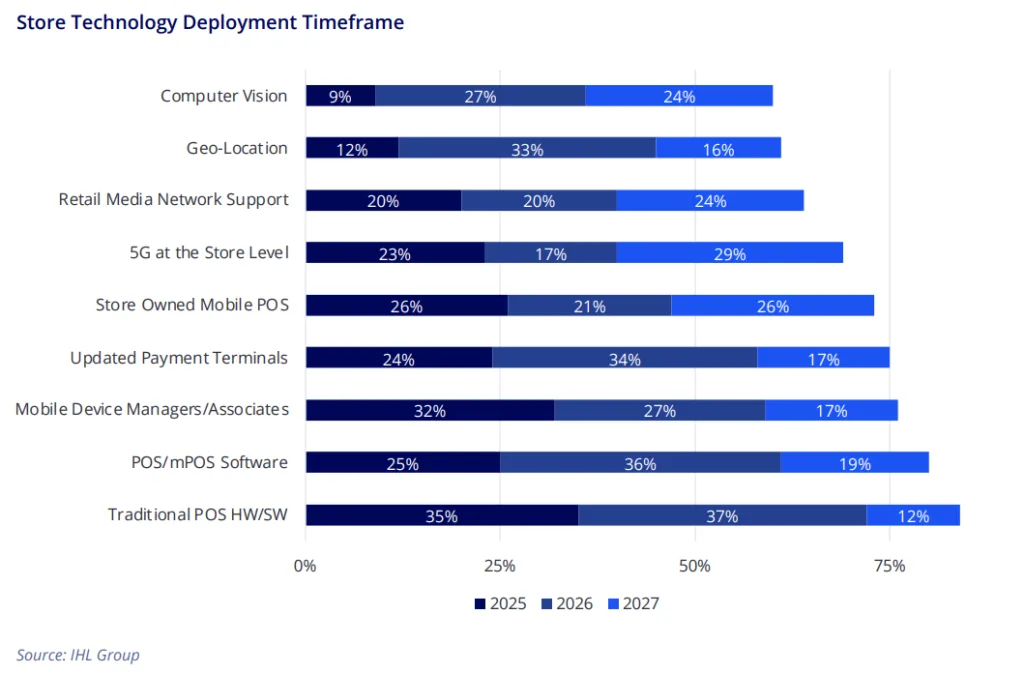
The infrastructure demands are changing just as fast. Retailers increasingly require properties with 5G connectivity, fulfillment-grade power systems, integrated sensors, and higher technology density. Colliers argues these systems can no longer be retrofitted efficiently into older properties, creating a widening divide between modern retail assets and outdated centers.
Stores Become Fulfillment Engines
The report reinforces a trend CRE owners have watched build for years: stores are now fulfillment hubs as much as shopping destinations.
One in four online orders is currently fulfilled through a physical store, nearly double the share seen in 2021. Colliers projects that figure will climb to 35.4% by 2030. Buy online, pick up in-store (BOPIS) sales now account for 8.9% of total retail revenue, up 71% year over year, yet only 18% of retailers say they have fully optimized their BOPIS operations.
That operational shift has direct implications for retail property design. Dedicated pickup zones, expanded back-of-house logistics space, curbside infrastructure, and technology-enabled layouts are becoming baseline requirements instead of premium amenities. At the same time, retailers are increasingly leaning on smaller-format locations to support faster fulfillment and hyperlocal distribution, particularly in dense urban and suburban trade areas.
The report also argues that physical stores are evolving into the “operational backbone” of e-commerce. AI increasingly influences product discovery before shoppers ever visit a store, shifting the store’s role from decision-making venue to fulfillment and trust layer.
A New Era for Retail Landlords
Colliers suggests landlords may need to rethink how they evaluate retail performance altogether.
Traditional occupancy cost ratios — which measure rent as a percentage of in-store sales — no longer capture the full economic contribution of modern retail locations. Stores now support online fulfillment, customer acquisition, retail media advertising, and data collection alongside direct sales.
Forward-looking landlords are increasingly underwriting “total location productivity,” according to the report. That broader framework includes store-fulfilled digital sales, BOPIS volume, retail media revenue, and other ancillary income streams that traditional retail metrics overlook.
The report also points to growing opportunities around ancillary revenue. Emerging technologies like 5G infrastructure and digital advertising networks are creating additional NOI streams for owners willing to modernize assets.
Why It Matters
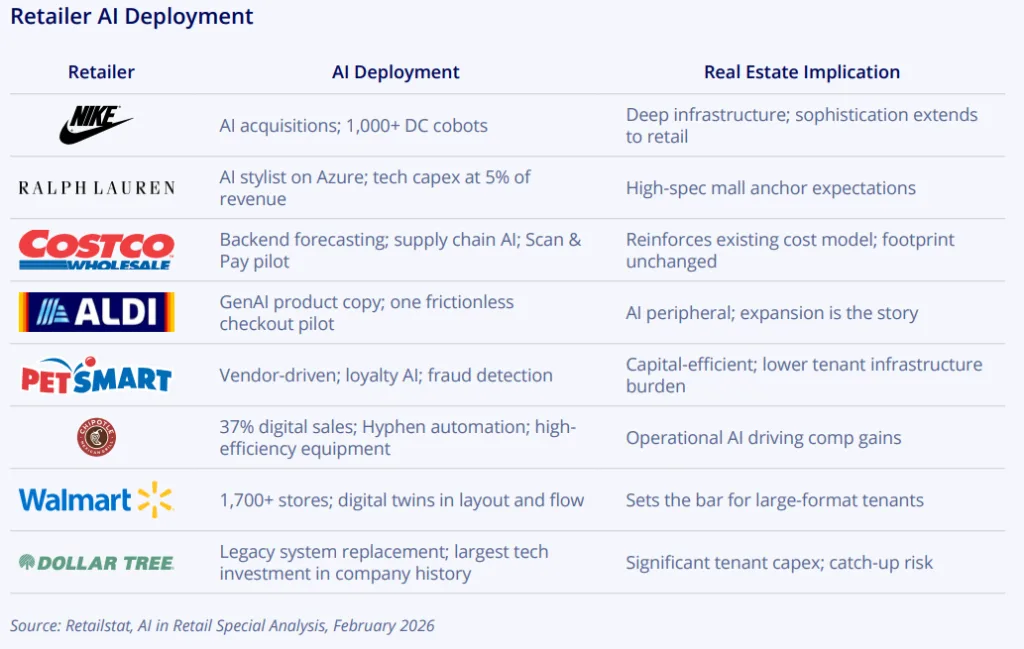
Retail real estate is no longer simply adapting to technology trends — it is becoming technology infrastructure itself.
That transition could reshape tenant expectations, development standards, leasing structures, and asset valuations over the next decade. Properties unable to support AI-enabled retail operations may face increasing competitive pressure as retailers prioritize locations equipped for fulfillment, automation, and real-time data integration.
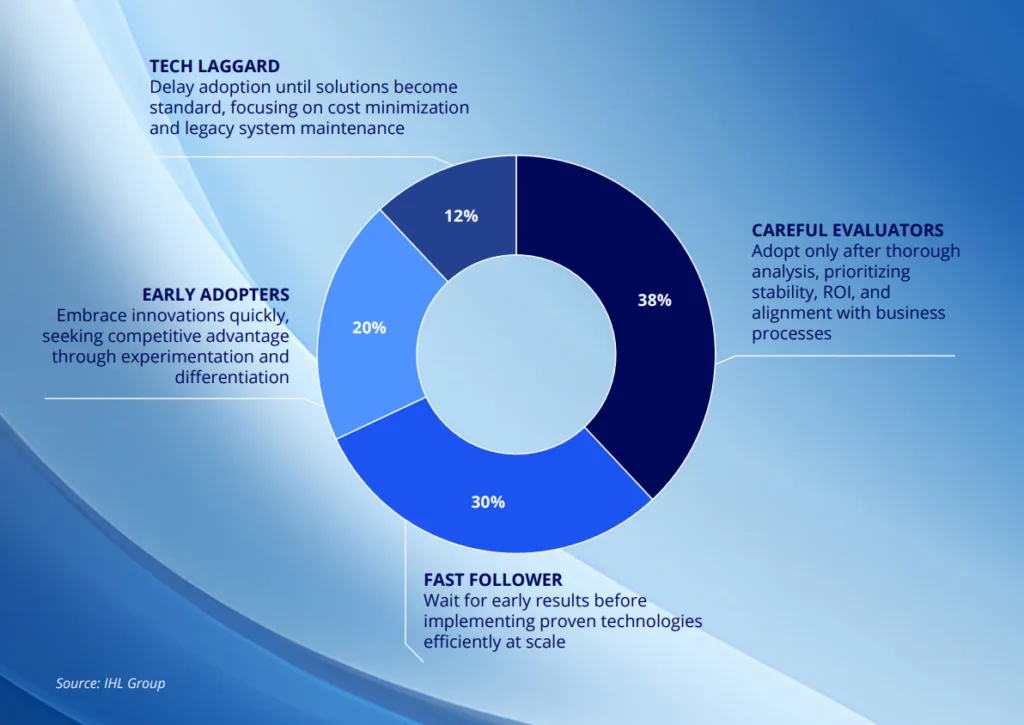
The report also highlights how fast the competitive divide is widening. Early adopters of in-store AI are already seeing 79% higher store sales growth and 34% stronger BOPIS performance than slower-moving peers, according to IHL Group.
What’s Next
Colliers expects several trends to accelerate over the next 12 to 18 months, including the rise of “agentic commerce,” where AI agents independently manage purchasing decisions and operational workflows.
The report points to a recent experiment from San Francisco-based Andon Labs, which allowed an AI agent named Luna to fully operate a retail store — including staffing, merchandising, vendor negotiations, and marketing. The case signals how automation could eventually reshape not only retail operations, but also leasing structures and tenant definitions.
Restaurant robotics may also approach a broader adoption tipping point as operators push for higher efficiency and labor automation. That could drive new demand for reconfigured kitchen layouts, higher equipment density, and more specialized retail infrastructure.
For CRE owners, the message is increasingly straightforward: retail properties built around AI-enabled operations are likely to outperform assets designed for yesterday’s shopping patterns.