






- Servicers modified 3,640 CMBS loans totaling $111.1B during the pandemic, and 52% of that March 2020 balance has since paid off.
- Some 17.8% of the modified balance is in special servicing or delinquent, against 9.9% for loans from the same period that never got relief.
- Hotels largely recovered while office did not: 39% of modified office balance is distressed, showing relief worked only where the shock was temporary.
Most of the CMBS debt that got pandemic relief has been repaid, but what’s left is in far worse shape than its peers, according to a Trepp analysis of COVID-era modifications.
Some 52% of the modified balance is now repaid. Another 17.8% is delinquent or with a special servicer, close to double the 9.9% for loans that were never modified.
Get Smarter about what matters in CRE
Stay ahead of trends in commercial real estate with CRE Daily – the free newsletter delivering everything you need to start your day in just 5-minutes
How the Wave Formed
Servicers moved quickly once hotels and stores went dark in 2020. They reworked 3,640 CMBS loans carrying $111.1B, with roughly 68% of them landing between April and June of 2020.
Hotel and retail loans were 83% of that balance.
These were mostly short-term patches. Just 4% extended the maturity date. About a fifth, 21%, took the form of forbearance agreements that paused or cut payments for a while.
By the Numbers
Trepp started with all loans that were outstanding as of March 2020, split the pool by whether a loan got pandemic relief, and checked each one’s status in October 2026.
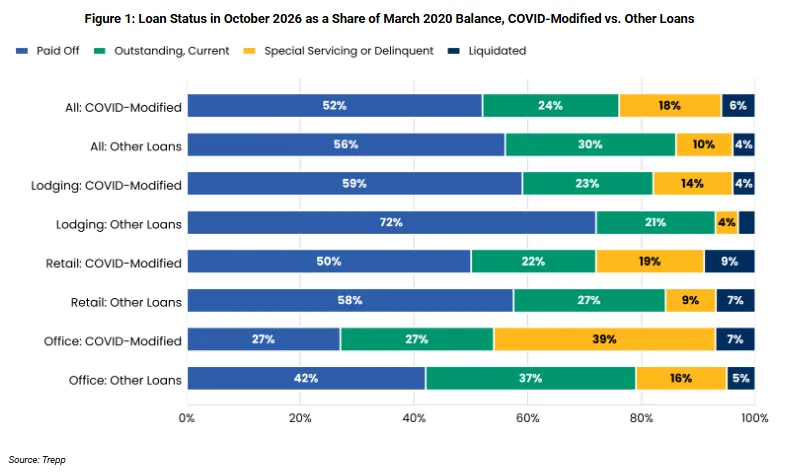
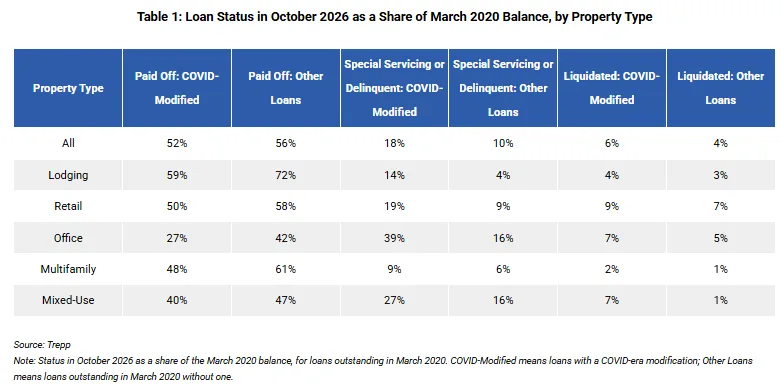
The payoff gap is small: 52% for modified loans against 56% for the rest. A further 24% of the modified balance remains on the books and is paying on time.
The losses are where the groups diverge. Liquidations reached 6.0% of the modified balance compared with 3.9%, and measured by number of loans, liquidation was roughly twice as common in the modified group.
Look only at what’s still outstanding and the picture darkens. Of the $36.4B of COVID-modified debt remaining, 42% is delinquent or in special servicing, versus 23% for other loans from the same period.
Hotels Healed, Office Didn’t
Lodging is the success story. No sector was hit harder than hotels in 2020.
Even so, 59% of the modified lodging balance is repaid. Hotel loans that never needed relief did better still, at 72%.
Office is the opposite. Relief was built for a temporary shock, and office demand never fully returned.
Some 39% of modified office balance is distressed, against 16% for other office loans, and just 27% is repaid.
Mixed-use tracks office at 27% versus 16%. Retail shows a milder gap, 19% versus 9%.
The Second Round
Plenty of these loans came back for more. By balance, 18% of COVID-modified loans were modified again from 2022 on, double the 9% rate for other loans.
Put another way, a quarter of all modifications granted since 2022 involved a loan that had already been reworked during COVID.
That fits what we covered last week. A separate Trepp study of 966 modifications since January 2022 found that 40% of loans modified without a paydown were in trouble 12 months later, versus 21% of those where the borrower paid down principal.
Why It Matters
The record gives lenders and bondholders a way to judge today’s extensions. A loan modification bought time that hotels and stores used to reopen and pay off their debt.
Where the damage proved permanent, as in office, Trepp concludes the relief only postponed the reckoning.
What’s Next
The bill for extend-and-pretend is still coming due, in Trepp’s words, and it’s concentrated in office.
The $36.4B of modified debt still outstanding is the pool to watch, since more than two-fifths of it is already distressed.