






- CPI rent of primary residence climbed about 2.9% in the year through October 2026, while same-store effective asking rents at apartments rose only 0.9%.
- Renewal leases and single-family rentals, both posting faster rent growth than new apartment leases, feed the government index, which also lags the market.
- Flat asking rents should eventually pull CPI rent lower, but NMHC expects the two measures to keep diverging for the foreseeable future.
The government’s rent gauge keeps running well ahead of what apartment data firms report, and a new research note from the National Multifamily Housing Council lays out why CPI rent and market rents diverge.
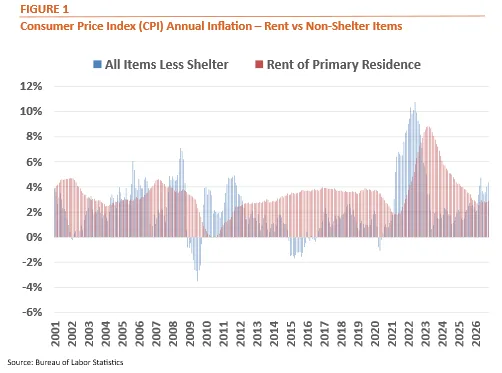
The CPI’s rent of primary residence measure climbed about 2.9% from October 2025 to October 2026. Over the same stretch, effective asking rents gained just 0.9% in the same-store apartment sets that CoStar and RealPage follow.
Get Smarter about what matters in CRE
Stay ahead of trends in commercial real estate with CRE Daily – the free newsletter delivering everything you need to start your day in just 5-minutes
The Big Picture
Rent inflation has cooled a lot. The 2.9% reading sits 5.9 percentage points under the 8.8% peak of April 2023, and October was the eighth month in a row that rents rose more slowly than non-shelter prices.
The stakes go beyond renters. Rent of primary residence carries a weight of about 7.8% in the overall index and 22.0% within shelter.
The same survey data also drives owners’ equivalent rent, which is 26.2% of total CPI and 73.6% of the shelter component. That figure estimates what homeowners would pay to rent their own homes.
A Small Sample
The index rests on a survey of only about 48,000 rental units. Each month’s change draws on a sixth of them, around 8,000.
Surveyors compare those units’ rents with the level six months before, then apply about one-sixth of the change to get the monthly move.
Private providers work differently. They pool unit-weighted data from millions of apartments.
One wrinkle in this year’s number: the October 2025 CPI report never came out because of the government shutdown, so NMHC averaged the September and November readings.
Three Reasons for the Gap
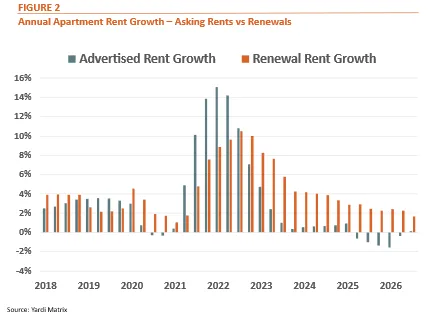
First, renewals. Firms like CoStar, RealPage and Yardi mostly report asking rents on new leases, which swing more than what existing residents pay to stay.
Yardi Matrix data shows the pattern. Asking rents fell during COVID in 2020 while renewal growth stayed positive. In 2022, asking rents jumped more than 15.0% and renewals topped out at 10.5%.
The gap has since flipped. Asking rents averaged growth of just 0.2% a year from Q3 2022 to Q3 2026, while renewal rents averaged 3.4%.
In Q3 2026, renewals rose 1.7% year over year. That’s 81 basis points slower than a year earlier and 59 slower than Q2, but still far above the 0.1% rise in asking rents.
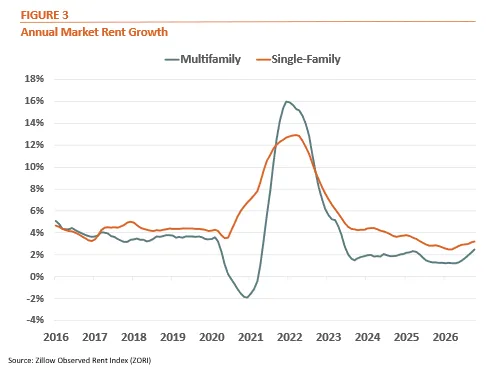
Second, houses. About 38% of the CPI rent sample is single-family homes, where Zillow’s rent index shows average growth of 3.2% a year across the last three years versus 1.8% for multifamily.
Third, timing. A change in market rent doesn’t reach a tenant until the lease, usually a year long, runs out.
RealPage’s effective asking rent growth bottomed at -1.4% in Q3 2020, but CPI rent didn’t trough until April 2021, at 1.8%. On the way up, RealPage’s measure peaked at 15.3% in Q1 2022, more than a year before CPI rent topped out.
CoStar’s numbers tell the same story. Its measure hit bottom at 0.0% in Q4 2020 and peaked at 10.5% in Q4 2021, each well ahead of the CPI turn.
Why It Matters
Owners and policymakers looking at the same market can come away with different numbers. NMHC’s point is that CPI rent tracks what renters have paid over time, not where the apartment market stands today.
Market data shows how soft new-lease pricing is. As we covered last week, RealPage found the average apartment concession deepened to 11.2% in October, even as fewer units offered one.
What’s Next
Same-store effective asking rents have been roughly flat for four years. NMHC chief economist Chris Bruen expects that to feed through to slower renewal growth and, eventually, lower CPI rent inflation.
Just don’t expect the two to match. Because the index includes single-family rentals and lease renewals and trails the market, Bruen writes that it will keep differing from reported asking-rent growth for the foreseeable future.