





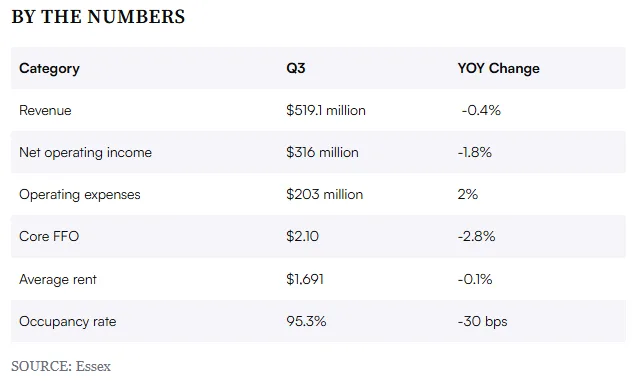
- MAA’s third-quarter revenue fell 0.4% to $519.1 million and net operating income dropped 1.8%, with core FFO of $2.10 per share, down 2.8%.
- The REIT lowered its full-year core FFO midpoint by four cents to $8.49 and cut its revenue growth midpoint by 35 basis points to -0.25%.
- New lease pricing improved in October against the usual seasonal trend and concessions began to ease, but Phoenix, Charlotte and Savannah still face heavy supply.
MAA’s third-quarter revenue slipped 0.4% as Sun Belt rents took longer to recover than expected, Multifamily Dive reports.
Net operating income fell 1.8%, and core FFO came in at $2.10 per share, down 2.8%.
Get Smarter about what matters in CRE
Stay ahead of trends in commercial real estate with CRE Daily – the free newsletter delivering everything you need to start your day in just 5-minutes
By the Numbers
Revenue totaled $519.1 million and net operating income $316 million. Average rent was $1,691, down 0.1%, and occupancy slipped 30 basis points to 95.3%.
Operating expenses rose 2% to $203 million. MAA shaved four cents off the midpoint of its 2026 core FFO outlook, which now sits at $8.49 a share, and its revenue-growth midpoint dropped to a 0.25% decline.
Management’s Read
CEO Brad Hill told analysts on the earnings call that demand is healthy and absorption is outrunning new deliveries. He sees a solid base for the next leg of the recovery, with timing varying by market.
New-lease rates strengthened between September and October, bucking the usual seasonal fade. Hill said management had counted on steadier consumer confidence and less economic uncertainty this year, and that didn’t happen.
Winners and Laggards
Charleston led the portfolio with 3.9% revenue growth, followed by Richmond at 3.5%. Most South Carolina and Virginia markets and Dallas also outperformed. Austin and Orlando are improving.
Phoenix, Charlotte and Savannah are still absorbing heavy supply. Executive Vice President Tim Argo said Charlotte’s two lease-ups are the heaviest users of concessions, with 10 to 12 weeks free on some floor plans.
Why It Matters
The delay stretches a story CRE Daily has tracked since February, when Sun Belt concessions averaged five weeks, lease-ups reached up to 10 weeks, and MAA expected new supply to fall sharply in 2026.
Supply is falling, but lease pricing hasn’t caught up. That mirrors August’s apartment REITs roundup, which found Sun Belt portfolios still exposed to supply pressure while coastal names led.
What’s Next
CFO Clay Holder expects marketing costs to ease as supply gets digested, with relief likely late in 2027. MAA broke ground on its last three planned 2026 projects in Q3: 88 units in Kansas City, 306 in Northern Virginia and 312 in Nashville, all targeting 2029 stabilization.
The firm bought back about 400,000 shares at an average $126.72 for $50 million and plans to speed up its apartment renovation program in 2027.
Hill defended development even with capital costs elevated, saying construction costs have come in under expectations so yields beat underwriting. Argo said renovated units lease faster than unrenovated ones, and the community Wi-Fi program added $1.35 million in Q3. Most urban assets are outperforming suburban ones.