








By now, most brokers can prompt their way to a sharp market brief in seconds. But then they spend the next twenty minutes copying it into Salesforce and emailing prospects.
At Ren, we surveyed users of our AI-powered relationship intelligence platform for their perspectives on AI adoption. Our report tells a clear story about commercial real estate brokers: prompting is table stakes.
From asking AI questions to giving AI a job
Two-thirds of CRE respondents (67%) consider themselves experts at writing prompts to research companies, compare sources, and synthesize information. Ask about the next step, though, and expertise drops off sharply.
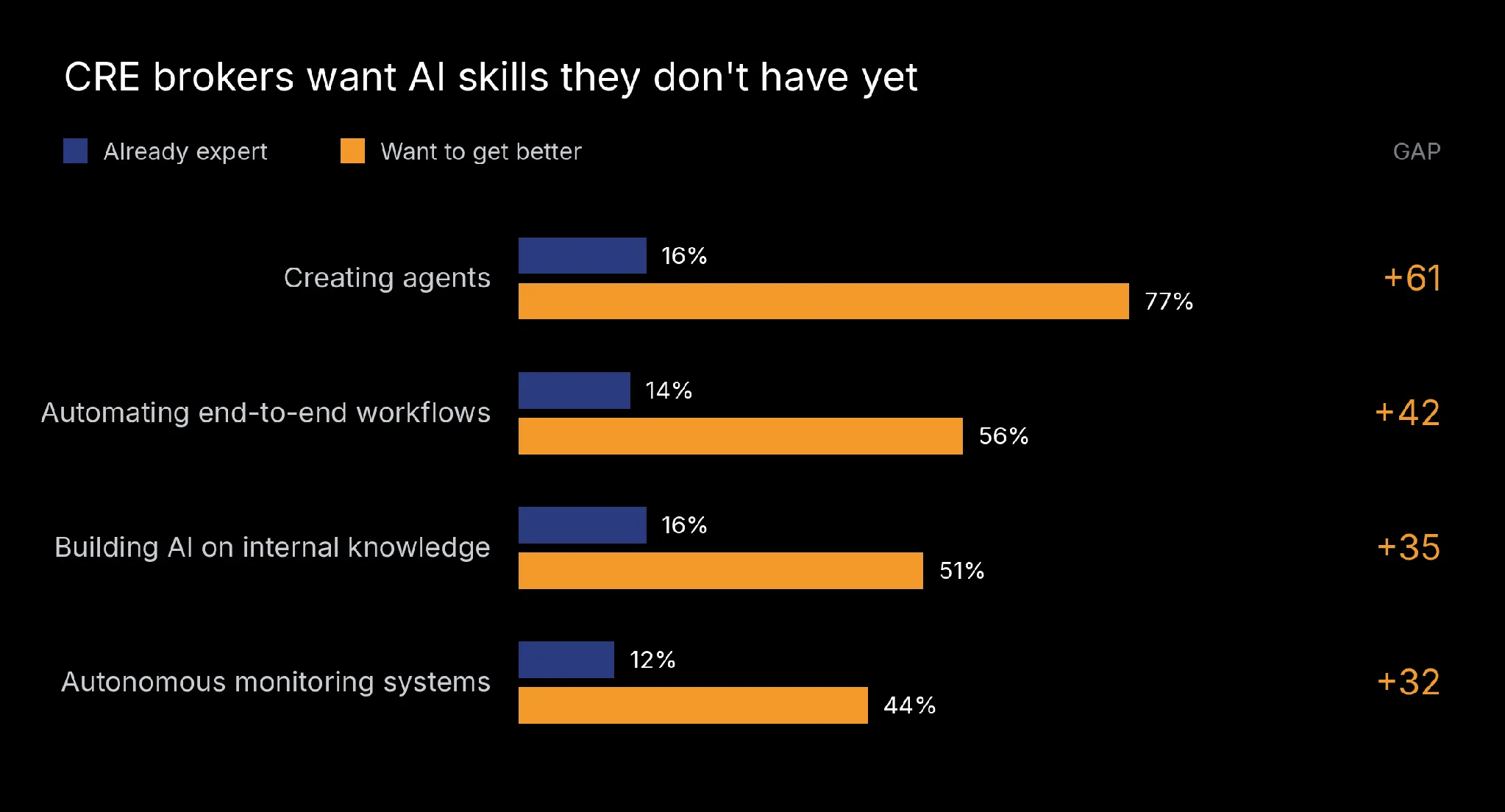
Brokers seek to offload tasks to AI. “Pre-set automations based on industry [and] workflow needs,” said one director at a 1,000+ person firm. Another put it more simply: “automated updates on deals and market happenings.”
Clogged plumbing
Brokers know what they want AI to do. Their tools just don’t connect. Asked for the one capability they most want from vendors, CRE respondents named integration and automation more than anything else. Only 5% say their current tools already meet their needs.
“More end to end integration with AI to save me time,” wrote a VP at a large firm. An individual contributor was more specific: “Being able to connect LinkedIn Sales Navigator to Claude.”
The plumbing already exists. MCP (Model Context Protocol) is the standard plug that lets an assistant like Claude or ChatGPT work directly with a broker’s CRM, inbox, calendar, and data sources. Think of it as USB-C for AI. With those connections in place, AI can take on more heavy lifting:
- Combine tools. A broker is seeking a warm intro to a prospect, and the AI checks a firm’s relationship data for the best path in.
- Run on its own. Every morning, the AI pulls a broker’s top clients from the CRM, gathers news on each, and emails them a digest.
- Take action. When someone in a broker’s network changes jobs, the AI logs it in the CRM and creates a follow-up task.
The blank-canvas chatbot is a starting point, not the destination. Yet fewer than a quarter of CRE respondents (23%) consider themselves experts at connecting AI to their tools, and at many firms, adding a new connection requires IT sign-off. That’s where firm leadership comes in.
From rollout to results
Firms got the first phase right. Most CRE respondents who told us how they found their latest AI tool said their employer rolled it out.
The next phase scales differently. Agents and automations only pay off once they’re integrated into the CRM, inbox, and broader tooling, and the right setup varies from desk to desk.
Speaking on a panel at Commercial Observer’s Power Tech & AI Forum, I made the point that the conversation has shifted from getting people to adopt AI to getting measurable outcomes from it. My advice to leaders: let the people producing the outcome bring you what works for them before you issue a mandate.
Brokers don’t need more prompt training. They need room to experiment with agents and automations, and firms need the integrations to scale what works.