






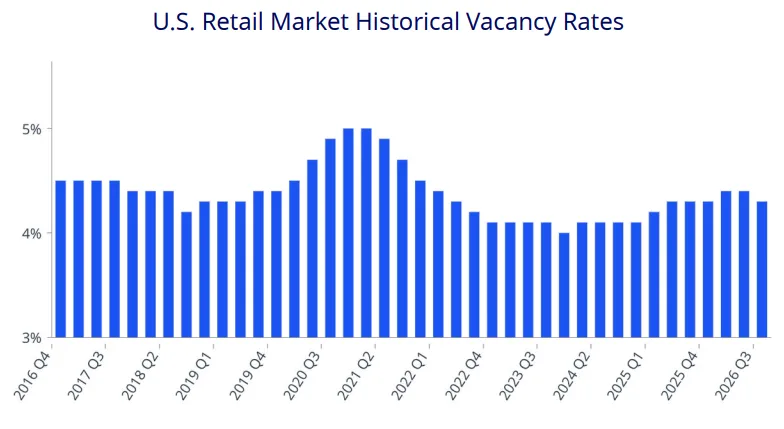
- National retail vacancy fell 10 basis points to 4.3% in Q3, while shopping center vacancy slipped to 5.4% and mall vacancy dropped 30 basis points to 8.2%.
- Leasing totaled 38.4M SF and net absorption hit 10.5M SF, led by general retail at 5.4M SF, with shopping centers at 3.0M SF and malls at 1.9M SF.
- Elevated construction and financing costs keep supply tight, with 58.1M SF under construction, and Colliers expects limited development to support measured rent growth through 2026.
National retail vacancy slipped a tenth of a point to 4.3% in Q3 2026, staying close to record lows, according to Colliers.
Retailers kept expanding and backfilling space, pushing net absorption to 10.5M SF, the strongest quarterly figure since 2023.
Get Smarter about what matters in CRE
Stay ahead of trends in commercial real estate with CRE Daily – the free newsletter delivering everything you need to start your day in just 5-minutes
Shopping Centers and Malls Improve
Shopping center vacancy improved by a tenth of a point from Q2 to 5.4%, and mall vacancy fell 0.3 point to 8.2%. Colliers credits scarce new construction and appetite for well-located space, especially in smaller formats.
Leasing and Absorption
Q3 leasing volume reached 38.4M SF. General retail absorbed 5.4M SF, shopping centers took 3.0M SF and malls 1.9M SF.
General retail includes freestanding and mixed-use space such as restaurants, grocers, pharmacies and big-box stores. Absorption was positive in all three categories, which Colliers reads as retailers growing and filling vacancies.
A Tight Pipeline, Led by Texas
Builders have 58.1M SF underway, and 7.6M SF delivered in the quarter. Costly construction and financing limit speculative starts, a theme also seen in the retail development pipeline squeeze from diesel prices.
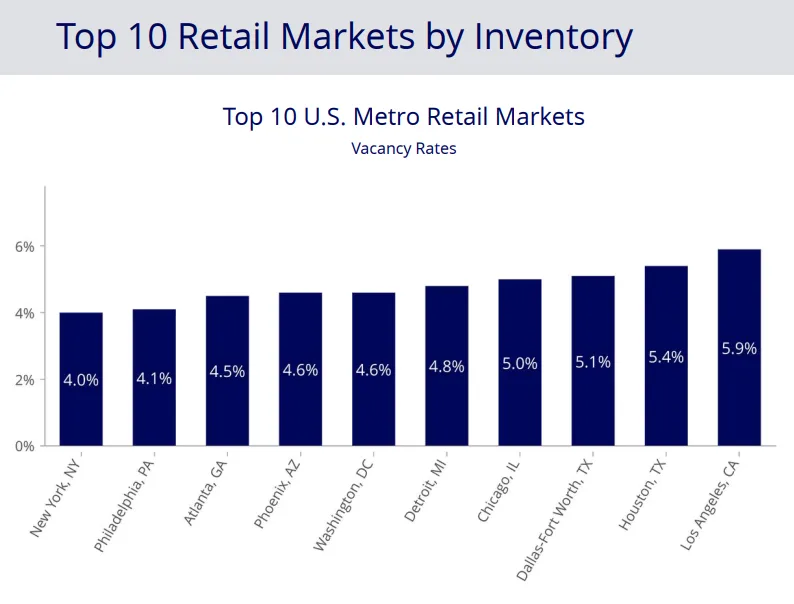
Dallas-Fort Worth has the largest pipeline at 7.2M SF, followed by Houston at 5.1M SF and Austin at 3.2M SF.
Shoppers Stay Selective
Foot traffic grew about 1.9% year over year nationally, down from 2.2% in Q2, consistent with the mixed picture in retail foot traffic data for August.
Department store traffic climbed 8.5% in July, then 5.3% and 11.7% in August and September respectively. Clothing stores gained 6.3%, 3.6% and 7.2% across the same months, and hobby, gift and craft stores saw monthly gains near 20% or more. Theater and music venue visits jumped 58.3% in August.
Why It Matters
Average asking rent reached $26.20 per SF, up 0.7% from Q2. Colliers says headline rent growth is normalizing, but tight availability and better retailer productivity still support pricing.
Consumers are protecting their budgets and favor value, convenience and experiences, which favors operators in those lanes.
What’s Next
Colliers expects limited development and solid tenant demand to keep fundamentals steady, with modest rent growth through the rest of 2026.