






- Twelve sponsor groups back 50.6% of the $24.02B securitized self-storage loan balance across just 93 loans.
- The two largest sponsors hold 53.1% of debt with yields below 8% and 63.4% of $7.55B in hard maturities through 2028.
- The loans are current and not in special servicing, but low debt yields could require paydowns, added equity, asset sales, or different terms.
Trepp reports that sponsor concentration in securitized self-storage debt is much higher by loan balance than by property count. Its analysis covers a $24.02B sector balance across 1,187 whole loans backed by about 4,700 properties. The median loan balance is $6.7M. Yet only 12 of 726 identified sponsor groups account for 50.6% of outstanding debt.
Get Smarter about what matters in CRE
Stay ahead of trends in commercial real estate with CRE Daily – the free newsletter delivering everything you need to start your day in just 5-minutes
Concentration Rises Quickly at the Top
The largest sponsor group holds 14% of the sector’s outstanding balance through only two loans. The three largest sponsors control 32.2% across 16 loans. The top five reach 38%, while the top 10 reach 47.4%. It takes just 12 sponsors and 93 loans to cross the halfway mark at $12.14B.
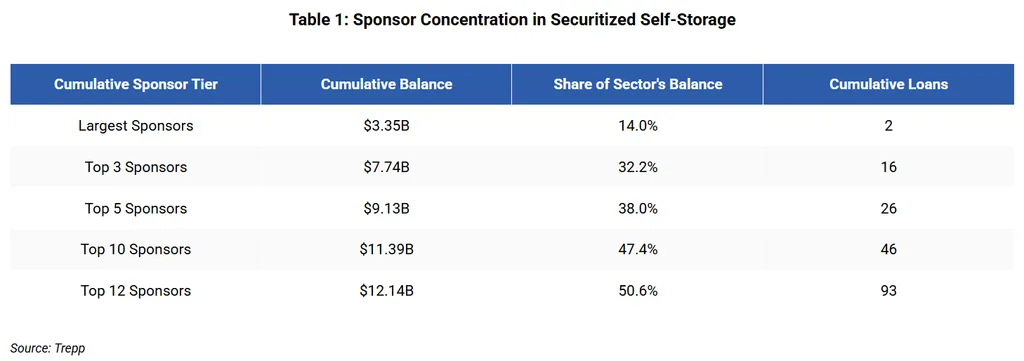
Two publicly traded self-storage REITs appear in the securitized universe. Together they hold $2.5B, equal to 10.6% of the sector. By comparison, the largest private sponsor holds $3.35B through only two loans.
The Details
The refinancing exposure is even more concentrated. Trepp uses an 8% debt-yield threshold as a screen for potential refinancing pressure, not as a default prediction. Debt yield equals annual net cash flow divided by the outstanding loan balance. A loan below an 8% threshold may not refinance its current balance if cash flow stays unchanged. Actual proceeds also depend on leverage, debt service coverage, rates, amortization, and lender terms.
The two largest sponsor groups have median debt yields of 6% and 7.28%, versus a 9.02% sector median. Together, they hold 23.8% of total sector debt but 53.1% of the balance with debt yields below 8%.
Maturities Add Another Concentration Layer
The same two sponsors account for 63.4% of the $7.55B in self-storage debt with hard maturities through 2028. Trepp uses the fully extended maturity date for loans with extension options. For loans without options, it uses the original maturity date.
Low debt yields make refinancing terms a central watch point for securitized self-storage loans through 2028. Under an 8% refinance debt-yield requirement, affected borrowers could need principal paydowns or additional sponsor equity. Asset sales or different loan terms could also close a refinancing gap.
Why It Matters
Concentration does not mean the self-storage sector is broadly distressed. The loans tied to the two largest sponsors are current and are not in special servicing. Large sponsors may also have more flexibility to contribute equity, sell assets, or use other financing channels.
Still, sponsor-level decisions could have an outsized effect on sector performance. The market looks diversified across roughly 4,700 properties. However, it is far more concentrated by debt balance, low-yield exposure, and upcoming maturities. That makes refinancing execution by a small group of borrowers unusually important.
What’s Next
Trepp’s analysis points to 2028 as the key horizon. Property fundamentals and lender requirements will determine actual refinancing proceeds. Interest rates, amortization, loan-to-value limits, and sponsor actions will matter as well. The main risk is not current delinquency. Instead, some large loans may struggle to refinance their full balances on existing terms if debt yields remain low.