



- Transaction volume across the 13 Highly Transparent markets rose 64% over two years and grew 20 percentage points faster than the rest of the world.
- Power availability, credit-market data, AI adoption, and alternative-sector coverage are among the fastest-changing areas of real estate transparency.
- JLL and LaSalle estimate that broader retail and pension access to private assets could unlock more than $800B for real estate by 2030.
JLL and LaSalle’s 2026 Global Real Estate Transparency Index tracks a widening investment gap. The most transparent property markets are capturing a larger share of investment. Transaction volumes across the 13 markets in the Highly Transparent tier increased 64% over two years. Their growth outpaced the rest of the 88 countries tracked by 20 percentage points. Those markets now represent 56% of global income-producing real estate and more than 80% of direct investment.
Get Smarter about what matters in CRE
Stay ahead of trends in commercial real estate with CRE Daily – the free newsletter delivering everything you need to start your day in just 5-minutes
The Details
The United Kingdom ranks first in the 2026 index, followed by France, Australia, and the US. The remaining Highly Transparent markets are the Netherlands, Canada, New Zealand, Ireland, Sweden, Germany, Belgium, Japan, and Singapore. JLL said these countries combine deep capital markets, clearer market data, and faster technology adoption.
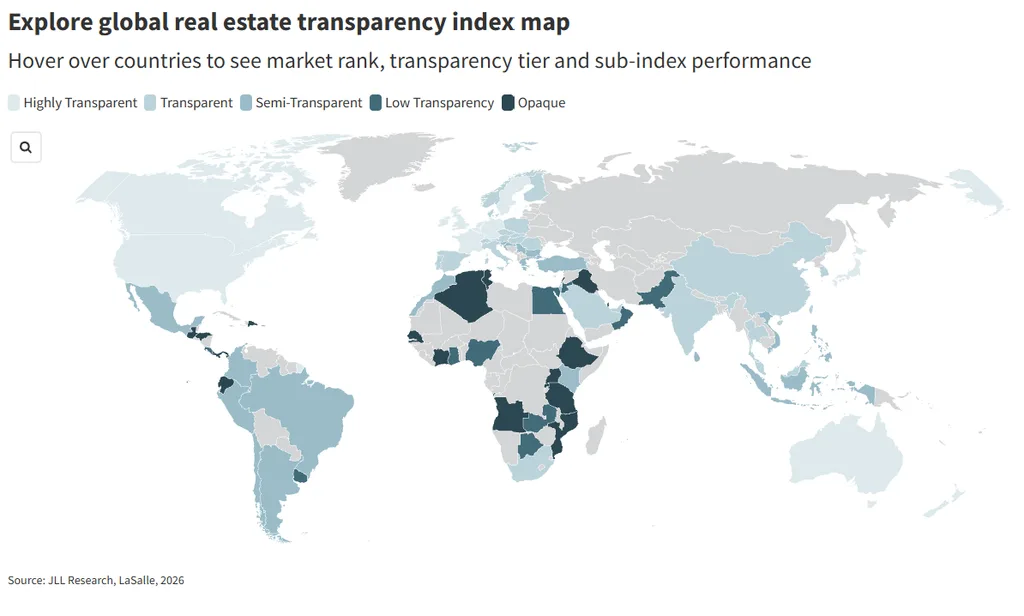
At the same time, two-thirds of all markets improved. Digitized land registries, better data for alternative sectors, and clearer building-efficiency standards supported gains across several regions. Asia Pacific had five of the top 10 global improvers, led by India and joined by Vietnam, South Korea, Australia, and Thailand. Gulf markets including Saudi Arabia, Dubai, Abu Dhabi, and Qatar also continued a decade of transparency gains.
Energy Data Becomes a Site-Selection Tool
Power availability and cost are moving closer to the center of real estate decisions. JLL said building-performance standards, in-use energy tracking, and power provision were among the most improved index components. The International Energy Agency projects global electricity demand could increase 40% or more by 2035, according to the report.
That creates a more demanding information requirement for power-intensive occupiers. Data centers and advanced manufacturers increasingly need grid-capacity information alongside rent and labor data. Several countries are also expanding building-efficiency and climate-risk disclosure requirements, making energy transparency part of both site selection and asset management.
Credit and AI Create New Transparency Gaps
Lending data is improving as banks, insurers, debt funds, and private credit providers all expand their roles. JLL’s Credit Intensity Index now incorporates more than $3.7T of lender quotes. New debt-fund and lending surveys in the US and UK are also giving investors better visibility into pricing and terms.
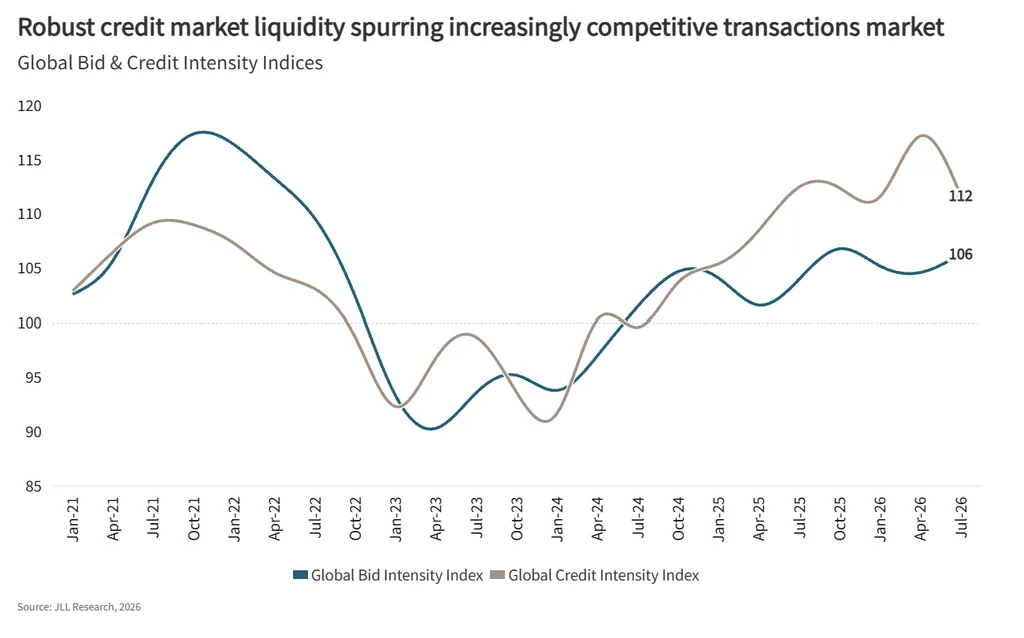
Still, the credit market remains fragmented. JLL recommends stronger lender due diligence and more focus on execution risk for specialized assets. That need is growing alongside cross-border real estate investment, which increasingly depends on comparable information across markets and capital sources.
AI is accelerating the same trend. More than 90% of occupiers and investors now use AI tools, according to JLL Research. Yet technology also creates concerns around cybersecurity, privacy, AI disruption, and uncertainty about future space needs.
Retail Capital Raises the Reporting Bar
The investor base is also broadening. Changes in the US, UK, and European Union are opening more private-market access for retirement and retail investors. JLL estimates these channels could make more than $800B of incremental capital available for real estate by 2030.
Much of that money is expected to move through semi-liquid and evergreen structures. JLL said wider access will require stronger valuation methods, standardized performance reporting, and clearer disclosure of liquidity terms such as redemption gates. Transparency therefore becomes more important as real estate reaches investors with less specialized market knowledge.
Why It Matters
The 2026 index suggests transparency is becoming a competitive advantage rather than a basic market feature. Capital is concentrating where investors can compare assets, financing, regulation, energy conditions, and performance with greater confidence.
GRETI now covers 88 countries and territories, 146 city markets, and 260 measures across performance, market fundamentals, governance, regulation, transaction processes, and sustainability. As technology and new capital sources expand, the markets that improve those information systems fastest may be better positioned to attract investment and occupiers.
The index combines quantitative data with surveys from JLL and LaSalle’s global network. Its six weighted sub-indices cover performance measurement, market fundamentals, listed-vehicle governance, legal and regulatory conditions, transaction processes, and sustainability. Markets receive scores from 1 to 5, with 1 representing the highest possible transparency. That structure lets investors compare both established markets and places where data or regulation are improving quickly.