








- Marcus & Millichap Research Services reported core retail sales fell 0.2% in July but remained 4.8% above year-earlier levels.
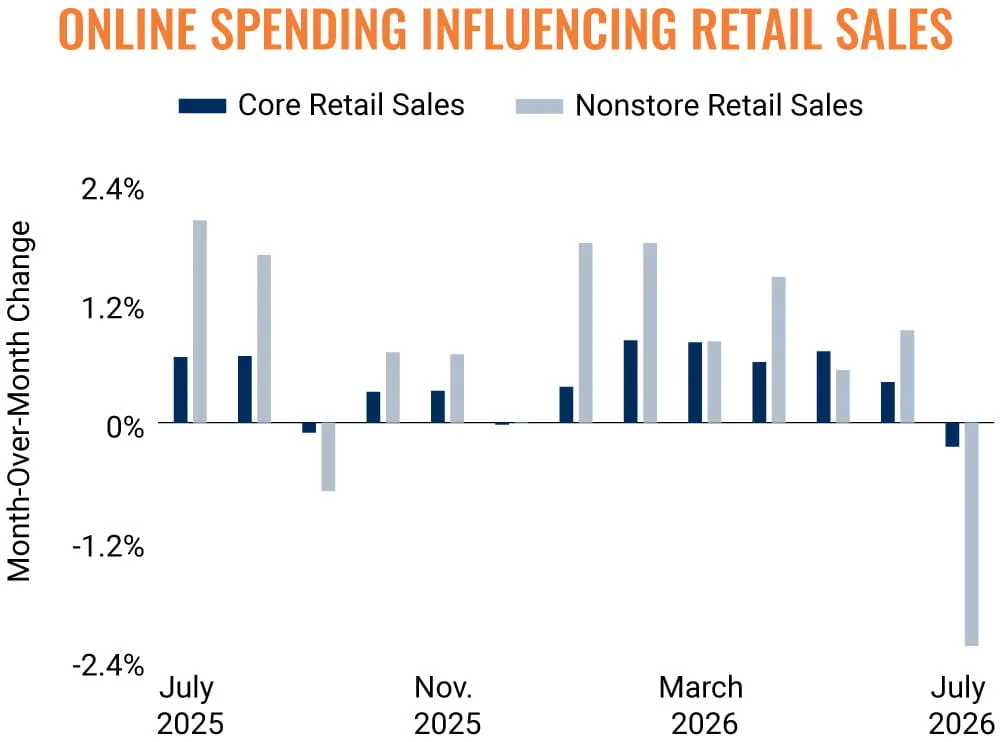
- Online spending dropped 2.3%, its largest monthly decline since January 2025. Seven of 10 retail categories still posted gains.
- Apparel sales rose 1.9%. Off-price retailers signed more than 100 leases totaling roughly 3M SF during the 12 months through July.
Marcus & Millichap Research Services reported core retail sales declined 0.2% in July, the first monthly drop of 2026. Sales still stood 4.8% above year-earlier levels. Drawing on BLS, BEA, Census Bureau and CoStar data, the brief linked much of the weakness to a 2.3% online spending pullback.
Get Smarter about what matters in CRE
Stay ahead of trends in commercial real estate with CRE Daily – the free newsletter delivering everything you need to start your day in just 5-minutes
Online Sales Drive the Retail Sales Decline
Marcus & Millichap reported non-store spending recorded its largest monthly drop since January 2025. Online sales have fallen three times since last July. Core retail sales declined in each of those months. July’s 2.3% decrease may partly reflect spending pulled forward by Amazon Prime Day in June.
Source: Marcus & Millichap
The pattern differed from the prior year. Online sales increased 1.7% in the month after that four-day event. Online channels still took one of every four core retail dollars each month this year.
Consumer Cushion Looks Thinner
Several household indicators point to tighter purchasing capacity. Real average hourly earnings fell 0.1% in July, while the personal savings rate remained near a four-year low. The report also described a labor market where employers across industries remain reluctant to expand headcount. Inflation offered some relief.
Core CPI declined 0.1% for the month, and gas prices fell 2.9%. Marcus & Millichap said renewed Persian Gulf conflict had not fully moved through supply chains. That leaves uncertainty around future retailer costs and consumer prices.
Apparel Spending Moves Higher
Seven of 10 retail categories still produced monthly sales gains in July. Apparel led with a 1.9% increase and reached record spending.
Marcus & Millichap said households may push more back-to-school purchases into August. That could support another strong month for clothing. Strong retail demand has also supported tighter supply conditions across high-performing shopping properties.
Burlington, Ross, Goodwill and TJ Maxx completed more than 100 new leases. Those deals totaled about 3M SF through July.
Why It Matters
The monthly decline looks less severe when online sales are separated from store categories. Most retail segments still grew in July, and core sales were up 4.8% from a year earlier. At the same time, the online pullback matters beyond retail storefronts. One-quarter of core retail spending has occurred online each month this year.
Marcus & Millichap said that share supports the demand outlook for warehouse and distribution space. The data therefore shows resilience in several brick-and-mortar categories alongside a softer month for e-commerce spending.
What’s Next
Back-to-school purchasing could support apparel spending in August. Household finances remain another constraint. Lower real earnings, a low savings rate and cautious hiring leave consumers with less room to absorb shocks.
The report also flagged uncertainty from renewed Persian Gulf conflict because higher supply-chain costs could still reach retailers. How much of those costs get passed to consumers remains unclear.