







- Private placement REITs raised $4.8B in H1 2026, an 11.8% YoY increase, surpassing public REIT fundraising for the seventh quarter.
- Private placement BDC fundraising dropped 18.5% to $6.9B, with significant redemption pressure leading sponsors to meet just over half the requests in Q2.
- Combined private placement REIT and BDC NAV climbed to $119.3B by mid-2026, reflecting continued investor interest in alternatives but heightened liquidity management demands.
Private placement real estate investment trusts (REITs) continued to attract investor capital in the first half of 2026, raising $4.8B—an 11.8% increase from the same period in 2025, according to AltsWire. This fundraising surge stands in stark contrast to business development companies (BDCs), which saw fundraising contract 18.5% year-over-year to $6.9B amid increased redemption pressure. Second-quarter trends reinforce the divergence, as private placement REITs brought in $2.5B (up 15.1% YoY) while BDCs’ quarterly haul dropped to $2.8B, their lowest since Q2 2023.
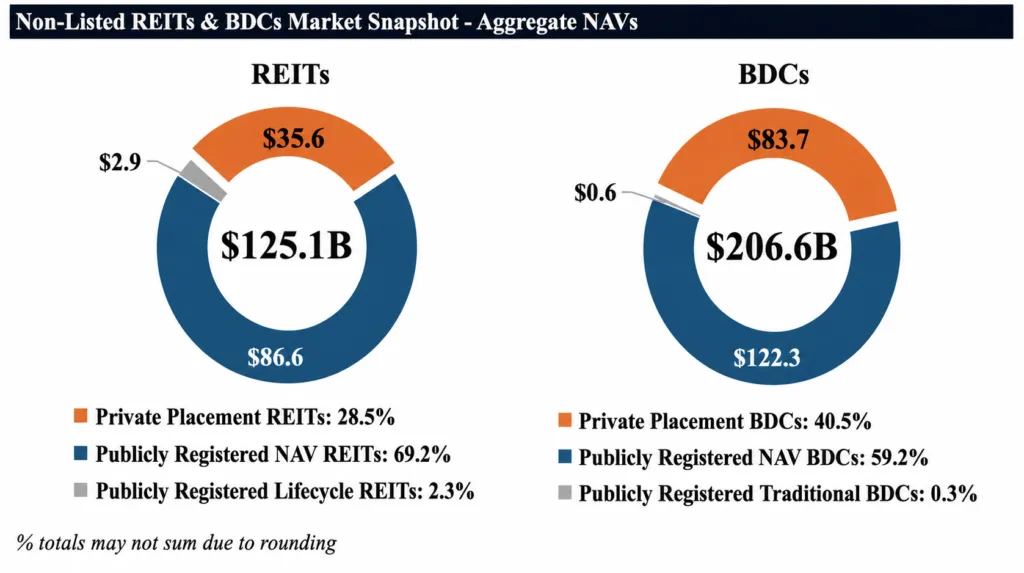
Private placement REITs represented 28.5% of the $125.1B nontraded REIT market as of June 30, 2026, up from 26.9% earlier in the year. Meanwhile, BDCs made up 40.5% of the $206.6B nontraded BDC marketplace. The combined net asset value of both segments reached $119.3B—rising 5.6% quarter-over-quarter and 39% year-over-year—illustrating investor appetite for alternative vehicles, but also underlying liquidity stress in non-core sectors.
Get Smarter about what matters in CRE
Stay ahead of trends in commercial real estate with CRE Daily – the free newsletter delivering everything you need to start your day in just 5-minutes
Private Placements Ride Higher Demand for Hard Assets
Private placement REITs have steadily expanded their market footprint as investors show greater interest in hard assets. Investors increasingly favor assets they perceive as less vulnerable to obsolescence. Stanger CEO Kevin T. Gannon says these vehicles have outpaced public REITs in fundraising for seven consecutive quarters.
The Stanger Private NAV REIT Total Return Index gained 10.1% during the 12 months ending Q2 2026. AltsWire and Stanger data show all 18 tracked private NAV REITs also delivered positive quarterly returns. Returns ranged from 1.1% to 4.5%.
Capital continues rotating into alternatives with lower short-term correlation to capital markets. Private placement REIT NAV reached $33.1B in Q1 2026, reflecting their growing scale. Private placements now represent 28.5% of the nontraded REIT market. That share increased from 26.9% at the end of Q1 2026.
Source: AltsWire
The Details
Private placement REITs raised $4.8B during the first six months of 2026. That marked an 11.8% increase from H1 2025 and about 41% more than public REITs. Meanwhile, private placement BDCs raised $6.9B, down 18.5% from $8.5B one year earlier.
Private BDC sponsors received redemption requests equal to 6.7% of NAV during Q2 2026. They fulfilled only 53% of those requests, returning $1.3B to investors, according to Stanger. Nine funds prorated redemptions, leaving $1.1B in requests unmet. In Q1, only five funds prorated requests, while sponsors fulfilled 74% of requested redemptions.
Redeeming Liquidity: BDC Contraction and Market Comparison
Private placement REITs benefited from investor demand for stable real assets. In contrast, BDCs faced heavier redemption activity and challenges similar to publicly registered BDCs. BDC fundraising fell by more than one-third from Q2 2025. Higher redemption pressure also forced sponsors to return significant capital and increase proration rates.
However, early Q3 reporting suggests some relief. Repurchase requests among a subset of BDCs fell from 7.8% of NAV to 4.5%. Most funds in that group fulfilled 100% of requests. Still, the limited sample makes it unclear whether broader redemption stress is easing.
Why It Matters
Private placement REITs have outpaced public counterparts in fundraising for seven consecutive quarters. This streak signals sustained investor movement toward nontraded alternatives, particularly vehicles targeting real assets. According to Stanger, these vehicles delivered strong returns while providing institutional access and perceived lower liquidity risk.
Private REITs generated a 10.1% trailing-year total return. A benchmark composite that included public offerings returned 8.1%. Meanwhile, REIT capital growth contrasts sharply with the contraction facing BDCs.
BDCs returned $2.6B to investors during 2026 but fulfilled only about half of Q2 redemption requests. The number of funds prorating redemptions nearly doubled quarter-over-quarter. This divergence highlights resilience among private REITs and growing liquidity risks within private credit allocations. Allocators should closely examine redemption mechanics, liquidity reserves, and sponsor discipline before committing capital.
What’s Next
Early Q3 data suggests BDC liquidity demand may be moderating. Redemption requests have declined among some funds, while several fulfilled 100% of repurchase offers. However, the small sample leaves uncertainty about whether fundraising and redemption trends have sustainably improved.
Private REIT fundraising could maintain momentum if volatility persists and traditional capital markets remain challenging. Allocators will seek more detailed reporting to determine whether private BDCs stabilize or face a prolonged redemption cycle.
CRE professionals should also monitor how sponsors manage redemption constraints. Investor confidence in these programs could shape private credit and real asset capital flows throughout 2026.