




- The national office vacancy rate fell to 17.7% in July 2026, its lowest in over a year, per Yardi Research.
- Medical office starts now represent more than a quarter of new supply, as general office development stalls.
- Regional dynamics diverge, with Manhattan and Miami seeing lowest vacancies, while Western and Southern markets show wide variance in rates and sales.
Modest Gains Amid Uneven Recovery
The US office market showed incremental improvement in July 2026, as the national vacancy rate ticked down to 17.7%, per Yardi Research data cited by CommercialCafe. That’s a 130 basis point decrease year-over-year—an encouraging sign after a prolonged stretch of record-high vacancies. Manhattan, N.Y., and Miami posted the lowest major market vacancy rates, while Dallas managed to drop below the 20% vacancy threshold for the first time since 2023.
The sector’s resilience remains uneven, with Manhattan leading both sales volume and pricing, and Western markets like San Francisco and Bay Area still battling high double-digit vacancies. The $33.58 PSF national average asking rate in July marked a 2.6% year-over-year gain, but the office supply pipeline stayed limited, with just 29.5M SF under construction—concentrated mostly in Manhattan, Boston, Dallas, and Miami.
Get Smarter about what matters in CRE
Stay ahead of trends in commercial real estate with CRE Daily – the free newsletter delivering everything you need to start your day in just 5-minutes
Flight to Quality Redefines Development
Pandemic-era disruptions and persistent hybrid work trends continue to shape the US office landscape. Since 2020, new project starts have trended downward, with developers shifting focus to prime, amenitized locations—especially for medical office space. While total office construction remains modest by historical standards, medical office now comprises 26.2% of starts, up from 11% five years ago. In 2025 alone, 7M SF of new medical office delivered, nearly a fifth of all US office completions, per CommercialCafe analysis.
This shift follows broader industry consolidation and tenant preference for high-quality, adaptable buildings. Leasing rates in Western and Northeastern markets now lead the nation, while Southern and Midwestern markets remain more affordable—but often struggle with higher vacancies or tepid absorption outside of select metros like Dallas, Miami, and Nashville.
The Details
In July 2026, Manhattan topped the leaderboard with over $5B in office deal volume, trailed by Dallas at $2.9B and San Francisco at $2.6B. San Francisco’s average sale price climbed to $543 PSF, its highest since 2023 but still half its 2020 peak. New construction remains clustered: Boston (3.4M SF), Manhattan (2.9M SF), and Dallas (2.8M SF) account for nearly a third of the national development pipeline. Miami stands out regionally, with 1.34M SF under construction—1.8% of its total stock, the highest market ratio nationwide and a reflection of robust investor demand for next-generation product.
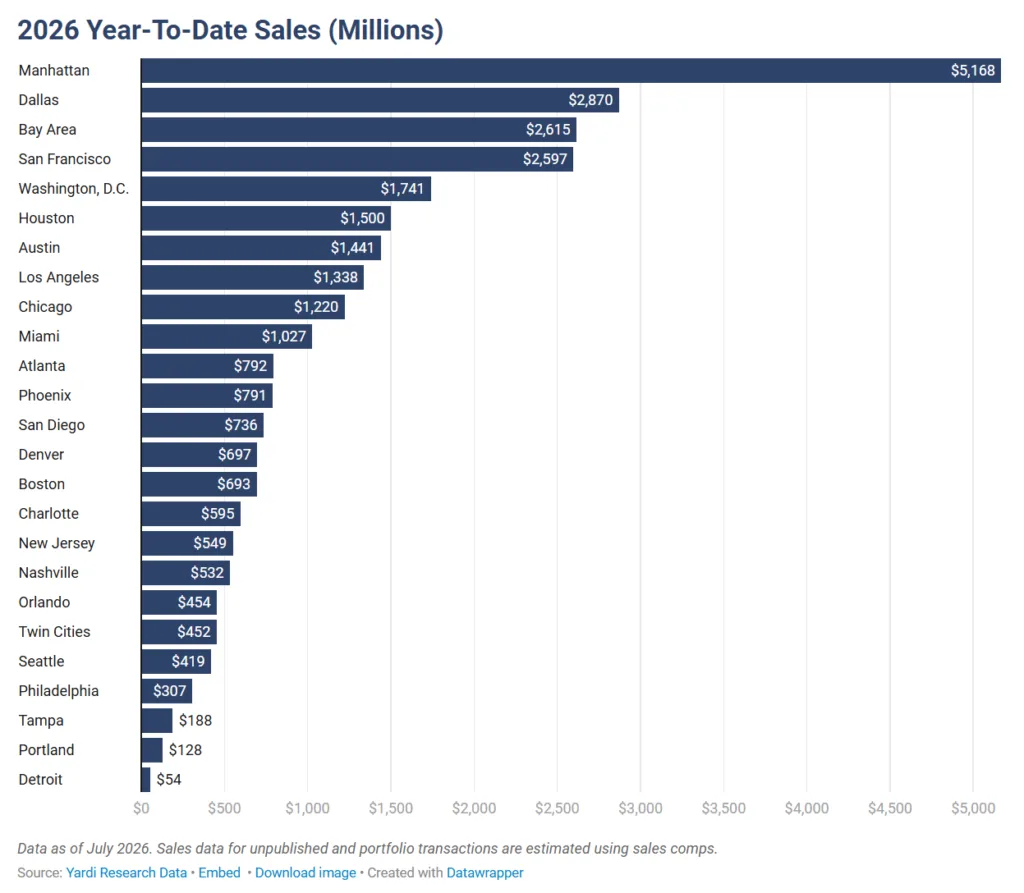
Vacancy varied widely: Los Angeles posted a regional low at 14.5%, while San Francisco saw office vacancy reach 26%. Listing rates followed suit, from $21.11 PSF in Detroit to $71.95 PSF in Manhattan. Meanwhile, nationwide, 19 of the top 25 tracked markets saw their vacancy rates decline over the previous year, underscoring the slowly improving fundamentals.
Medical Office Outperforms Traditional Product
The rise of medical office is one of the cycle’s most defining office trends. Unlike general office, medical office construction and property values have held up consistently. Overall office starts dropped 73% since 2020, while medical office starts declined just 9.5%. This resilience also extends to financing, where medical office loans continue outperforming amid strong demand and attractive returns. CommercialCafe found 67% of traded medical office properties appreciated between 2024 and 2026. That compares with just 52% for general office peers.
Demographics are a key driver. In Sun Belt and retiree-friendly metros like Tampa and Phoenix, more than 89% of medical office trades appreciated during the period. The essential nature of healthcare keeps physical occupancy robust and limits tenant churn, with long-term demand underpinned by an aging population and tenants’ reluctance to relocate.
This stands in sharp contrast to traditional office, especially properties in central business districts that have struggled to adapt. From 2024 to May 2026, nearly three-quarters of CBD office assets sold at a discount, and urban and suburban properties aren’t immune—discount rates reached 48% and 42% respectively. Tenant flight-to-quality and ongoing portfolio rightsizing have concentrated leasing and investment into the best-located, highly amenitized assets.
Why It Matters
The rebalancing in US office fundamentals is slow-moving but evident. Declining vacancy for the first time in years signals that the sector may be approaching a cyclical bottom, but the improvement remains highly localized. Standout markets—like Manhattan and Miami—demonstrate that trophy and amenitized spaces can still command rents far above national averages, but the depth of tenant demand is thin. Markets like San Francisco, which registered the nation’s highest vacancy at 26% and still only managed a partial rebound in pricing, remind owners and lenders that recovery will not be evenly distributed.
Medical office has emerged as the clear outperformer. Supported by a stable, inelastic demand set and demographic tailwinds, medical office values are rising while the broader office sector grapples with value impairment. Per CommercialCafe data, Tampa and Fort Lauderdale saw 89% of medical office trades appreciate, beating both regional and national averages for other office types. The trend is structural, and it’s shifting how institutional capital and REITs approach portfolio allocation, particularly in markets with older or growing populations.
The office development pipeline is thin by historical measures—less than 0.5% of market inventory in most tracked metros. Developers are selective and capital remains cautious outside the upper tier, limiting new supply risk but also capping the speed of potential recovery. Leasing environments remain tenant-favorable in all but the strongest Sun Belt and gateway markets. However, a consistent drop in vacancy, even if modest, could help restore liquidity and confidence for well-located assets later in 2026.
What’s Next
Looking ahead, gradual improvement in overall office fundamentals is expected to continue, but with deeper bifurcation between top-tier and commodity properties. Medical office’s outsized share of new development and price appreciation will likely extend as aging demographics and healthcare trends remain robust. For general office product, the slow crawl out of historic vacancies will depend on further job growth, hybrid work normalization, and owners’ ability to attract tenants with quality-focused repositioning.
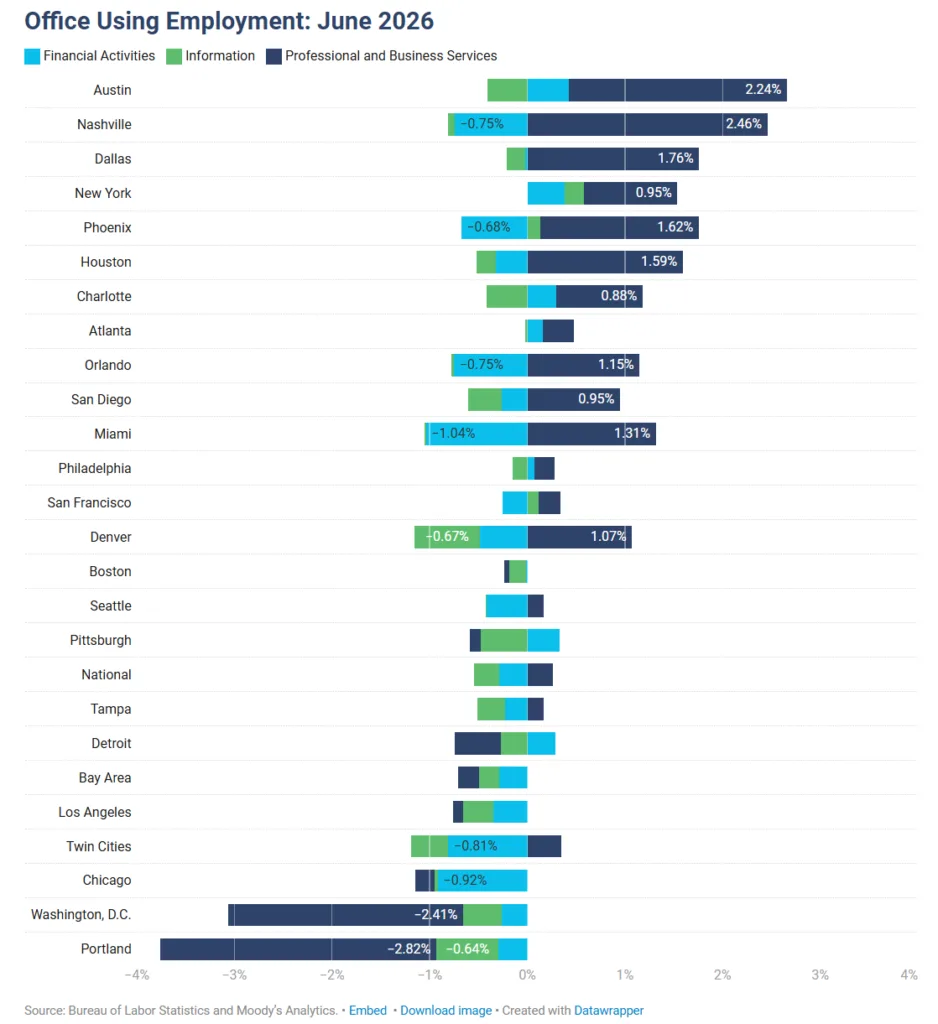
Markets with the fastest employment recovery—like Dallas, Miami, and Phoenix—are poised to capture disproportionate leasing activity and investor interest. Developers are likely to keep pipelines lean until absorption fully stabilizes and lenders regain risk appetite. Absent a macroeconomic setback, 2026-2027 could mark the transition toward equilibrium, but the strongest demand and rent growth will remain concentrated in specialized segments and the highest-quality urban and Sun Belt assets.