





- Tech and artificial intelligence firms accounted for 23% of US office leasing in Q1 2026, leading demand in select markets, according to CBRE.
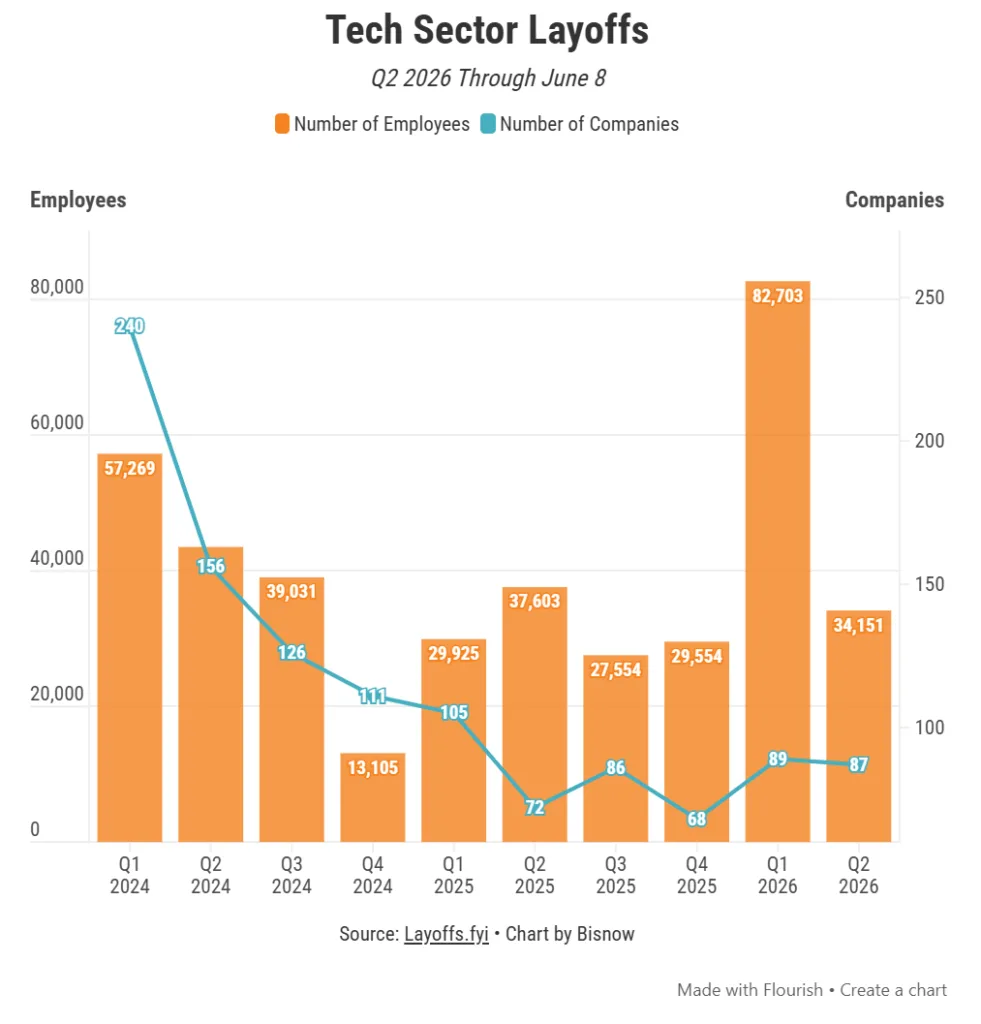
- Layoffs in the tech sector already exceed 116,000 in 2026, raising concerns about long-term office demand as AI investment outpaces hiring.
- Despite concentrated leasing in cities like San Francisco and Manhattan, national office vacancy remains stuck around 20%, with a growing structural surplus.
An Uneven Office Recovery
While the US office market continues to wrestle with historically elevated vacancy, a burst of leasing activity from AI-driven tech companies is providing a selective boost. According to Bisnow, tech firms leased 11.5M SF of office space in Q1 2026, representing a decade-high 23% share of all leasing volume per CBRE. Much of this activity is concentrated in prime markets and best-in-class assets. But this headline momentum masks a deeper paradox: the very companies driving demand are also cutting headcount at a historic pace. The rapid integration of AI is fundamentally changing office usage, stalling traditional recovery metrics and dividing the market between winners and losers.
Despite tech’s ongoing interest in prime real estate, total US office market vacancy has hovered near 20% for several years, per CBRE, as occupiers shrink footprints and trade up for quality. Waves of tech layoffs—116,854 so far in 2026 per Layoffs.fyi, already outpacing 2025—highlight just how precarious traditional office-using job growth remains. AI’s promise of efficiency is leading to spend on new tech and infrastructure rather than staff expansion, reinforcing the volatility underlying today’s leasing gains.
Get Smarter about what matters in CRE
Stay ahead of trends in commercial real estate with CRE Daily – the free newsletter delivering everything you need to start your day in just 5-minutes
AI-Led Clustering in Key Markets
This bifurcated recovery is most apparent in the cities and assets capturing tech’s leasing surge. AI and tech firms signed 36.7M SF of office leases during 2025, nearly 17% of all deals, CBRE reports. But nearly all net absorption is happening in Manhattan, San Francisco, and Silicon Valley, with Manhattan alone seeing 1M SF of AI office leases in Q1 2026—more than all of 2025. San Francisco posted 3.5M SF of Q1 deals from AI firms, 60% of the prior year’s total, while other Sun Belt and Tier 2 cities see minimal spillover. Meanwhile, industry giants like Amazon are simultaneously cutting their office footprint by the equivalent of 14M SF, even as they lease selectively in core innovation markets. This push-pull is remaking office geography, drawing capital and talent into a shrinking set of high-performance locations.
The Details
According to CBRE’s Q1 2026 data, tech leasing reached a high-water mark, with AI-focused occupiers now a major driver of office demand. OpenAI alone has committed to over 1M SF in California and Washington so far this year, including five major leases. Other fast-growing players like Anthropic have taken a similar volume across California since last fall. Still, these expansion moves contrast sharply with sector-wide consolidation: Oracle, Amazon, Intel, Microsoft, and Meta cut 118,483 jobs since January 2025, representing 57% of tracked tech layoffs. Recent workforce reductions have also pressured office demand in several major markets, underscoring how employment cuts can quickly outweigh leasing momentum. While AI firms are betting on future headcount growth by pre-leasing, the rest of the market faces difficult adjustments—including demolition or conversion of obsolete buildings. Office-to-residential conversion only pencils for assets that have lost nearly all value, a trend that signals pain still to come for many landlords.
Job Cuts and a Reshaped Labor Market
The macro picture is mixed. The US economy added 172,000 jobs in May 2026, primarily in healthcare, hospitality, and government. By contrast, the financial sector shed 22,000 positions in May and 107,000 in the past year. Executives surveyed by Mercer see the writing on the wall: 99% of HR respondents expect to cut jobs due to technology in the next two years. As Colin Yasukochi, executive director of CBRE’s Tech Insights Center, notes, much of this ties back to AI infrastructure spending outpacing near-term hiring. Personnel budgets are being redirected; Uber, for example, capped staff AI tool usage at $1,500 per month to curb escalating costs, per Bloomberg. OpenAI’s Sam Altman and Nvidia’s leadership have cited the price of computing power as a lasting drag on short-term ROI.
Many companies, Chandan of NYU points out, are now drafting new workplace policies for AI adoption as they wait for meaningful productivity gains. Yet, the math on headcount reductions likely accelerates once infrastructure improves, according to Columbia’s Stijn Van Nieuwerburgh. Until then, strategic pre-leasing by AI firms is driving some observers to worry about a replay of dot-com-era over exuberance.
Why It Matters
The standoff between AI-driven demand and broad downsizing will shape the next phase of the US office market. By early June 2026, tech layoffs had already surpassed 2025 totals. Meanwhile, leasing growth remains concentrated in a small group of trophy assets and submarkets.
Even those bright spots carry risks. OpenAI and Anthropic are leasing space for future hiring plans. However, current headcounts do not yet support that expansion. Historically, similar patterns have often appeared near market peaks. CBRE reports that more than one-fifth of US office space remains vacant. At the same time, top buildings in core tech markets are nearly full. As a result, landlords must rely on conversions or demolitions to reduce obsolete inventory.
Van Nieuwerburgh told Bisnow that landlords need significant write-downs before many conversions become viable. In most cases, conversion economics only work after buildings lose much of their value. Meanwhile, AI is reshaping the labor market. Companies are replacing traditional office jobs with emerging roles. Many of those positions focus on compliance, governance, and data security, according to Manulife’s Erin Patterson. The key question remains unresolved. Can AI-driven businesses create enough office demand to offset rising obsolescence elsewhere? The answer will help determine the market’s next direction.
What’s Next
Expect the office market to grow more divided through 2026 and into 2027. Leasing should remain strong for top-tier properties in select markets. AI firms continue pre-leasing space for future growth. However, most buildings will face higher vacancy. As a result, conversion or demolition cases will strengthen.
Meanwhile, the industry is watching AI’s broader impact. Many want to see if new businesses can create enough office demand. That demand must offset ongoing layoffs and space reductions elsewhere. For now, AI-driven leasing offers a short-term boost. At the same time, it highlights deeper structural challenges. US landlords must address those issues as market conditions evolve.