






- CMBS distress increased in 17 of the 25 largest US metro areas, pushing the aggregate distress rate to 12.7% from 12.2% a year earlier.
- Minneapolis, Denver, and Rochester posted the highest distress rates, while St. Louis and Oklahoma City recorded the largest annual increases.
- Office loan weakness and maturing floating-rate debt continue driving stress, though some Sun Belt markets are showing improvement through loan resolutions.
According to CRED iQ, CMBS distress spread further across the nation’s largest metro areas in May 2026. The aggregate distress rate across the 25 largest US MSAs reached 12.7%. That’s up from 12.2% a year earlier. Seventeen markets posted year-over-year increases, highlighting growing pressure across commercial real estate lending markets.
The data includes loans classified as delinquent, in special servicing, or held as REO across conduit and SBLL pools. The overall increase appears modest. However, several individual markets saw dramatic deterioration. Many of the largest jumps occurred in markets with significant office exposure and large volumes of maturing debt.
Get Smarter about what matters in CRE
Stay ahead of trends in commercial real estate with CRE Daily – the free newsletter delivering everything you need to start your day in just 5-minutes
Office Troubles Deepen
Minneapolis posted the highest CMBS distress rate among the top 25 markets at 55.2%. Denver followed at 43.0%, while Rochester reached 40.1%. According to CRED iQ, office-related challenges remain a major driver in Minneapolis and Denver. Several large loans remain in extended special servicing.
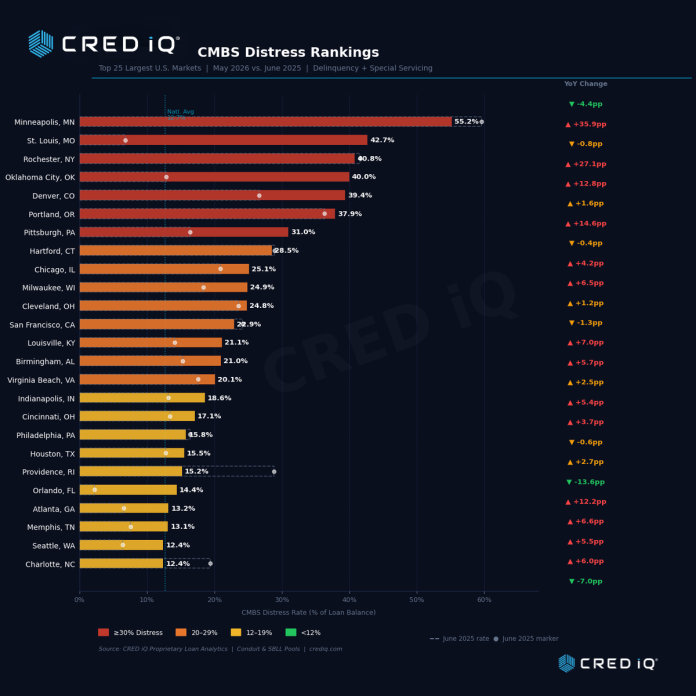
These markets continue to struggle with weak office demand and refinancing challenges. Rochester’s elevated reading reflects a smaller loan pool with a concentrated group of distressed assets. That concentration amplifies the market’s distress percentage compared to larger metro areas with more diversified loan balances.
The Details
New York recorded the lowest distress rate among the major markets at 12.0%. San Antonio and Houston followed at 14.7% each. Their lower readings reflect larger and more diversified loan pools. Individual loan failures have less impact on overall distress levels.
At the other end of the spectrum, distress accelerated sharply in several Midwest and secondary markets. St. Louis posted the largest increase, jumping 29.9 percentage points from a year earlier. Oklahoma City followed with a 28.5-point increase. Pittsburgh recorded a 16-point rise, while Denver and Louisville each posted increases above 15 percentage points.
Debt Maturities Add Pressure
Many of the fastest-deteriorating markets share similar characteristics. They have concentrated office inventories and significant exposure to 2021 and 2022 loan vintages. Borrowers in these markets are now confronting a much different financing environment than the one that existed when those loans originated.
Higher interest rates continue to pressure borrowers. Refinancing options remain limited for loans approaching maturity. More loans are moving into special servicing. Delinquencies also remain elevated. Together, those factors are creating a growing pipeline of distressed assets across several regional markets.
Why It Matters
The latest figures show CMBS stress remains concentrated. However, it is spreading across more secondary and tertiary markets. The trend suggests distress is no longer limited to a handful of office-heavy downtowns. Instead, lenders and investors are seeing broader pressure across multiple property types and regions.
Gateway cities still face office headwinds. However, larger and more diversified CRE markets have helped contain distress levels. Markets such as New York, Houston, and San Antonio benefit from deeper loan pools and a wider mix of property sectors. That diversification can soften the impact of individual loan failures.
The industry’s focus is also shifting. Loan resolutions and refinancing risk are becoming more important than valuation declines alone. According to CRED iQ, office distress across the 25 largest markets stood at 17.1% in May 2026. That figure was nearly unchanged from 17.2% a year earlier. Multifamily distress, however, increased to 11.0% from 10.3%.
Some markets are improving through workouts, modifications, payoffs, and asset sales. That can lower distress rates even when property fundamentals remain weak. As a result, investors are paying closer attention to loan-level outcomes rather than headline distress figures alone.
What’s Next
Not every market is moving in the wrong direction. Providence recorded the largest improvement among the top 25 markets. Its distress rate fell 14.7 percentage points from a year earlier. Charlotte and Austin also posted notable declines as troubled loans moved through the resolution process.
Industry participants will closely monitor loan modifications, maturity extensions, and special servicing outcomes through the rest of 2026. Office distress remains elevated. Multifamily pressure is also building. As a result, loan resolutions may become as important as new defaults in shaping future distress trends. For lenders, borrowers, and investors, loan-level performance will remain one of the clearest indicators of CRE credit conditions.