




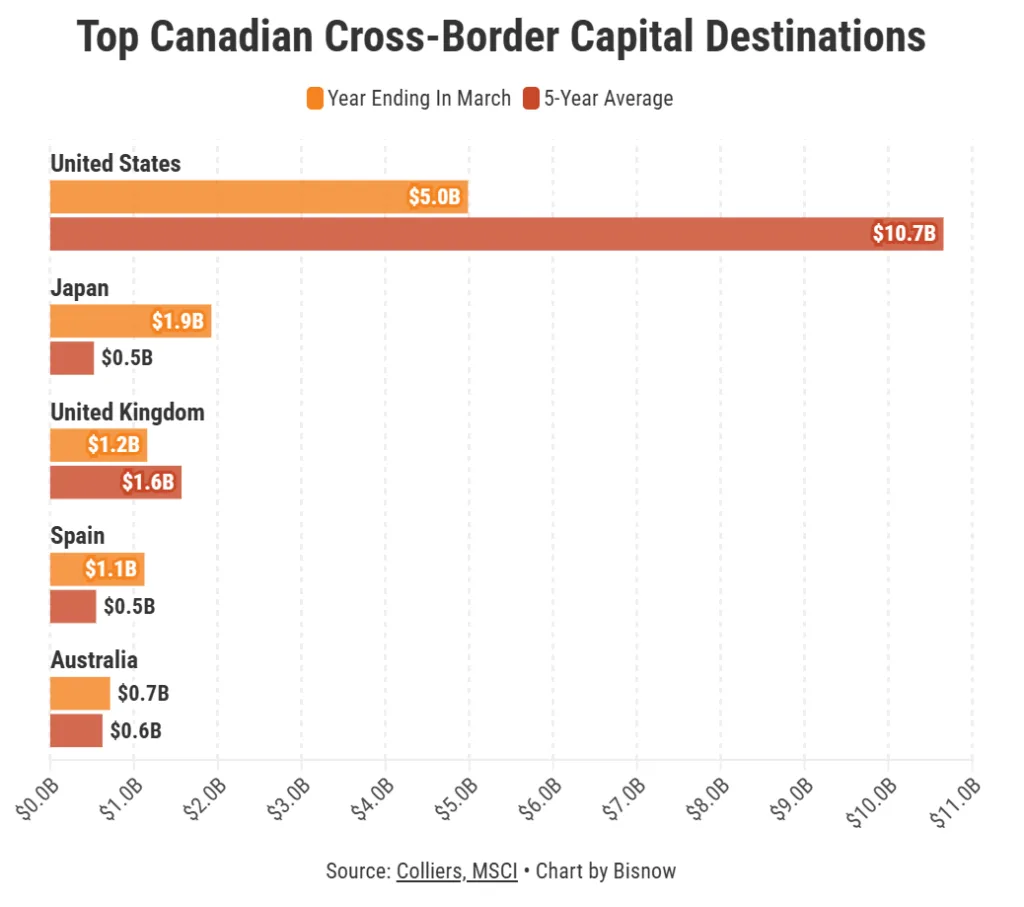
- Canadian investment in US real estate fell 32% year-over-year to $5B through March 2026, according to Colliers, marking a sharp slowdown in a historically dominant capital pipeline.
- Canadian institutions still raised $13.4B for overseas investment in 2025, but allocated just 37% to US assets versus 54% the year prior as trade tensions intensified.
- The pullback signals how geopolitical friction and economic nationalism are beginning to reshape global CRE capital flows, even as US assets remain attractive to institutional investors.
Canadian investors are pulling back from US commercial real estate after decades of serving as one of the market’s most reliable foreign capital sources, reports Bisnow. Trade disputes, tariffs, and increasingly strained political rhetoric between the two countries have slowed cross-border deal activity and pushed many institutions to reconsider concentration risk in US assets.
According to Colliers’ Q1 2026 Global Capital Flows report, Canada-to-US commercial real estate transaction volume fell 32% year-over-year to $5B during the 12 months ending in March 2026. The total sits well below the average annual investment pace Canadian buyers maintained over the previous five years.
Get Smarter about what matters in CRE
Stay ahead of trends in commercial real estate with CRE Daily – the free newsletter delivering everything you need to start your day in just 5-minutes
Politics Reshapes Cross-Border CRE Investment
The slowdown comes after a year of escalating economic and political friction between Ottawa and Washington. President Donald Trump’s renewed tariff campaign against Canada and Mexico — including proposed 25% duties before taking office — added uncertainty to cross-border business activity throughout 2025.
Canadian Prime Minister Mark Carney responded with a more nationalist economic agenda centered on diversification away from the US economy. In April 2026, Carney publicly argued that Canada’s close economic relationship with the US had become a strategic vulnerability, while his government launched a new sovereign wealth initiative aimed at broadening international investment exposure.
That messaging appears to be resonating with both institutions and the public. André Brin, CEO of World Trade Center Winnipeg, told Bisnow that businesses and investors increasingly want to reduce reliance on the US market amid ongoing volatility and policy unpredictability.
The Details Behind Canada’s Pullback
Canadian institutions still raised substantial capital for overseas investment. Colliers reported that investors amassed roughly $13.4B for foreign deployment in 2025, nearly matching the prior year’s total. The difference was allocation strategy.
Only 37% of that capital targeted US assets, down sharply from 54% in 2024, according to Colliers data. The decline marks a notable shift for a country that has consistently ranked as the largest source of foreign capital into US real estate.
Per JLL data cited by Bisnow, Canadian investors poured roughly $73B into US assets between 2019 and early 2025 — more than four times the volume invested by any other foreign country during that stretch.
While tariffs and policy disputes created immediate hesitation, broader market uncertainty also weighed on dealmaking. Investors spent much of 2025 navigating fluctuating trade rules, court battles over tariff authority, and global economic instability tied to conflicts in the Middle East, Europe, and Asia.
Still, foreign appetite for US commercial real estate overall remains resilient. Cross-border investment into US assets climbed 24% year-over-year to $25.9B through March 2026, according to Colliers, even as the top five foreign capital sources collectively raised slightly less money than the prior year.
US Commercial Real Estate Still Draws Global Capital
Despite Canada’s retrenchment, institutional investors continue viewing US real estate as a relative safe haven compared to other global markets. Andrew Yam, who joined multifamily investor American Landmark in February 2026 to expand institutional capital relationships, told Bisnow that Canadian investors remain active in meetings and property tours across the US.
That dynamic reflects a broader reality in global capital markets: relative stability still matters more than absolute certainty. Europe continues grappling with economic weakness tied to the Russia-Ukraine war, China’s property sector remains under pressure following its housing collapse, and geopolitical tensions in the Middle East have rattled infrastructure and hospitality markets.
Against that backdrop, US multifamily, industrial, and necessity-based retail assets still offer liquidity, transparency, and operational scale that many institutional investors struggle to find elsewhere.
At the same time, Canadian institutions increasingly appear focused on geographic diversification rather than outright withdrawal from the US market. Industry executives say many funds are reallocating portions of their capital to Europe, Asia, and domestic Canadian opportunities instead of concentrating exposure south of the border. That shift is also showing up in consumer real estate activity, with more Canadians listing US vacation properties amid growing economic and political tension between the two countries.
Why It Matters
Canadian investment in US real estate has long served as a foundational source of foreign capital for American CRE markets. A sustained slowdown could pressure deal volume, particularly in gateway cities and institutional-quality assets that historically attracted pension funds and sovereign-scale buyers from Canada.
The shift also highlights how political rhetoric and trade policy are beginning to influence capital allocation decisions in global real estate. Cross-border CRE investment has traditionally been driven by yield, liquidity, and fundamentals — but geopolitical alignment is increasingly entering the equation.
For US sponsors and operators, the trend reinforces the importance of diversifying capital relationships beyond traditional international partners.
What’s Next
Canadian capital is unlikely to disappear from US real estate altogether. Industry leaders still expect pension funds and institutional investors to pursue high-performing US assets, particularly in multifamily and logistics sectors with durable cash flow profiles.
But the era of automatic Canadian overweight exposure to US real estate may be fading. As Ottawa pushes economic diversification and institutional investors recalibrate global portfolios, cross-border capital flows could become more selective, politically sensitive, and geographically diversified over the next several years.