


Houston's Office Reset Is Fueling a Demolition Boom
Owners of debt-free properties are opting to demolish obsolete offices as land values outpace building values.
In partnership with

Good morning. Houston's high office vacancy is accelerating demolitions as owners decide vacant land is more valuable than aging buildings. Many other obsolete offices remain stuck because outstanding debt makes demolition financially difficult.
🎙️ This Week on No Cap: Leon Capital Group's Fernando De Leon shares how he went from translating legal disputes as a teenager to building a $3B real estate empire, plus his views on AI, data centers, senior housing, and why stamina is the ultimate competitive edge. (Thanks to our sponsor, Lennar Investor Marketplace)
Listen & subscribe: Apple Podcasts | Spotify | YouTube

Your pitch was ready before you finished your coffee.

You have a tenant-rep meeting at 10. By 8, Viktor has built the entire pitch and posted it to your Slack: a full underwriting model with cap rate and IRR sensitivity, six comparable signed leases, a branded pitch deck, and a draft LOI ready to send. He pulled the data, ran the numbers, and wrote the deck overnight while you slept.
No analyst. No two hours of prep before every meeting. You walk in with the model already built and the story already written.
He lives in Slack and Microsoft Teams and connects to 3,200+ tools. He acts on his own: he flags a new listing the moment it fits your client's brief, drafts the outreach, and tees up the next deal before you ask.
SOC 2 certified. Your data never trains models.
"Viktor is now an integral team member, and after weeks of use we still feel we haven't uncovered the full potential." Patrick, Director, Yarra Web.
Market Snapshot
|
||
|
||
|
||
|
||
|
||
|
Office Reset
Houston's Office Reset Is Fueling a Demolition Boom
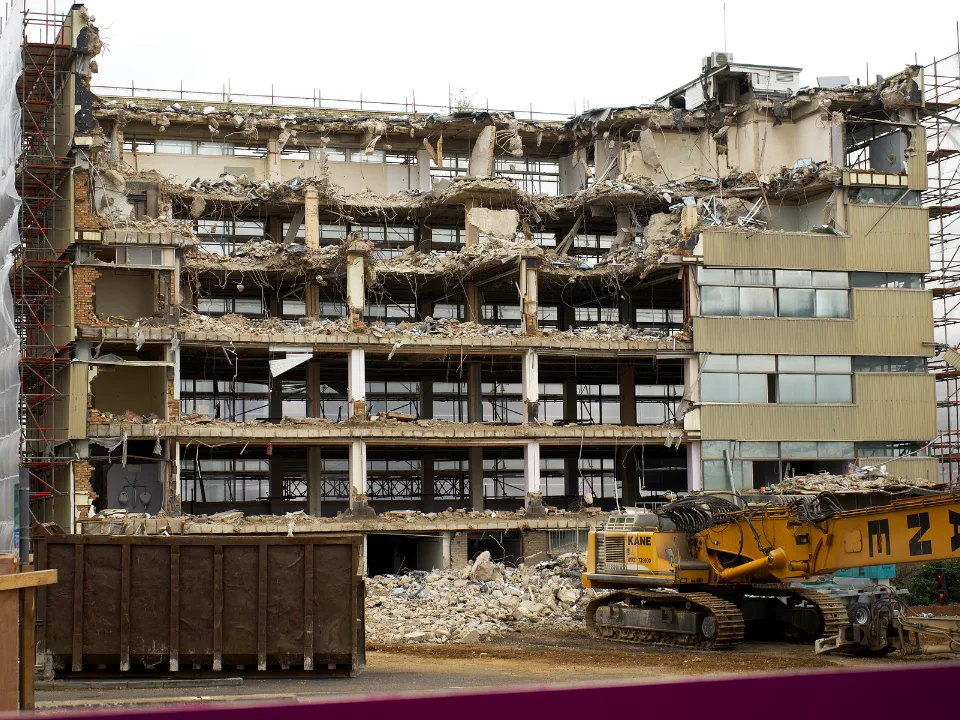
With aging office buildings losing value faster than the land beneath them, more Houston owners are deciding it's cheaper to demolish obsolete properties than continue maintaining them.
By the numbers: Houston's office vacancy rate reached 26.8% in the first quarter of 2026, according to JLL, one of the highest in the country. Older Class B and Class C office buildings continue to struggle with high vacancies, fueling demand for demolition even as many projects remain sidelined by limited capital and outstanding debt.
Land now outweighs the building: The demolition of the 109,000-square-foot Halbouty Center at 5100 Westheimer illustrates the shift. Built in 1973, the property's $9.3 million appraised value is now driven largely by its $7 million land value, which has exceeded the building's value for years. Owner representative Joe Evans said demolishing the building costs about the same as maintaining it for a year.
Why owners are choosing demolition: After years of unsuccessful sale efforts, the pandemic reshaped demand for older office space, making leasing increasingly difficult. For owners of well-located, debt-free properties, clearing the site can reduce carrying costs while preserving future redevelopment or sale opportunities.
Debt is the biggest obstacle: Many obsolete office buildings remain standing because they're tied to distressed loans. According to Evans, lenders often have little interest in taking ownership or funding demolition, leaving many vacant properties in limbo despite having little chance of regaining value as office space.
Demolition firms remain busy: Grant Mackay Demolition has worked on several high-profile Houston projects over the past year, including the former 1 million-square-foot Fluor campus in Sugar Land and a parking structure tied to the George R. Brown Convention Center renovation. The company says public-sector work has helped balance slower private demand as higher interest rates continue to pressure redevelopment activity.
➥ THE TAKEAWAY
The bigger picture: Houston's office distress is increasingly becoming a land story rather than a building story. For owners of debt-free properties in prime locations, demolition can be the most cost-effective strategy while waiting for redevelopment opportunities. But for heavily leveraged assets, aging office buildings may continue to sit vacant until financing conditions improve or ownership changes hands.
Around Texas
➥ Core Spaces broke ground on a 2,201-bed student housing community near Texas A&M, set to become Northgate’s largest new development with extensive resident amenities.
➥ Industrial construction is accelerating in Southwest Houston, where developers have already broken ground on 50% more warehouse space in the first half of 2026 than during all of 2025.
➥ Houston’s retail market reached 95.2% occupancy at midyear 2026, with strong tenant demand and limited store closures supporting 1.8M SF of new retail deliveries.
➥ Dallas-based architecture firm HKS has cut about 80 jobs amid the commercial real estate slowdown as it restructures to align with changing market conditions.
➥ Prudential Financial will relocate its Dallas operations to new office space at 23Springs and Trammell Crow Center, expanding its footprint across two premier towers.
Follow the Money
| OFFICEHOUSTON IES Holdings will relocate its headquarters to a Westchase office building it purchased in 2025, backed by a planned $3.9M interior build-out. |
| SENIOR HOUSINGTYLER LifeCare has sold The Blake at Tyler, a 115-unit seniors housing community in East Texas, to an undisclosed publicly traded REIT while retaining Blake Management Group as operator. |
| RETAILKATY Phillips Edison & Co. has acquired Firethorne Plaza, a fully leased 29,986 SF retail center in Katy, in a sale brokered by JLL, expanding its Texas shopping center portfolio. |
| OFFICEDALLAS Ross Tower, a 1.1M SF office building in downtown Dallas, has been listed for sale as owners capitalize on growing investor interest tied to Uptown’s expanding financial district. |
| MULTIFAMILYDALLAS-FORT WORTH S2 Capital is dissolving its $400M inaugural multifamily fund with no capital returned to investors as it seeks fresh funding to salvage viable assets amid ongoing market distress. |
📈 CHART OF THE WEEK

Dallas-Fort Worth apartment rents are showing a slow but steady recovery in 2026. CoStar’s daily asking rent index indicates modest gains through midyear—tracking below historical norms but outperforming the sharper late-year declines seen in 2024 and 2025.
-
📬 Newsletters: Stay ahead of the market with our national CRE Daily newsletter — or get hyper-local insights from CRE Daily New York.
-
🎙️Podcast: No Cap by CRE Daily delivers an unfiltered look at the biggest trends—and the money game behind them.
-
🗓️ CRE Events Calendar: The largest searchable calendar of commercial real estate events—filter by city or sector.
-
📊 Market Reports: A centralized hub for brokerage research and market intelligence, all in one place.
-
📈 Fear & Greed Index: A fully interactive sentiment tracker on the pulse of CRE built in partnership with John Burns Research & Consulting.

You currently have 0 referrals, only 1 away from receiving Multifamily Stress Test Model.
What did you think of today's newsletter? |