





- US office vacancy fell slightly to just under 14% in Q2 2026, according to CoStar’s revised outlook.
- Net absorption reached 17M SF over the past year, but is projected to slow to 13M SF in 2026 and 5M SF in 2027.
- Shrinking supply, driven by low deliveries and heightened demolitions, may prompt vacancy to decline gradually after 2026.
Supply Contraction Reshapes Office Market
CoStar’s latest US office sector forecast highlights a turning point for office supply dynamics. The national vacancy rate dropped below 14% during the second quarter of 2026. That figure sits 30 basis points below its mid-2025 peak. Over the last year, total office inventory shrank by 7M SF. This contraction reflects both minimal new deliveries and record-high demolitions.
The construction pipeline remains near 50M SF, matching the cycle low recorded in 2011. Phil Mobley, CoStar’s director of office analytics, says this sharp supply reduction is helping suppress vacancy. He expects the trend could continue for several more quarters. That could offer landlords some relief, even as tenant demand remains soft.
Get Smarter about what matters in CRE
Stay ahead of trends in commercial real estate with CRE Daily – the free newsletter delivering everything you need to start your day in just 5-minutes
The Details
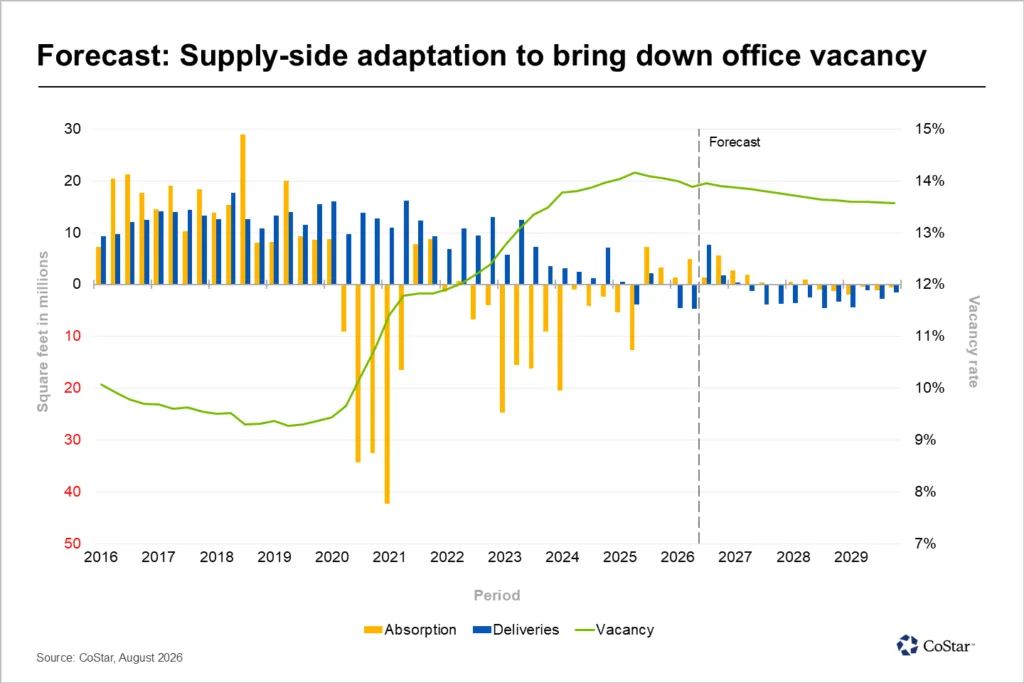
From July 2025 through June 2026, US offices recorded 17M SF of total net absorption. This marked only the second sustained stretch of positive absorption since 2020. CoStar expects net absorption to ease to 13M SF for full-year 2026. It then projects another slowdown to 5M SF during 2027. Both figures represent slight downgrades from earlier projections.
Meanwhile, the national office pipeline remains stubbornly low, with only 50M SF currently underway. That figure resembles the post-Great Financial Crisis trough. Demolitions continue rising, while construction starts remain near historic lows. Consequently, total inventory fell by 7M SF during the past 12 months. Such contraction remains unusual in the normally slow-changing office sector.
Positive Absorption Amid Persistent Headwinds
This stretch of positive absorption breaks with recent history. Most quarters since 2020 recorded net losses in office occupancy. However, the reversal remains sluggish compared with recoveries following other major downturns. The 14% national vacancy rate still signals substantial slack. Before the pandemic, vacancy rates hovered closer to 10%, according to CoStar data.
Net absorption during Q2 also exceeded the lackluster levels recorded throughout the previous three years. Still, analysts emphasize the modest scale of positive demand. They also expect future annual absorption to remain below earlier forecasts. Overall, the office sector’s muted recovery contrasts with stronger multifamily and industrial rebounds since 2021.
Why It Matters
The US office market’s slowly falling vacancy and modest absorption highlight two major forces. Structural demand remains weak, while meaningful supply contraction continues reshaping market fundamentals. Office conversions already contributed to a historic decline in US office supply during 2025, reinforcing this contraction. Employers are largely maintaining or reducing their footprints. At the same time, productivity gains among knowledge workers continue changing space requirements. These trends suggest permanent behavioral shifts have become deeply embedded.
CoStar expects annual net absorption to remain well below long-term averages. It forecasts 13M SF for 2026 and 5M SF for 2027. Earlier projections called for 17M SF and 6M SF, respectively. Meanwhile, the current 50M SF construction pipeline stands at its lowest level since 2011. That limits oversupply risk but provides few catalysts for a rapid recovery. Rising demolitions and stalled groundbreakings are also shrinking total US office inventory. This marks the first meaningful contraction in decades. A smaller inventory base could gradually lower vacancy, but tenant demand remains fragile.
For investors, stabilization will likely take time. However, limited new construction could eventually help well-located assets regain pricing power. Office leasing fundamentals remain sharply divided by property age, amenities, and location. Flight to quality continues driving tenant decisions across major markets. Mobley says AI and remote productivity advances could further reduce space requirements per employee. Conversely, stronger in-person work requirements could encourage companies to expand their footprints. For now, landlords can benefit from supply contraction while closely watching the evolving demand picture.
What’s Next
CoStar expects US office vacancy to remain near current levels through the end of 2026. After that, the rate could begin a slow and incremental decline. The construction pipeline appears unlikely to expand significantly, while demolitions should continue removing obsolete inventory. Together, these forces could push vacancy lower during late 2027 and beyond.
However, workplace efficiency gains remain a major downside risk, particularly as companies adopt more AI tools. An upside scenario could emerge if employers strengthen in-person requirements and lease more space per worker. For CRE players, careful asset selection will remain critical throughout this slow recovery. Strategic amenity upgrades could also help properties compete for tenants as the market gradually heals.