






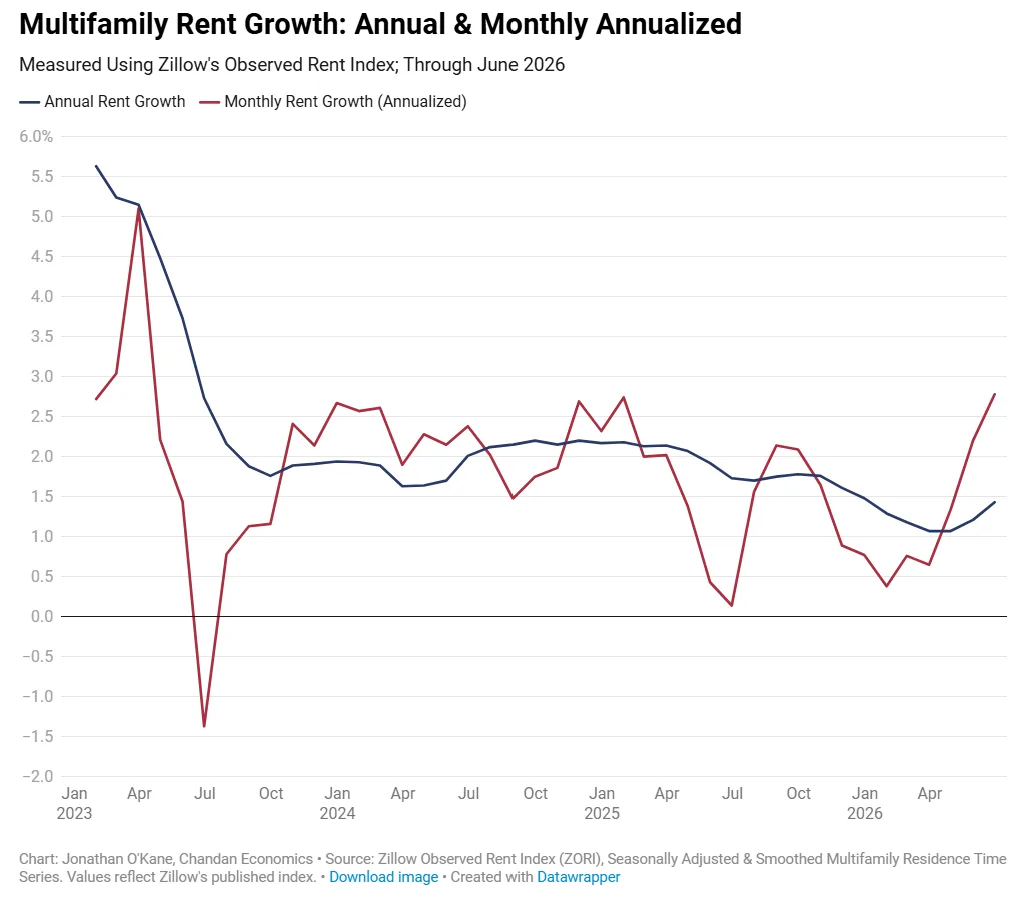
- US multifamily rents posted a 1.4% annual increase in June 2026, up from 1.2% the prior month, according to Zillow’s index.
- San Francisco led metros for annual rent growth at 8.5%, while several Florida and Texas markets continued to lag.
- Strengthening rent growth and wider market participation suggest the multifamily sector is rebounding after a lengthy cooling period.
Signs of a Market Shift
National multifamily rent growth showed clear acceleration in June, per data from the Zillow Observed Rent Index (ZORI) reported by Chandan Economics. Headline rents increased 1.4% year over year, up 0.2 percentage points from May and reaching this year’s peak pace. The uptick breaks from a prior cooling stretch and points toward improving fundamentals for apartment owners and investors.
This boost is notable given how tepid growth has been relative to the post-pandemic run-up. Short-term rent gains were even stronger, with month-over-month annualized growth climbing to 2.8%—the healthiest monthly figure since March 2023. About 71.5% of US metros saw rents rise from May to June, the broadest participation in nearly a year, while nearly nine out of ten markets posted annual gains.
Get Smarter about what matters in CRE
Stay ahead of trends in commercial real estate with CRE Daily – the free newsletter delivering everything you need to start your day in just 5-minutes
The Details
According to June 2026 ZORI data, national rent growth reached 1.4% year over year, its strongest first-half reading. Month over month, rents increased at a seasonally adjusted 2.8% annualized rate. Meanwhile, 71.5% of tracked metros posted monthly gains, the highest share since September 2025. Another 88.1% recorded annual increases, marking the broadest growth since February 2025. The strongest annual performers clustered across Northern California, the Northeast, and the Midwest.
San Francisco led the nation with 8.5% annual rent growth. Urban Honolulu followed at 6.4%, while Akron and San Jose each posted 6.2% gains. Toledo also ranked among the leaders with 5.5% annual growth. By contrast, North Port fell 4.4%, while Cape Coral declined 3.7%. San Antonio dropped 3.5%, and Austin recorded a 2.9% annual decline. Still, several pressured Sun Belt markets stabilized monthly, suggesting an early recovery may be forming.
A Tale of Two Regions Persists
Regional divides remain pronounced as uneven supply and demand dynamics shape performance nationwide. The strongest rent gains cluster across the Midwest, Northeast, and coastal California. These regions generally face more disciplined development pipelines and comparatively resilient demand. San Francisco and San Jose posted strong annual and monthly results. Their momentum reflects more than favorable year-over-year comparisons.
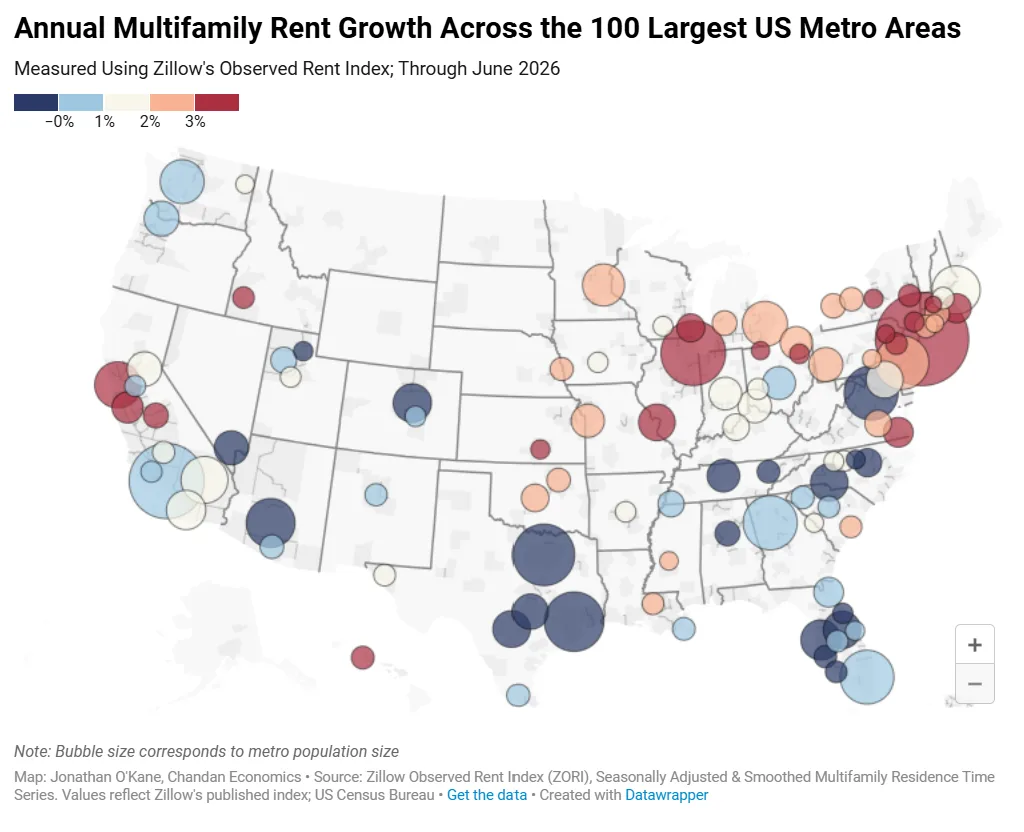
Meanwhile, major Sun Belt metros continue working through heavy new supply after leading pandemic-era migration growth. North Port, Cape Coral, San Antonio, Austin, and Denver posted the steepest annual rent declines. However, the share of markets reporting positive monthly growth continues to climb. Rents in Dallas, Houston, Orlando, Tampa, and Jacksonville are flat or moving higher. That improvement suggests the worst oversupply pressures may be easing across some markets.
Why It Matters
June’s multifamily rent data marks an important inflection point for two main reasons. First, rent growth and market breadth improved after nearly two years of post-pandemic deceleration. That shift suggests national multifamily fundamentals may have moved beyond their cyclical trough. ZORI showed 1.4% annual growth and a 2.8% monthly annualized pace. Both readings reached their strongest levels in at least a year. The data suggests markets are rebalancing as new supply gets absorbed and previous imbalances gradually correct.
Second, persistent regional divergence shows investors and operators that opportunities and risks remain highly localized. Markets with limited pipelines and resilient demand continue outperforming, especially across California, the Northeast, and Midwest. Meanwhile, much of the supply-heavy Sun Belt still faces near-term rent pressure. However, monthly momentum is improving across several lagging markets. That trend suggests the broad weakness seen during late 2024 and early 2025 is no longer worsening.
Stakeholders considering acquisitions, dispositions, or development must keep focusing on market, submarket, and asset-level differences. Broad national narratives increasingly give way to more nuanced stories of localized resilience and stress.
What’s Next
The rental market’s gradual normalization should continue through 2026 as more metros return to stable, positive rent growth. Moderating supply pipelines and improving absorption should support that recovery. That trend follows earlier signs of stabilization, when improving monthly momentum suggested rent declines were beginning to ease. However, a full national rebound still depends on markets absorbing recently delivered units. Areas with lingering oversupply could remain soft into 2027. Meanwhile, supply-constrained markets may see rent growth accelerate further.
Investors should track local data and watch migration, employment, and development trends for signs of faster rebalancing. As rents regain momentum, disciplined operators may hold the strongest position entering the cycle’s next phase.