






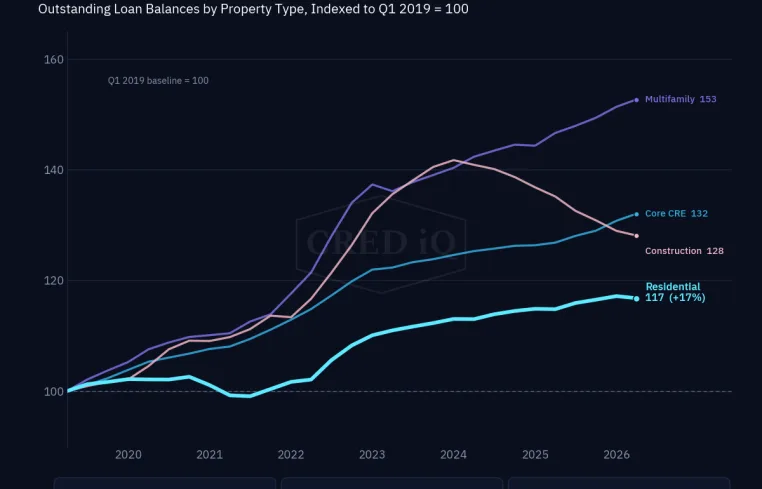
- US multifamily loan balances rose 53% from Q1 2019 to Q1 2026, the fastest percentage growth among CRE asset classes.
- Core commercial and residential categories each added over $440B in balance sheet debt, while multifamily gained $229B.
- Growth patterns highlight shifting risk exposure and changing priorities across bank loan portfolios amid broader lending volatility.
Bank Lending Exposures Reshaped
According to the Commercial Observer, CRED iQ reported that US bank real estate loan balances hit $6.14T in Q1 2026, marking a significant evolution in the composition of CRE and residential debt since 2019. Multifamily lending posted the highest percentage increase, but the largest absolute gains occurred in core commercial and residential categories. These shifts underscore a realignment of risk and focus within US bank real estate portfolios as lending priorities adapt to evolving market conditions.
Get Smarter about what matters in CRE
Stay ahead of trends in commercial real estate with CRE Daily – the free newsletter delivering everything you need to start your day in just 5-minutes
The Details
By the first quarter of 2026, multifamily loan balances indexed at 153 (a 53% jump versus 2019), core CRE at 132 (up 32%), and construction and development at 128 (up 28%). Residential, spanning one- to four-family properties plus home equity, reached an index of 117, a 17% rise. Despite multifamily’s rapid percentage ascent to $665B, it remains much smaller in absolute dollars than residential ($3.1T) and core CRE ($1.92T). Residential and core CRE both expanded by over $440B in loans since 2019, while multifamily gained $229B and construction landed at $453B.
Source: CRED iQ
Percentage Growth Versus Absolute Dollar Change
The difference between percentage expansion and dollar growth exposes where risk is most pronounced. While multifamily leads in proportional growth, both residential and core CRE added more net debt—around $445B and $467B respectively since Q1 2019—due to their larger starting base. Multifamily’s growth reflects sectoral enthusiasm but leaves banks with far larger overall exposures to housing and mainline commercial sectors, aligning risk not just with growth trends but portfolio maturity as well.
Why It Matters
Multifamily’s 53% upswing sharpens focus on how quickly banks have pivoted into rental housing. Tight for-sale inventory and shifting demographics supported this expansion. Yet multifamily loan totals remain dwarfed by residential’s $3.1T and core CRE’s $1.92T. Meanwhile, rising CMBS distress across major US metros highlights mounting credit pressure within these larger commercial exposures. Core CRE and residential together now comprise roughly 79% of all US bank real estate lending.
The construction and development segment is following a different track. Balances reached an index of 142 in 2024 before falling to 128 by early 2026. This reversal signals a retreat from aggressive development lending as higher rates and weaker demand encourage caution. The divergence matters for investors because portfolio risk depends on both growth rates and total dollar exposure.
What’s Next
Banks will likely keep a close eye on multifamily fundamentals as vacancy ticks up and rent growth slows. The disproportionate percentage surge in multifamily, set against far larger exposures in residential and core CRE, could influence future credit risk assessments, stress testing, and underwriting standards. Borrowers and investors should anticipate more granular risk modeling by lenders, particularly for asset classes showing sharp recent expansion. Watch for further realignment as liquidity, rates, and regulatory fears continue to reshape lending appetites across US CRE segments in the second half of 2026.