



- US apartment rents fell 0.03% to $1,751 in August, ending eight consecutive months of national rent increases.
- The Pacific Northwest and Midwest led annual regional growth at 2.2%, while 31 of the top 50 markets declined monthly.
- Elevated but easing inventory continues to restrain national pricing, leaving local supply conditions as the main differentiator.
US apartment rents edged lower in August after eight straight monthly increases, Commercial Observer reported. The August rent report from Apartments.com showed the national average falling 0.03% to $1,751.
Get Smarter about what matters in CRE
Stay ahead of trends in commercial real estate with CRE Daily – the free newsletter delivering everything you need to start your day in just 5-minutes
The Details
The $1 monthly decline brought the national average down from July’s revised $1,752 level. Apartments.com said late-summer rent declines have also appeared in each year since 2024.
However, August 2026 was milder than the prior two years. The report compared the 0.03% decline with drops of 0.1% in August 2024 and 0.2% in August 2025.
Apartments.com said that smaller decline suggests improved pricing conditions. Annual rents also continued to rise despite elevated supply levels limiting stronger national growth.
The national change was small in dollar terms, but it ended eight consecutive months of monthly increases. That makes the seasonal timing more important than the size of the decline alone.
West Coast Markets Still Advance
The Pacific Northwest and Midwest posted the strongest regional annual growth in August at 2.2% each. The Northeast followed with a 2% year-over-year increase.
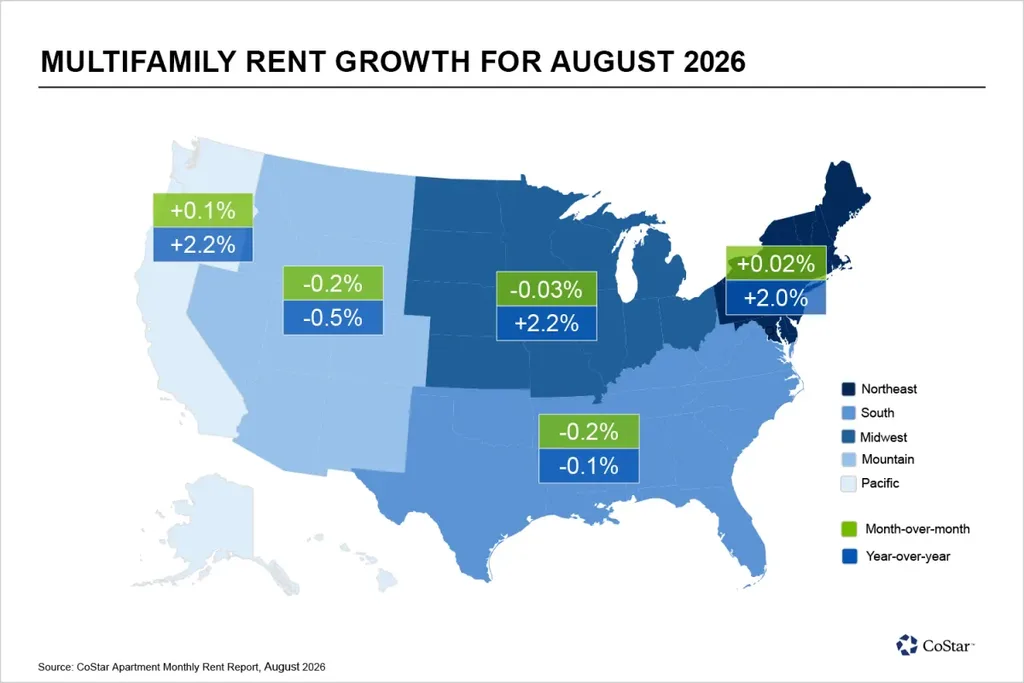
Monthly gains were less widespread. Of the 50 largest markets, 12 recorded increases, seven were unchanged, and 31 posted declines.
Several California markets bucked the national monthly drop. Orange County rents rose 0.6%, San Francisco increased 0.4%, East Bay gained 0.3%, and San Jose rose 0.2%.
Chicago also increased 0.2% for the month. On an annual basis, San Francisco led the country with 11.9% rent growth, followed by San Jose at 7.7%.
Those annual West Coast gains stand out against the broader monthly cooling. They also show how local supply conditions can outweigh the national direction for individual markets.
Why It Matters
New supply remains a key constraint on rent growth. Apartments.com said elevated inventory continues to moderate pricing even as most markets move beyond peak construction activity.
The August data therefore shows two conditions at once. National monthly rents have softened, but year-over-year performance remains positive and varies sharply by local supply.
For owners, that makes market selection more important than the national average. West Coast and Midwest readings show that some regions still have meaningful pricing momentum.
The report described annual performance as stronger across every region even though the breadth of monthly gains narrowed. That divergence is consistent with a market still absorbing elevated inventory.
What’s Next
Apartments.com expects the inventory overhang to keep easing gradually rather than disappear quickly. That supply backdrop will remain central as the summer leasing season closes.
The next monthly readings will show whether August was another seasonal dip or the start of broader softness. Local construction and inventory levels will continue to shape the outcome.