





- Texas Gov. Greg Abbott ordered ERCOT and state regulators to audit large-load projects and temporarily halt new data center grid connections.
- The state has 171 data centers under construction and 878 planned, while ERCOT is evaluating 474 GW of large-project power requests, about 90% tied to data centers.
- The pause could squeeze speculative developers while boosting established firms with approved interconnections, financing and behind-the-meter power options.
Texas data centers are entering a new phase as Gov. Greg Abbott moves to scrutinize their electricity demands without formally blocking development, as indicated by Bisnow. The Aug. 11 directive pauses new grid connections while ERCOT and the Public Utility Commission of Texas audit projects, creating a near-term hurdle for developers but potentially clearing an overloaded pipeline.
Get Smarter About What Matters in Texas
Subscribe to our free newsletter covering the biggest commercial real estate stories across Texas — delivered in just 5 minutes.
A power pause, not a construction ban:
Abbott’s directive does not stop developers from building. Instead, it pauses new grid connections while regulators gather more information about proposed projects. The audit covers power and water use, ownership, tax incentives and efforts to limit impacts on nearby communities.
That distinction matters. Dan Walters, a professor of energy law at Texas A&M University School of Law, sees the move as a potential cleanup of an overcrowded interconnection queue. He does not view it as a retreat from Texas’ data center strategy. Walters expects some short-term delays but does not believe the move will hurt Texas’ reputation as a data center destination.
The details: Texas’ pipeline keeps expanding
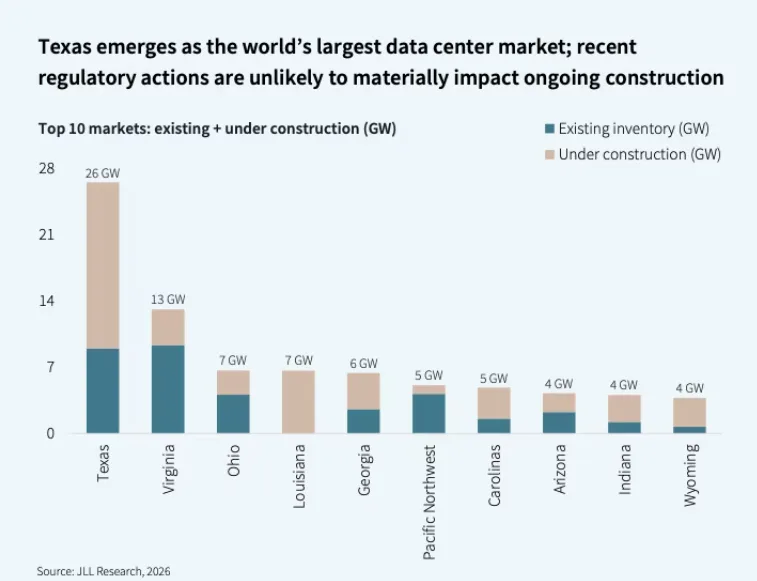
Texas has 171 data centers under construction and another 878 planned, compared with 144 under construction and 545 planned in Virginia, according to Aterio. JLL’s midyear 2026 data center report also found that Texas’ construction pipeline will more than double its existing inventory. That puts the state on track to become the world’s largest data center market by pipeline.
Power demand is driving the scrutiny. ERCOT’s peak load reached a record 91.1 GW in late July 2026. The grid is also considering more than 474 GW of power requests from large projects, according to Abbott’s directive. About 90% of those requests are tied to data centers.
Texas remains attractive for several reasons. Relatively low electricity costs, abundant land and a business-friendly environment have made the state a leading destination for artificial intelligence and cloud infrastructure.
A new advantage for established developers:
The new rules could widen the gap between well-capitalized developers and speculative projects. Some developers secured land before securing a reliable path to power. Those projects now face greater uncertainty.
Mark McNees, a Florida State University researcher who has studied data center cost allocation across 13 states, said the audit could help officials separate viable projects from those that exist largely on paper.
Established developers may have an advantage. Firms with financing, documented plans and credible power strategies should be better equipped to meet the new requirements. Speculators waiting for future grid capacity could lose leverage.
Texas lawmakers already moved in this direction in 2025. A new law requires data centers and other large-load customers to contribute to interconnection costs when they use the state’s grid.
Behind-the-meter power gets more valuable:
The pause could accelerate another trend: developers generating power outside the public transmission network. Texas already leads the U.S. in announced behind-the-meter data center capacity, with 40 GW, according to CleanView.
That strategy has financial and environmental implications. Meta’s planned 1 GW data center outside El Paso, for example, is expected to initially use an on-site plant with 800 natural-gas generators, according to The New York Times.
Brian Chen, vice president of sales at Stewart Title’s energy and infrastructure group, said projects with approved grid power and additional on-site generation have become more valuable under the new rules. Those alternatives include natural gas and solar power.
Why it matters: Power is becoming a development constraint:
Texas’ data center boom is running into growing concerns about grid reliability. JLL’s 2026 midyear report found that 79% of respondents support the U.S. maintaining a leading role in artificial intelligence. Only 14% support data center development in their own communities.
That gap helps explain the political pressure on Abbott, who is seeking reelection in November 2026. A June 2026 poll found that only 29% of Texans supported building a data center in their community.
For developers, the message is clear: power access now matters as much as land, capital and fiber. Projects with credible electricity strategies could gain an edge as regulators and communities demand more accountability for infrastructure costs and grid reliability.
What’s next: The queue gets tested:
The key question is how quickly ERCOT and the PUC can complete the audits. Officials must determine which projects should receive grid connections and under what conditions.
The review could slow some construction starts while making projects with approved power and alternative generation more attractive. But the broader pipeline is unlikely to disappear.
As Walters noted, the investments are still likely to happen. The bigger question is where they will happen. For Texas, that could mean fewer speculative projects, more sophisticated power strategies and continued data center growth—with a higher bar for connecting to the grid.