





- Super-regional banks reported commercial loan growth and higher net interest income in Q2 2026, indicating renewed lending momentum.
- Improvements in credit costs were broad-based, but CRE nonperforming loans increased at select banks even as overall charge-offs declined.
- The divergence in CRE asset quality signals the need for close monitoring as headline measures may mask underlying risk trends for the sector.
Mergers and Acquisition Activity Shapes Bank Results
Super-regional banks reported stronger commercial loan activity in Q2 2026, according to Trepp. However, major acquisitions complicated year-over-year comparisons. Fifth Third absorbed Comerica. Huntington added Veritex and Cadence. PNC acquired FirstBank of Lakewood. U.S. Bancorp completed its BTIG acquisition.
Zions and PNC also recorded sizable one-time Visa-related gains. Even so, underlying business trends improved. Net interest margin expanded at more than half the banks. Every institution posted year-over-year revenue growth, highlighting resilient commercial credit demand despite rate uncertainty.
Get Smarter about what matters in CRE
Stay ahead of trends in commercial real estate with CRE Daily – the free newsletter delivering everything you need to start your day in just 5-minutes
The Details
Net interest income increased sequentially at all 11 super-regional banks during Q2 2026. Citizens and PNC each reported a 4% increase. Fifth Third posted a 14% gain after consolidating Comerica.
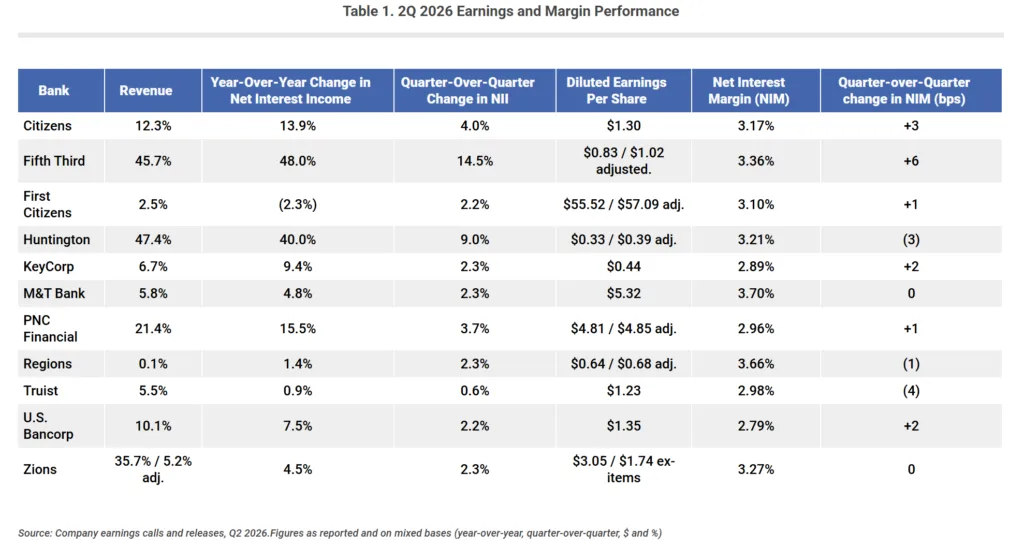
PNC grew total revenue 21%, supported by the FirstBank acquisition and its Visa gain. Zions increased revenue 36%, including $252M in pretax notable items. Net charge-off ratios declined at eight banks. Credit loss allowances also fell at 10 of 11 institutions, signaling improving credit conditions after earlier office market stress.
Still, several banks reported weaker CRE metrics. Truist, U.S. Bancorp, and KeyCorp each recorded higher CRE nonperforming assets, even as overall charge-offs declined.
Commercial Lending Grows, But CRE Credit Metrics Split
Second-quarter results showed a widening gap across commercial lending portfolios. C&I balances, especially at Huntington, drove much of the loan growth. In some cases, they also increased nonperforming assets.
CRE performance varied more widely. Citizens reduced its CRE charge-off rate to 0.36% from 0.64%. PNC lowered nonperforming CRE balances and reduced total nonperforming loans by 10%.
Meanwhile, Huntington, KeyCorp, and Fifth Third each reported modest increases in nonperforming asset ratios. Some rose by double-digit basis points. These results suggest uneven stress tied to legacy office and multifamily exposure. They also show that improving headline credit costs can hide portfolio-specific risks.
Why It Matters
Q2 results point to a cautiously improving outlook for super-regional banks. However, commercial real estate finance still faces meaningful challenges. Trepp noted lower net charge-off ratios and reduced provisioning at 10 of 11 banks. Those trends suggest new credit stress remains contained. They also align with Federal Reserve comments that office sector weakness remains manageable for diversified lenders.
Still, CRE investors and lenders should stay cautious. Some banks continue reporting rising nonperforming real estate assets. Strong C&I lending may also mask weakness in office portfolios and flatter overall asset quality. That contrasts with other regional lenders that reduced commercial real estate exposure while working through problem loans.
PNC’s 10% decline in total nonperforming loans and Citizens’ 0.36% CRE charge-off rate stand out. However, KeyCorp and Huntington reported nonperforming asset ratio increases of 11 and 13 basis points. Those results highlight portfolio-specific risks. As commercial lending accelerates, selective CRE stress remains a key concern, especially in markets still adjusting after the pandemic.
For CRE professionals, this quarter’s credit improvement may not tell the full story. Legacy office vacancies, valuation resets, and hidden exposures could quickly change conditions. Acquisition integration adds another layer of uncertainty. Active risk monitoring remains essential for lenders and property owners.
What’s Next
Banks will likely expand relationship-driven commercial lending as loan growth and credit metrics improve. That trend could support transaction activity through the rest of 2026. Trepp plans deeper analysis of CRE originations and pricing trends across C&I and property-backed lending in coming quarters.
The key question remains whether commercial loan demand can sustain current momentum. Market share gains and renewed credit line usage may only provide temporary support. Meanwhile, asset quality across office properties and weaker submarkets will remain under close watch through Q3 and beyond.