







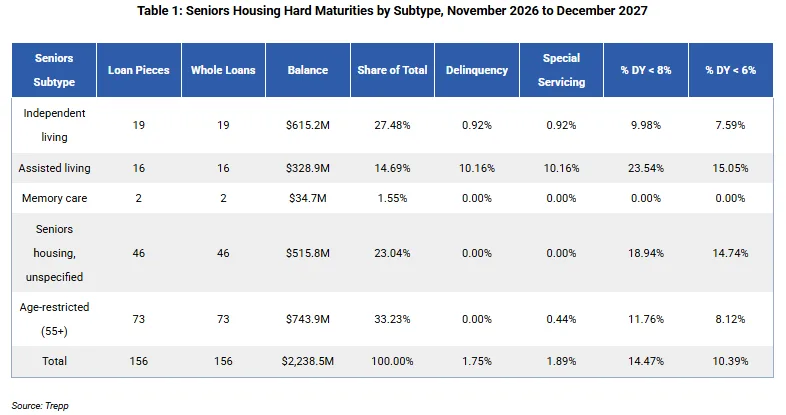
- Trepp counts $2.24B of securitized seniors housing debt across 156 loans reaching hard maturity from November 2026 to December 2027, meaning no extension options remain and borrowers must repay or renegotiate.
- Only 1.75% of the balance is delinquent, but 14.47% carries a debt yield below 8% and 10.39% below 6%, and assisted living shows the highest delinquency at 10.16%.
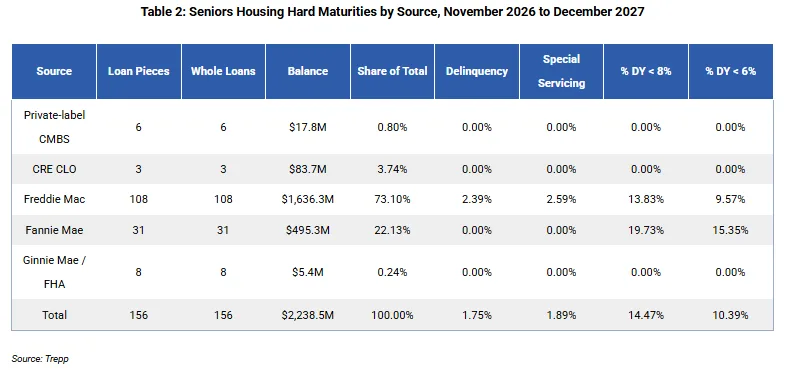
- Freddie Mac holds $1.64B and Fannie Mae $495.3M, so refinancing outcomes at the agencies will shape credit performance, with Fannie showing the larger share of thin debt yields.
A wave of seniors housing debt is headed for maturity: $2.24B across 156 securitized loans from November 2026 through December 2027, according to Trepp.
Agency-backed debt is over 95% of the total, and only 1.75% is delinquent.
Get Smarter about what matters in CRE
Stay ahead of trends in commercial real estate with CRE Daily – the free newsletter delivering everything you need to start your day in just 5-minutes
What Hard Maturity Means
A hard maturity is a loan with no extension options left. The borrower has to repay or work out another deal with the lender.
Trepp’s cohort uses modeled maturity dates that reflect extensions already signed, and leaves out loans in foreclosure or REO.
By Property Type
Age-restricted 55+ properties carry the most at $743.9M, or 33.23%. Independent living follows with $615.2M and unspecified subtypes hold $515.8M, because Fannie Mae doesn’t report subtypes in this dataset.
Assisted living adds $328.9M and memory care $34.7M.
Thin Debt Yields
Refinancing is the risk. Debt yields under 8% cover 14.47% of what’s coming due, and yields under 6% cover 10.39%.
Of the $232.7M below 6%, $193.6M is still current. The nearest wave is $140.2M across 19 loans in November and December 2026, and 47.47% of it is below 6%, though every loan is current.
Trepp’s separate look at floating-rate apartment loans found the same pattern in Texas, where 25.3% of performing Agency loans report a DSCR below 1.0x but keep paying.
Assisted Living Is the Weak Spot
Assisted living has the highest delinquency among identified subtypes, at 10.16% of its balance. And 23.54% of it, about $77.4M, has a debt yield below 8%.
Two loans make up all $39.1M of delinquent debt. One is $33.4M on The Point at Rockridge in Oakland, Calif., with a 1.77% debt yield. It was extended to February 2027 and went to the special servicer that month, and the borrower is now current on modified payments, per Trepp.
The other is $5.7M on Corinthians Retirement Community in Carrollton, Texas, 60 days late with a 1.19% debt yield.
Agencies Own the Exposure
Freddie Mac holds $1.64B, or 73.10%, and Fannie Mae $495.3M, or 22.13%. CRE CLOs ($83.7M), private-label CMBS ($17.8M) and Ginnie Mae/FHA loans ($5.4M) fill out the rest.
Freddie’s share is larger, but Fannie’s balance is thinner on yield. Some 19.73% of Fannie’s maturing debt has a debt yield below 8%, versus 13.83% at Freddie.
Why It Matters
Capital has chased the sector’s demographics. CRE Daily’s coverage of Kayne Anderson’s Fund VII noted $2.5B raised toward a $4B cap, with supply expected to fall short by more than 300K units in five years.
Strong demand doesn’t fix a debt yield of 6%. Refinancing at today’s rates will test borrowers on thinner coverage.
What’s Next
With so little delinquent today, the 2027 refinancings are the real test. Trepp says agency outcomes will be the key read on credit performance.