



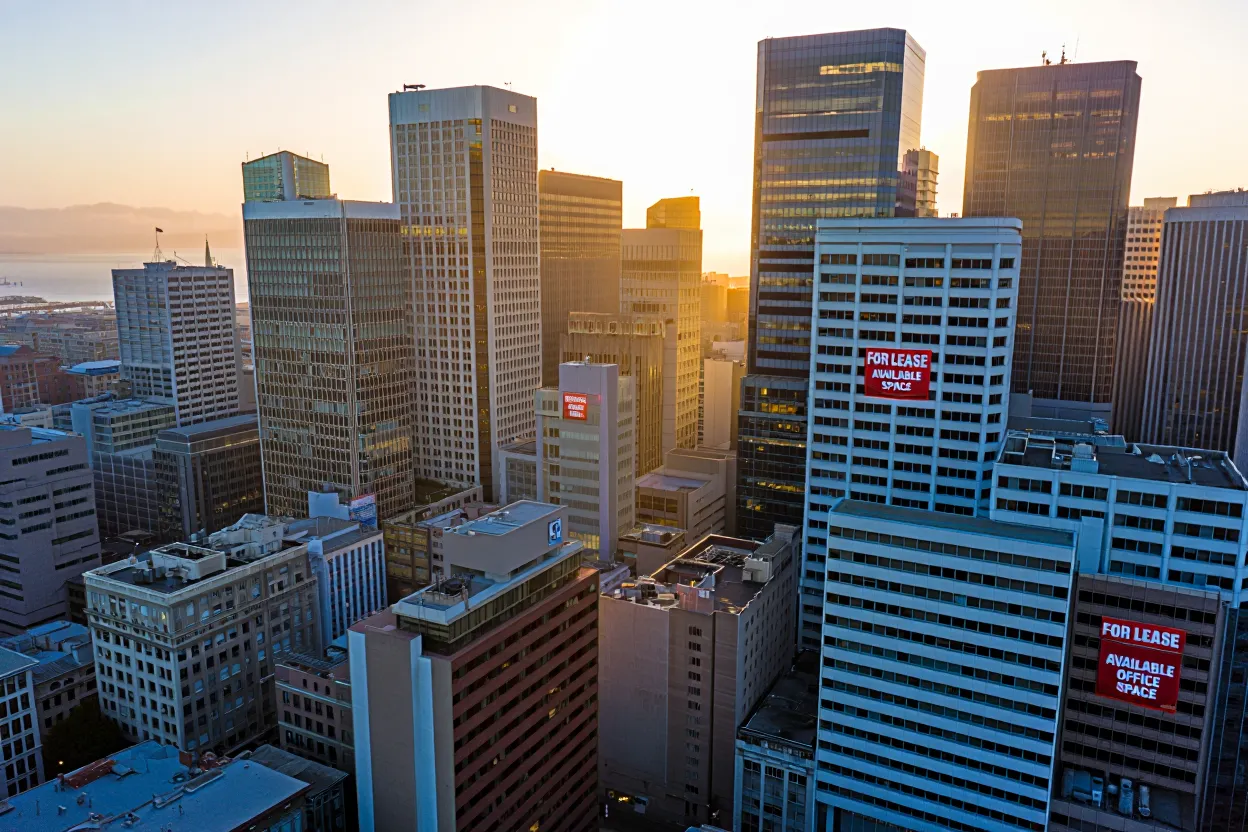
- San Francisco office CMBS delinquency fell to 6.63% in June 2026, well below the national average of 11.53%, per Trepp data.
- AI-driven leasing has fueled record absorption and deal volume, with over 7.5M SF leased by AI firms and submarkets like Mission Bay reporting vacancy below 9%.
- Institutional capital flows and strong loan originations signal that while recovery is uneven, San Francisco’s floor is in—unlike slower-recovering peers like LA and Chicago.
Leasing, loan performance, and renewed investment are building an evidence-based case for San Francisco’s commercial real estate recovery. According to a June 2026 Trepp report, the metro’s office CMBS delinquency rate is now 6.63%—about half the US office average—and office absorption, led by AI demand, has surged back to 2019 levels.
With institutional capital flowing in and submarket-level vacancy plummeting in AI-centric districts, San Francisco may be emerging as the first gateway market to find its cyclical bottom.
Even so, legacy pain points remain for CRE lenders and owners alike. The same Trepp data shows that San Francisco still suffers from high-profile foreclosures and distressed multifamily assets, with retail and hotel sectors stabilizing more gradually.
The city’s uneven comeback, fueled by tech and AI absorption in select corridors, stands in contrast to continued distress in peer metros like Chicago, Los Angeles, Seattle, and Portland.
Get Smarter about what matters in CRE
Stay ahead of trends in commercial real estate with CRE Daily – the free newsletter delivering everything you need to start your day in just 5-minutes
The Fall Was Real, and So Is the Floor
San Francisco’s CRE downturn hit every major asset class. Office originations vanished, sales volume collapsed, and major retail and hotel assets struggled with tenant exits and loan defaults.
Several examples show the scale of the decline. Trepp tracked the $725M Hilton San Francisco Union Square loan. Its appraised value fell from $1.56B in 2016 to $489M by March 2026. Occupancy and cash flow also dropped sharply.
Multifamily faced similar stress. The Parcmerced loan, San Francisco’s largest single-asset CMBS multifamily workout, covers 3,221 units. The property remained in foreclosure through mid-2026. Occupancy only recovered after a court-appointed receiver invested $70M in emergency capital improvements.
Retail also deteriorated quickly. Flagship assets such as One Stockton fell to 0% occupancy and generated negative NOI. The speed of that decline highlighted how fragile the market had become.
However, Trepp’s latest loan data suggests the distress cycle may have peaked. A market floor now appears to be forming.
The Details
Recent data paints a clearer picture of San Francisco’s recovery.
Trepp tracked $12.1B in outstanding San Francisco office CMBS loans. The market posted a 6.63% delinquency rate and 84% average occupancy. Both metrics outperformed national averages.
Brokerage data from Kidder Mathews showed Q1 2026 office vacancy falling to 28%. That marked a 370-basis-point improvement from a year earlier.
Net absorption reached nearly 800,000 SF, the strongest result since 2019. Leasing volume climbed above 3.4M SF, rising 43% year over year.
CBRE reported 4.1M SF of gross leasing during the quarter. That was the highest quarterly total since Q2 2019. The market also recorded nine leases exceeding 100,000 SF, setting a new record.
JLL reported 1.6M SF of net absorption. That made San Francisco the largest contributor to US office absorption during the quarter.
Sublease availability also improved. Cushman & Wakefield reported that San Francisco reduced available sublease space by 2.2M SF year over year, the largest decline nationally.
AI Tenants Fuel Bifurcated Recovery
AI and technology leasing now drive the market’s recovery.
CBRE reported that AI companies accounted for roughly one-quarter of all leased office space in 2025. Those firms also represented more than 80% of newly leased space.
AI tenants signed more than 500,000 SF of deals during early 2026. Total active AI leases now exceed 7.5M SF, up 28% from 2020 levels.
Mission Bay vacancy fell below 9%. The Presidio, now heavily occupied by venture capital firms, reports vacancy below 2%.
This recovery differs from earlier tech cycles. BXP’s president noted that tenants now favor flexible mid-rise buildings over trophy towers.
As a result, performance varies sharply across submarkets. Core districts continue tightening while older Financial District assets remain under pressure.
Why It Matters
For investors and lenders, these trends materially change the risk profile.
The market floor looks stronger than at any point since the pandemic downturn. San Francisco office loans now outperform national averages for both occupancy and delinquency.
National office CMBS delinquency stands at 11.53%. San Francisco sits at 6.63%, while AI-focused submarkets perform even better. That momentum mirrors broader leasing gains now reshaping both San Francisco and Manhattan office markets.
Retail recovery remains slower. Still, broader metro occupancy exceeds 93%. Most retail distress remains concentrated within a single mall property.
Hotels continue recovering gradually. Occupancy remains below pre-pandemic levels but has climbed to nearly 69%.
Multifamily data also requires context. The large Parcmerced default heavily distorts market delinquency figures. Excluding that loan lowers the marketwide rate closer to 1%.
Lenders have already responded. San Francisco led all major US markets in multifamily CMBS originations last quarter with $599M. That figure nearly tripled the next-largest market, according to Trepp.
Institutional investors have also returned. JLL ranked San Francisco as the second-most targeted office investment market in the country.
These figures support a broader stabilization story rather than a temporary rebound. The contrast with peer markets remains striking.
Seattle’s office CMBS delinquency rate stands at 13.16%. Portland sits at 45.53%. Los Angeles and Chicago continue adding new defaults to the pipeline.
What’s Next
AI demand and returning capital will determine the next stage of recovery.
Watch for continued absorption in prime AI corridors. At the same time, legacy Class A towers may continue lagging broader market improvements.
The next major test arrives over the next 18 to 24 months. Large tenants such as LinkedIn will approach lease expirations during that period.
The key question is whether AI and technology firms absorb that space.
Institutional investors have already started placing bets. Firms like DivcoWest and Blackstone are actively pursuing repositioning opportunities.
For now, leasing velocity, deal flow, and capital markets remain the key indicators.
The data increasingly suggests that San Francisco commercial real estate is back. The recovery simply remains concentrated in the places where new technology companies want to operate.