






- REIT net acquisitions have trended upward since reaching a recent low in Q3 2024, while gross acquisitions and dispositions also increased.
- Public REITs can move capital without relying as heavily on fundraising cycles, making their transaction activity a useful market signal.
- Nareit expects broader CRE activity to improve as public and private valuations move closer and capital costs become more favorable.
Public REIT property transactions are moving higher after a prolonged slowdown. Nareit says its REIT Industry Tracker data show net acquisitions rising from a Q3 2024 low. Gross purchases and dispositions have generally increased since then as well. The shift comes despite elevated interest rates, economic uncertainty and a continued gap between public and private real estate values.
Get Smarter about what matters in CRE
Stay ahead of trends in commercial real estate with CRE Daily – the free newsletter delivering everything you need to start your day in just 5-minutes
REIT Activity Turns Higher
REITs have historically been active buyers and sellers across real estate cycles. They have usually remained net buyers. The global financial crisis marked the last extended period when the group became a net seller. REITs also prune portfolios through dispositions even in stronger markets. That makes the recent increase in both sides of the transaction ledger notable after several years of valuation and capital-market friction.
The Details
Nareit’s rolling four-quarter data covers acquisitions and dispositions across 13 REIT property sectors, excluding timberland. Net acquisitions are calculated by subtracting dispositions from gross acquisitions. Since the Q3 2024 trough, the measure has moved upward alongside broader transaction volumes.
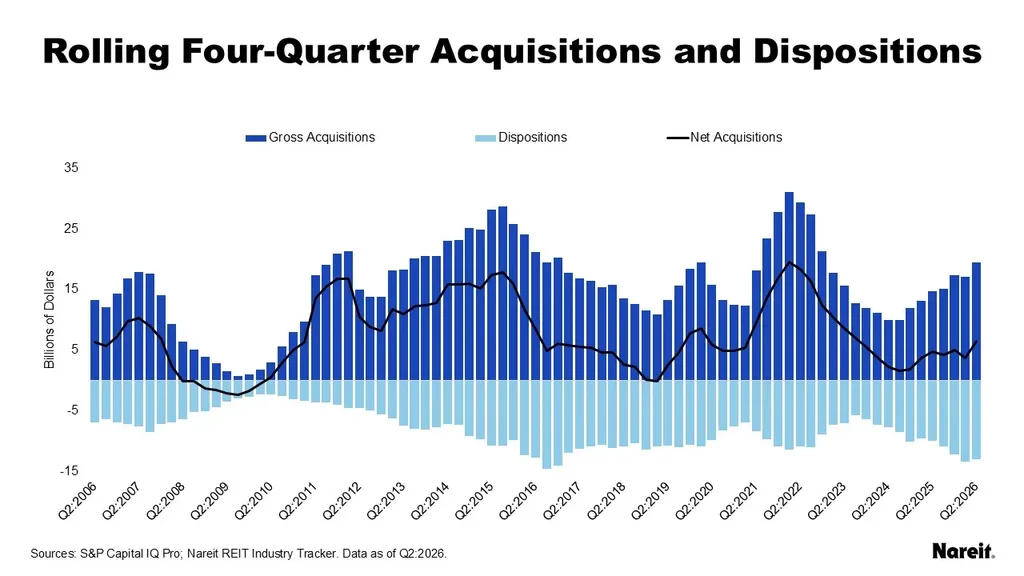
The pattern resembles earlier periods when REIT transaction activity improved as valuations and capital costs became more supportive. Nareit views that movement as a possible early signal that property markets are moving toward a more normal transaction environment.
Why It Matters
Public REITs provide a useful window into commercial property liquidity because they are ongoing capital allocators. They are generally less dependent on private fundraising cycles than many investment managers. That flexibility lets them respond more directly to changes in pricing, financing and relative value. Rising activity does not prove the entire market has recovered. It does show more buyers and sellers are finding prices that allow transactions to close.
What’s Next
Nareit expects broader CRE transaction activity to accelerate as public and private property values become more aligned. The group also points to solid operations and disciplined balance sheets. Access to cost-advantaged capital is another support. If those conditions keep improving, public REITs could continue expanding portfolios while the wider property market moves closer to normal transaction levels.