



- Manhattan’s coworking supply shrank by 200,800 SF in Q2 2026, while Brooklyn and Queens saw inventory gains.
- Average per-desk rates in Manhattan rose 4.6% to $821, with Lower Manhattan hitting $947—the city’s highest.
- Overall New York City office rents continue to outpace national averages, with Brooklyn fundamentals narrowing the gap.
Borough Shifts Redefine NYC Coworking Landscape
According to CPE, New York City’s coworking sector continues to show uneven performance. Citywide coworking, creative office, and shared lab inventory fell to 15.2M SF in Q2 2026 from 15.3M SF in Q1. However, the decline reflects mixed results across the boroughs.
Coworking footprints expanded almost everywhere except Manhattan. The borough recorded the only inventory decline. This shift reflects changing tenant preferences as companies favor smaller, flexible office concepts. Meanwhile, strong demand in the outer boroughs continues to reshape the city’s workspace landscape.
Get Smarter About What Matters in New York
Subscribe to our free newsletter covering the biggest commercial real estate stories across the five boroughs — delivered in just 5 minutes.
The Details
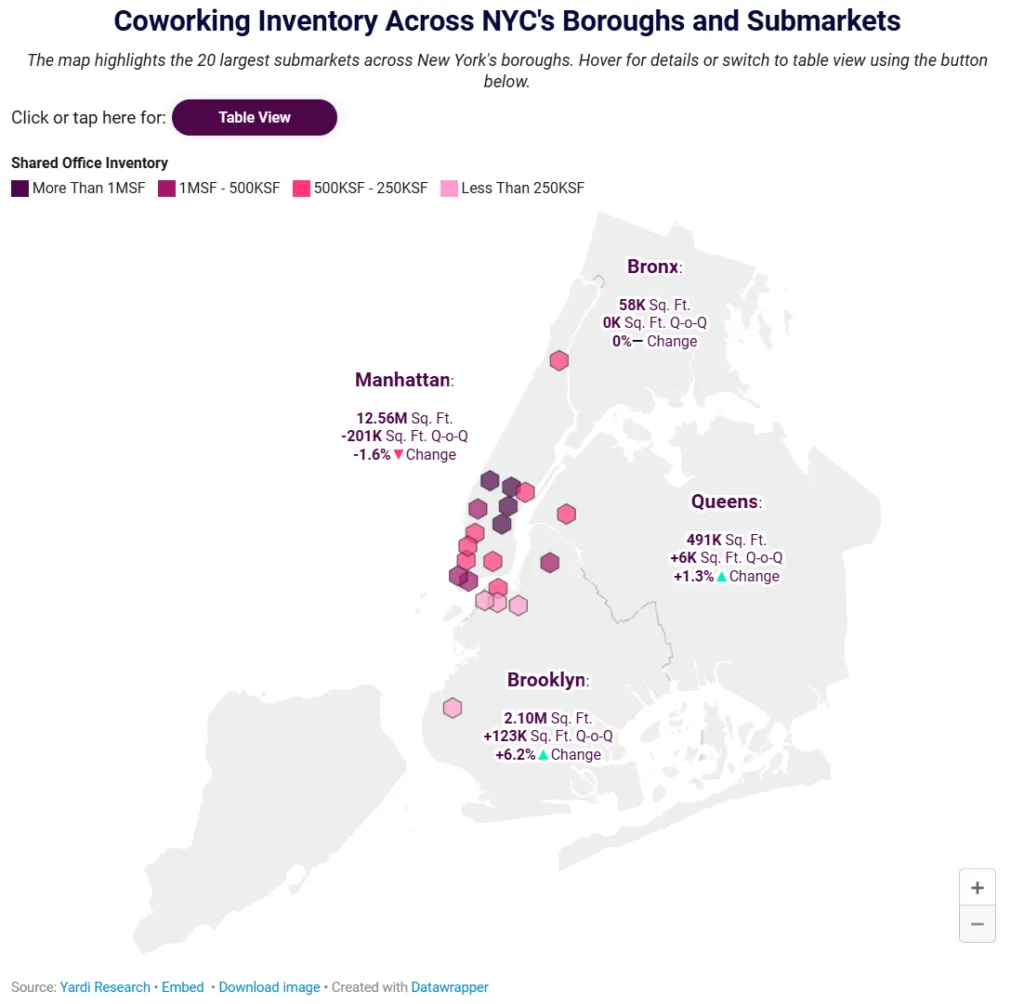
According to Hubble, Manhattan lost a net 200,800 SF of coworking and flexible office space. World Trade Center lost 61,900 SF. United Nations-Turtle Bay shed 64,500 SF. Times Square-Hell’s Kitchen dropped 73,900 SF. However, Gramercy Park added 27,800 SF, while Greenwich Village gained 62,000 SF.
Outside Manhattan, Brooklyn posted the strongest growth. The borough added 122,600 SF, increasing inventory 6.2% quarter over quarter to 2.1M SF. Queens expanded 1.3%. Meanwhile, the Bronx recorded no inventory change.
Pricing Power Shifts by Location
Manhattan’s shrinking coworking inventory failed to slow pricing. Instead, the average private office desk rate climbed 4.6% quarter over quarter to $821. Lower Manhattan reached a record $947 per desk after a 15.7% increase. Brooklyn remained stable, with average pricing rising from $716 to $720.
These trends mirror the broader office market. Manhattan’s traditional office rents reached $72 PSF, more than double the US average of $33.67. The Plaza District led at $107.46 PSF, followed by Chelsea and SoHo. Brooklyn office rents rose 6.9%. Queens gained 4.6%, while the Bronx slipped 0.4%.
Why It Matters
The gap between Manhattan and the outer boroughs highlights changing workplace strategies. Manhattan lost 200,800 SF while private office pricing climbed sharply. These trends suggest tenants still value premium space. However, operators appear more cautious about maintaining large footprints.
Brooklyn tells a different story. The borough expanded 6.2% to 2.1M SF, while Queens continued to grow. Flexible workspace has become a mainstream option beyond Manhattan. As a result, more companies now consider outer boroughs for new office locations.
This shift extends beyond coworking. Traditional office fundamentals also improved in Brooklyn and Queens. Manhattan still commands average asking rents of $72 PSF. Residential demand has also remained resilient, with Manhattan and Brooklyn continuing to lead the city’s rent growth. Meanwhile, Brooklyn’s 6.9% quarterly rent growth shows tenants remain willing to lease outside the city’s core. Lower Manhattan now leads private office pricing at $947 per desk. Consequently, affordability and location flexibility have become key priorities for occupiers.
What’s Next
If Manhattan’s coworking decline proves temporary, operators will likely adjust portfolios to match tenant demand instead of pursuing rapid expansion. Brooklyn and Queens should continue adding inventory as startups and small businesses drive leasing activity.
Market participants will closely watch upcoming quarterly data for signs of stabilization or renewed Manhattan growth. Traditional office rents remain well above national averages. At the same time, the outer boroughs continue strengthening their role in New York City’s hybrid work market.