







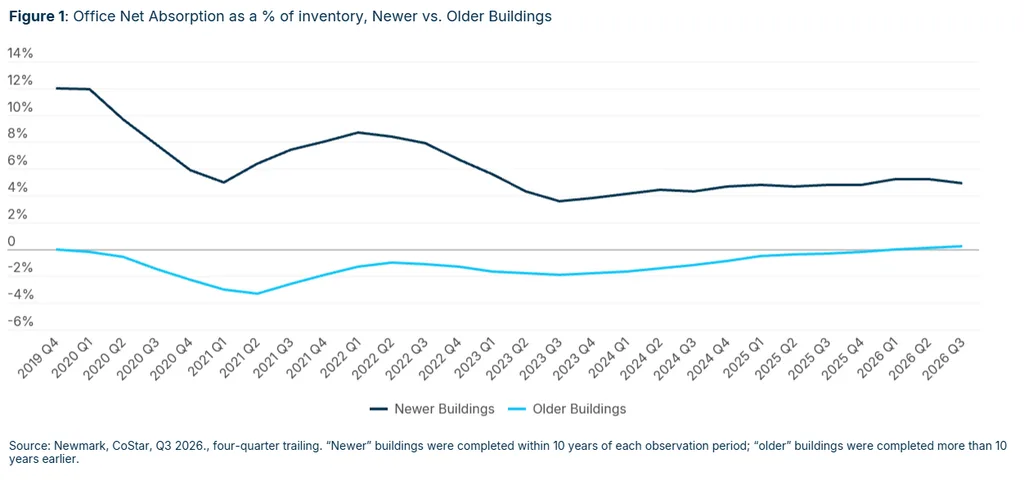
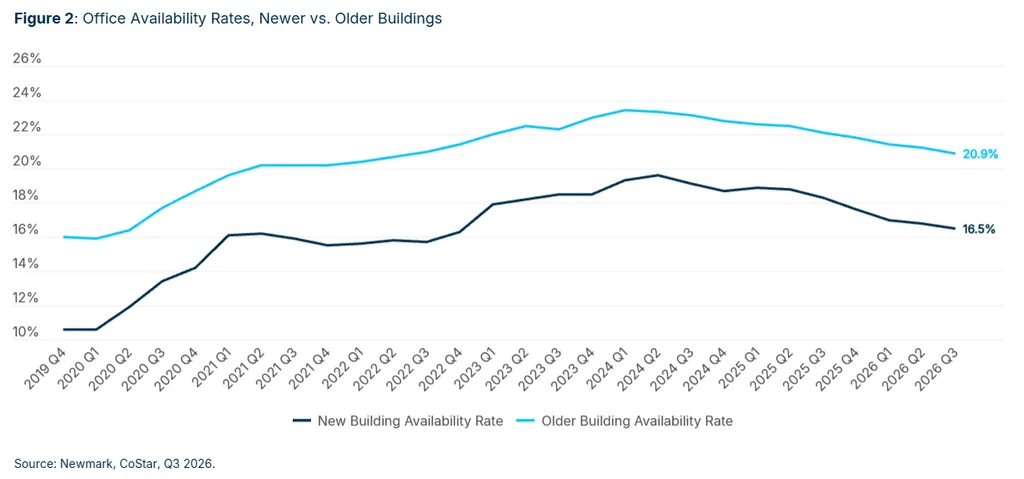
- Newmark says newer office buildings absorbed 4.9% of inventory over four quarters versus 0.2% for older ones, cutting newer-building availability to 16.5% from 23.4% at the 2024 peak.
- Office construction is at its lowest in over a decade, with 2026 deliveries of 12.3 million square feet versus a 40.4 million annual average from 2015 to 2019.
- Newer-building rents carry a 53% premium to the market, and tenants with 2028 to 2030 expirations may find fewer options than today’s availability suggests.
A thin office construction pipeline is narrowing options for tenants even with vacancy near record highs, according to a Newmark report.
Newer buildings are absorbing space far faster than older ones, and little new product is coming.
Get Smarter about what matters in CRE
Stay ahead of trends in commercial real estate with CRE Daily – the free newsletter delivering everything you need to start your day in just 5-minutes
Newer Buildings Lead
In Q3 2026, trailing four-quarter net absorption in buildings less than 10 years old equaled about 4.9% of inventory. Older buildings managed 0.2%.
Across 62 markets, newer-building availability fell to 16.5% from a 23.4% peak in 2024, still above the 10.6% pre-pandemic level. It now sits 4.4 percentage points below older properties.
Big Gaps by Market
In Palm Beach, newer-building availability is 3.3% against 15.1% overall. Houston’s is 7.7% versus 26.6%, and New York City’s is 8.4% versus 14.0%.
Newmark says higher availability elsewhere is mostly a near-term effect of just-delivered space leasing up.
A Decade-Low Pipeline
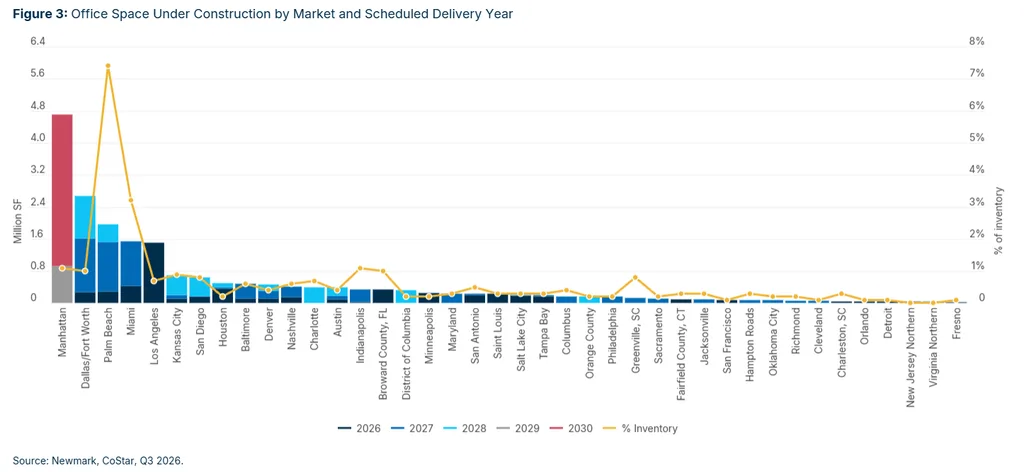
Just over 20M SF is under construction, the lowest in more than a decade. Newmark expects 12.3M SF to deliver in 2026, versus a 40.4M annual average from 2015 to 2019, and only 6.5M SF in 2027.
Construction is concentrated. Twenty-two markets, including Chicago, Atlanta and Seattle, have none underway. Dallas, Manhattan, Palm Beach, Miami and Los Angeles hold more than 60% of the total, and much of Manhattan’s space is already preleased.
Rent Premium Grows
Asking rents in newer buildings were 53% above the market average in Q3, compared with a 37% premium in Q1 2020. Newmark expects the premium to grow as occupiers pay up for efficiency and employee experience.
That demand picture matches Newmark’s early survey in which 60% of occupiers expect to add headcount, which we covered when it came out.
Why It Matters
For landlords, a thin pipeline can support lease-up, especially for well-positioned buildings, though Newmark says targeted upgrades must pencil against local demand and costs. For occupiers, today’s availability may overstate options at the next expiration.
The shift is visible in Manhattan, where vacancy fell to 12.6% in Q3, the lowest since before 2020, according to Commercial Observer.
What’s Next
Newmark advises tenants with leases expiring in 2028 to 2030 to reassess how availability, demand and deliveries may change their choices.