






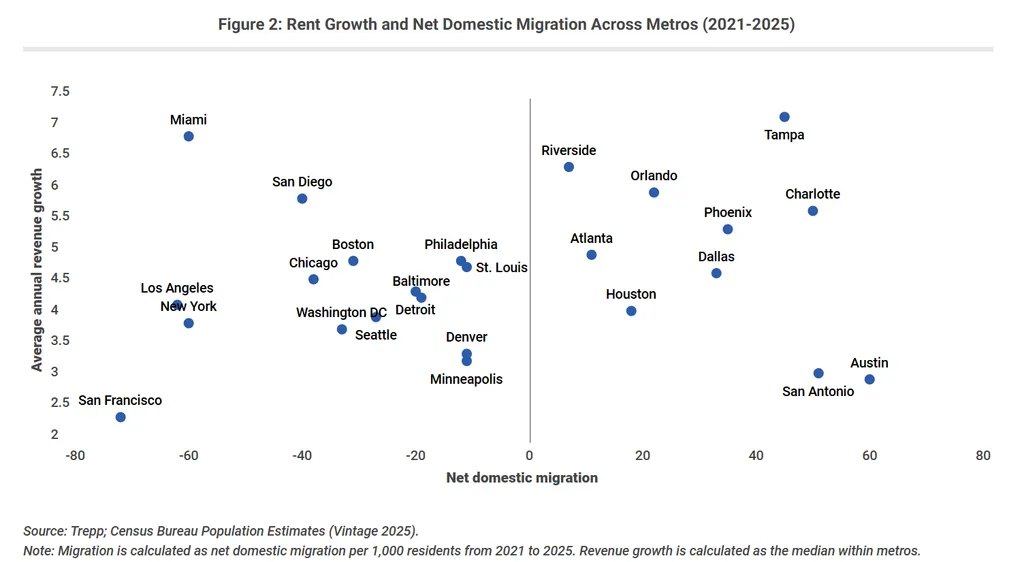
- Trepp found only a 0.16 correlation between cumulative domestic migration and average multifamily revenue growth from 2021 through 2025.
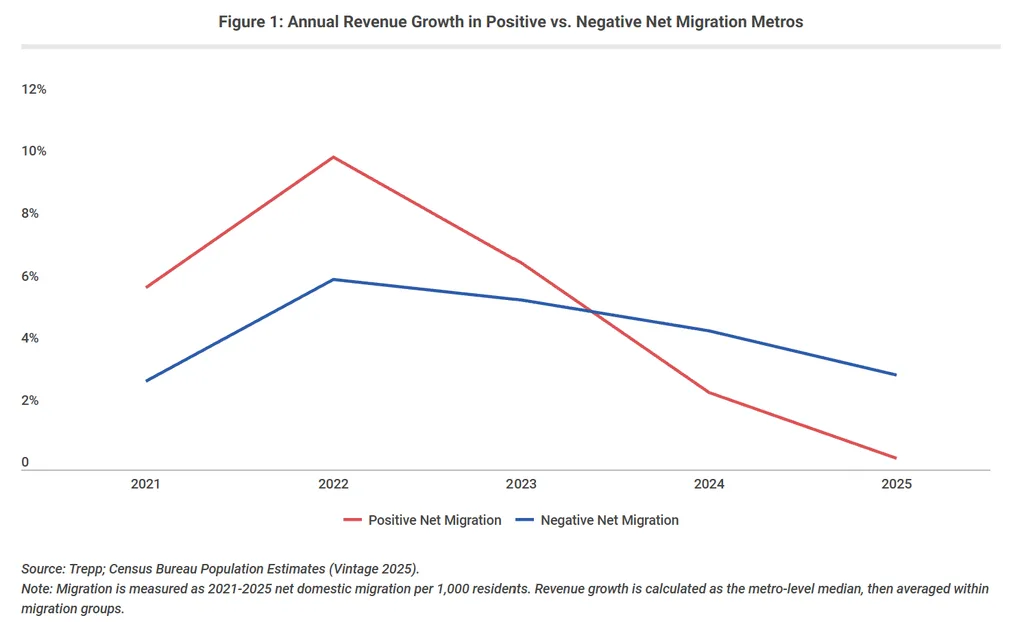
- High-inflow markets led revenue growth through 2023, but that advantage disappeared as apartment supply expanded in many fast-growth metros.
- Austin and Phoenix show that strong migration can coexist with negative revenue growth when construction outruns near-term demand.
Trepp’s multifamily migration analysis finds that population growth alone is a weak guide to apartment revenue performance. The study combines Census Bureau net domestic migration with Trepp property-level revenue data. It focuses on the 25 largest US metros.
Inflow markets led revenue growth through 2023. However, that advantage disappeared by 2024 and 2025 as new apartment supply caught up. Outflow metros attracted less construction and maintained steadier revenue growth throughout the period.
Net domestic migration measures moves into a metro from elsewhere in the country minus moves out. Census estimates cover annual migration through mid-2025. Trepp’s revenue series uses annual building-level financial data to compare population movement with property performance.
Get Smarter about what matters in CRE
Stay ahead of trends in commercial real estate with CRE Daily – the free newsletter delivering everything you need to start your day in just 5-minutes
Multifamily Migration Edge Fades
Trepp first divided the metros by cumulative domestic migration since 2021. Early results matched the standard demand story. Markets gaining residents generally produced faster revenue growth through 2023. More residents competed for existing housing, supporting occupancy, rents and property revenue.
However, the gap later closed. By 2024 and 2025, inflow metros had lost their earlier revenue-growth advantage. Outflow metros stayed comparatively steady across the full period. Many inflow markets instead gave back their earlier gains.
Trepp points to heavy apartment construction as an important part of the shift. Population growth strengthened demand but also encouraged developers to add units. As those apartments delivered, additional supply reduced the revenue advantage that migration initially created.
The Details
Trepp then compared each metro’s cumulative migration with average annual revenue growth from 2021 through 2025. The relationship remained positive, but the full-sample correlation was only 0.16. Inflow metros still tended to perform better, but the connection was modest.
Austin, San Antonio and Miami heavily influenced the result. Austin and San Antonio combined strong inflows with relatively weak average revenue growth. Miami showed the reverse pattern, posting comparable revenue growth despite experiencing domestic outflows.
Removing those three metros lifted the correlation to 0.62. That highlights how strongly individual markets can alter the national relationship. Sun Belt oversupply helps explain why migration did not translate cleanly into sustained revenue gains.
Austin and Phoenix Reverse
Austin shows the classic boom-and-reversal pattern. Strong population inflows supported apartment demand early in the period. However, that growth also coincided with substantial construction. New supply eventually moved ahead of near-term demand, leaving existing properties more exposed.
By 2025, Austin’s revenue growth had fallen to negative 4.5%. The reversal mirrored Trepp’s broader finding that high-inflow markets initially outperformed before surrendering their advantage as new apartments delivered.
Phoenix followed a similar path. Revenue grew 8.7% in 2021 and 13.2% in 2022, the strongest early boom in Trepp’s sample. Growth then fell to negative 1.6% by 2025. Both markets show how construction can weaken pricing power even while population inflows continue supporting apartment demand.
Outflow Markets Hold Up
New York offers the opposite case. Revenue growth was only 1.1% in 2021, the lowest reading in Trepp’s sample. However, performance stabilized afterward. From 2022 through 2025, growth stayed within a relatively tight 3.5% to 5.7% range.
That steadier performance shows that domestic outflows did not automatically weaken apartment revenue. Markets can maintain revenue growth when supply remains controlled or other sources of housing demand offset domestic population losses.
Miami was another exception. Trepp classifies it as an outflow market, yet revenue growth rose from 5.4% in 2021 to 10.6% in 2022. Growth eased to 2.7% by 2025 but never turned negative. Its performance resembled several high-growth inflow markets despite negative domestic migration.
Why It Matters
The metro examples show why migration should not be treated as a rent forecast. Population inflows can strengthen apartment demand, improve occupancy and support revenue. However, those same fundamentals can encourage developers to deliver enough units to erase that advantage.
Austin and Phoenix demonstrate the supply risk on the inflow side. Meanwhile, New York and Miami show that domestic outflows do not necessarily translate into weak revenue performance. Local supply conditions can matter as much as population movement.
For owners and investors, that changes how market selection should work. A strong population forecast is incomplete without analyzing construction pipelines, deliveries and absorption. The key question is whether incoming demand can absorb the additional units entering the market.
What’s Next
Trepp’s bottom line is to treat domestic migration as one demand input rather than a standalone rent forecast. Investors should compare population flows with construction pipelines, scheduled deliveries and actual market absorption.
Strong inflows can support apartment demand, but that benefit only lasts when demand keeps pace with new supply. If construction has already caught up, a high-inflow market may deliver less revenue growth than its population numbers suggest.
The reverse can also hold in outflow markets. Limited construction and resilient underlying demand can support revenue despite population losses. For CRE investors, the balance between demand growth and deliveries ultimately matters more than migration alone.