



- New bulk industrial occupancies of at least 100K SF rose 25% year over year to 221M SF through June.
- Net absorption jumped 82% to 108M SF, while move-ins of 1M SF or more nearly doubled to 26 buildings.
- Colliers expects leasing, measured construction and broader tenant demand to support continued occupancy gains into 2027.
Colliers Knowledge Leader reports that US industrial occupancy accelerated during the first half of 2026. The firm’s industrial occupancy tracker shows bulk move-ins of at least 100K SF rising 25% year over year. Total occupancy reached 221M SF through June, up from 177M SF.
Net absorption climbed 82% to 108M SF from 60M SF during the first half of 2025. Colliers attributed the momentum to stronger leasing, build-to-suit development and user purchases. Together, the gains indicate tenants are expanding again after the post-pandemic slowdown.
Get Smarter about what matters in CRE
Stay ahead of trends in commercial real estate with CRE Daily – the free newsletter delivering everything you need to start your day in just 5-minutes
Industrial Occupancy Accelerates
Users moved into 26 buildings of at least 1M SF during the first half. That was nearly double the 15 large occupancies recorded a year earlier. More than one-third were build-to-suit facilities or user purchases. Activity concentrated in the West, Southeast and Southcentral regions.
Major examples included Hyundai SK’s $5B facility in Kingston, GA. Jabil bought a 1.5M SF Memphis-area building for data center cooling-system production. Tesla occupied a 1.5M SF build-to-suit facility in Sparks, NV. 3PL, manufacturing and construction-related users accounted for most of these large transactions.
The Details
Average new bulk occupancy size increased to 288,855 SF from 267K SF in 2025. However, the average remains below the 2022 level of 309K SF. Larger transactions drove much of the latest increase.
Occupancy for spaces of at least 750K SF jumped 52% to 47M SF. Every size category above 200K SF grew more than 20%. By comparison, the 100K to 199,999 SF segment increased only 1% to 54M SF. The figures show the recovery is strongest among larger industrial requirements.
Regional Growth Broadens
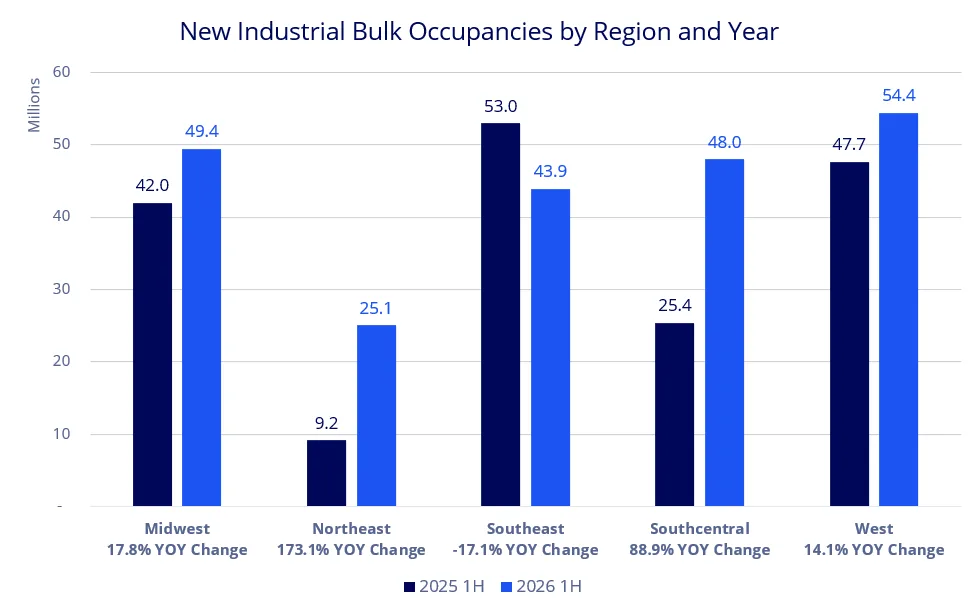
The Midwest recorded the most move-ins, with 196 occupancies totaling 49M SF. That represented an 18% annual increase. The West led total volume at 54M SF across 184 occupancies, up 14% year over year.
Source: Colliers Knowledge Leader
The Northeast posted the fastest growth, with volume surging 173% to 25M SF across 86 move-ins. The Southeast was the only region to decline. Occupancy there fell 17% to 44M SF across 145 transactions. Despite that decline, growth across other regions suggests the recovery has broadened geographically.
Demand Mix Shifts
3PL, trucking and transportation companies still account for roughly one-third of bulk occupancies. Asian-based companies have represented about 23% of 3PL bulk occupancy since early 2024. Colliers said that trend showed no signs of slowing during the first half.
Manufacturing represented nearly 15% of first-half activity, down from 17% in 2025. Building materials, construction, power equipment and HVAC increased their share above 10%, compared with 8% last year. Data center and technology-related users also exceeded 10%. Industrial occupier demand is becoming more diversified.
Much of the technology demand comes from companies supporting data center construction. These firms manufacture, store and distribute electrical equipment, cooling systems and other infrastructure. Their expansion adds another source of industrial demand beyond traditional logistics and warehouse users.
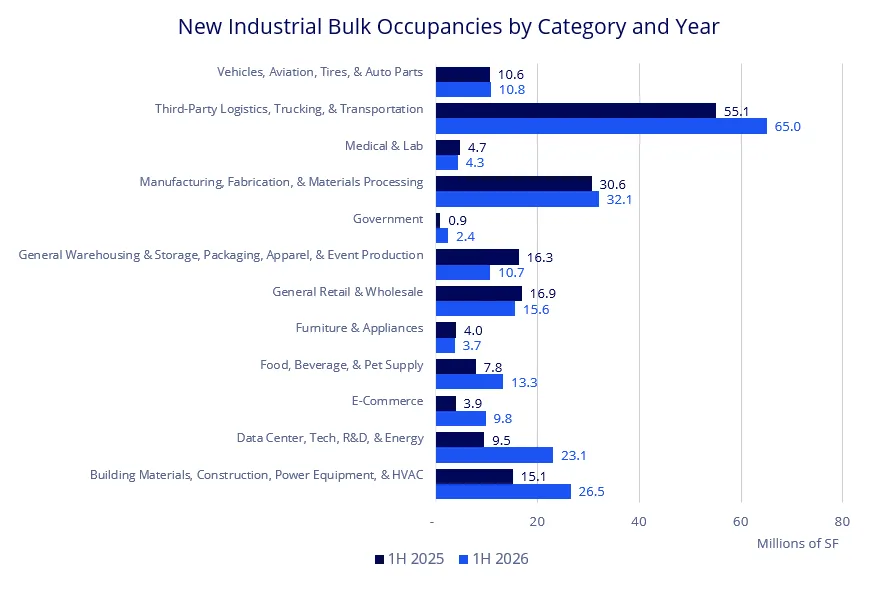
Source: Colliers Knowledge Leader
E-Commerce Reappears
E-commerce represented 4.4% of first-half bulk occupancy. Colliers said Amazon appears to be returning to growth after several years of logistics consolidation. The firm expects e-commerce’s share to increase following recent lease announcements.
Amazon was the most active new bulk occupier, taking at least 13 facilities totaling 6.5M SF. DHL ranked second with six facilities totaling 3.5M SF. DSV followed with five occupancies encompassing another 3.5M SF.
Why It Matters
Colliers said big-box demand has returned after several slower years. The recovery is particularly strong in spaces of at least 500K SF. Big-box vacancy rates have also declined for several consecutive quarters nationally and across most major markets.
Stronger absorption and measured construction indicate the industrial market is working through excess space. Meanwhile, demand increasingly comes from multiple industries rather than one dominant tenant group. That reduces reliance on logistics alone and gives the recovery a broader base.
What’s Next
Recent leasing should support more move-ins through the rest of 2026. Tenants will occupy recently signed space as additional build-to-suit facilities reach completion. Colliers said demand now exceeds new supply, while the construction pipeline remains below its recent peak and pre-COVID levels.
Vacancy appears to have peaked and should gradually decline as tenants absorb available space. Fewer move-outs and measured construction could reinforce that trend. Improvement will vary by market and region. Still, Colliers expects 3PLs, manufacturers, construction-related companies, data center suppliers and e-commerce users to sustain momentum into 2027.