







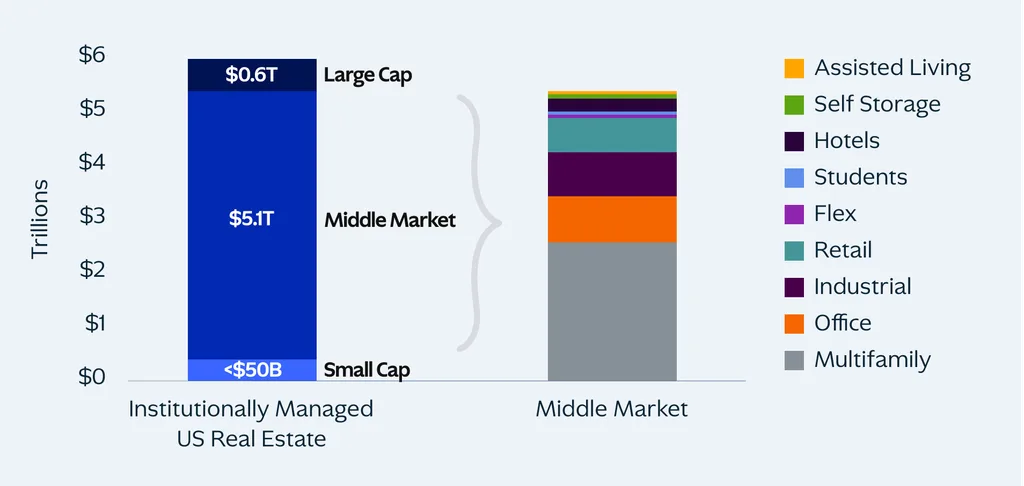
- Arctos analysis of CoStar and Preqin data puts middle-market sponsor holdings at $5.1 trillion across US commercial real estate.
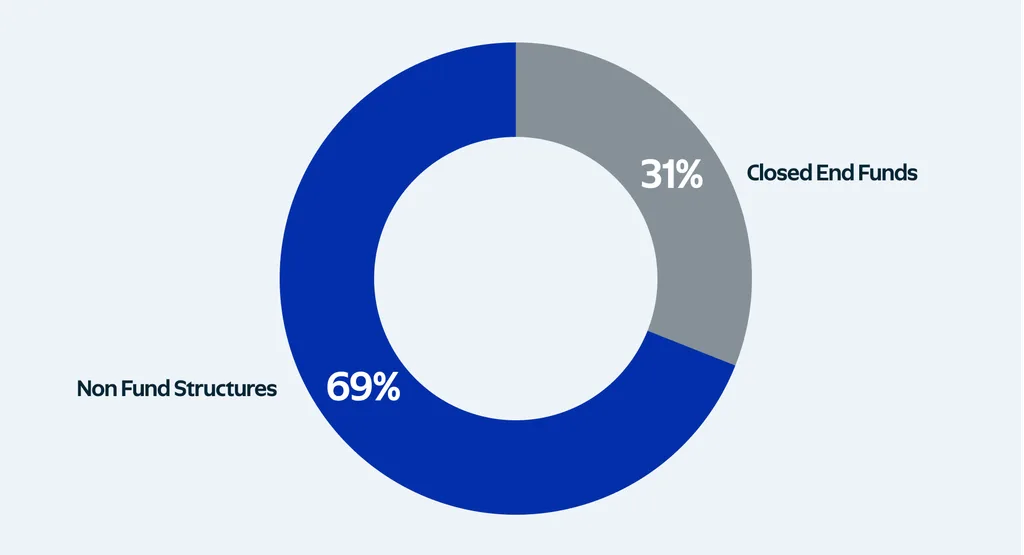
- Arctos estimates 69% of institutionally sponsored real estate sits outside traditional closed-end funds, highlighting fragmented capital channels.
- Middle-market sponsors often need flexible capital for GP commitments, liquidity, recapitalizations, platform growth, and other enterprise-level needs.
According to KKR, middle-market CRE sponsors represent a major share of institutional real estate ownership, but their capital structures remain fragmented. Arctos analysis of CoStar and Preqin data identifies about 5,800 middle-market sponsors. They control $5.1 trillion of US commercial real estate, or roughly 85% of the institutionally sponsored market.
Get Smarter about what matters in CRE
Stay ahead of trends in commercial real estate with CRE Daily – the free newsletter delivering everything you need to start your day in just 5-minutes
Sources: CoStar, Preqin, Arctos analysis. Data as of January 2026.
Middle-Market CRE Is Broad and Fragmented
Arctos identifies about 5,830 active US sponsors with institutionally sized portfolios. Only 27 qualify as large-cap sponsors under its methodology, controlling about $600B of gross property value. The remaining 5,800 make up the middle market. They manage nearly 300,000 properties and more than 24B SF across asset classes. Sponsor formation also accelerated after the Global Financial Crisis. Preqin and Arctos data show about 2,500 sponsors formed from 2010 through 2019, compared with roughly 1,600 from 2000 through 2009.
Traditional Fund Data Misses Much of the Market
Closed-end North American private real estate funds hold about $881B of net asset value, according to Preqin data cited by Arctos. Arctos estimates that equals about $1.76 trillion of gross property value when assuming 50% leverage. That leaves traditional commingled funds holding only 31% of the $5.7 trillion institutionally sponsored market. The other 69% sits in different partnership structures.
Sources: Preqin, Costar, Arctos analysis. Data as of January 2026.
For middle-market sponsors, those structures can include joint ventures, syndications, personal accounts, operating company balance sheets, and direct allocator partnerships.
Capital Needs Extend Beyond Individual Properties
Those ownership models create needs that standard property-level capital may not address. Sponsors may require funding for GP commitments, temporary liquidity, legacy ownership recapitalizations, new strategy seeding, talent retention, or internal platform expansion. Arctos argues that these needs require underwriting both the real estate and the sponsor’s broader business. The structure can make middle-market sponsors harder for institutional capital to access, even when their portfolios have meaningful scale.
The Details
Arctos describes several strategic capital structures that can address those gaps. GP financing can help fund sponsor commitments. Preferred equity can bridge capital needs without forcing immediate ownership dilution.
Portfolio recapitalizations can consolidate fragmented ownership positions and create operating scale. Private-market data has also gained strategic value, highlighted by BlackRock’s $3.2B Preqin acquisition. Beyond transaction capital, sponsors may need support across reporting, investment processes, operations, value creation, and human capital.
Why It Matters
The middle market controls nearly 25% of the broader US commercial real estate market, according to Arctos analysis. Its size contrasts with the limited share held through traditional commingled funds. That mismatch helps explain why capital access can remain uneven across a large ownership base. For sponsors, the issue can involve both financing and organizational capacity. For capital providers, the opportunity depends on structuring solutions around platforms as well as individual assets.