




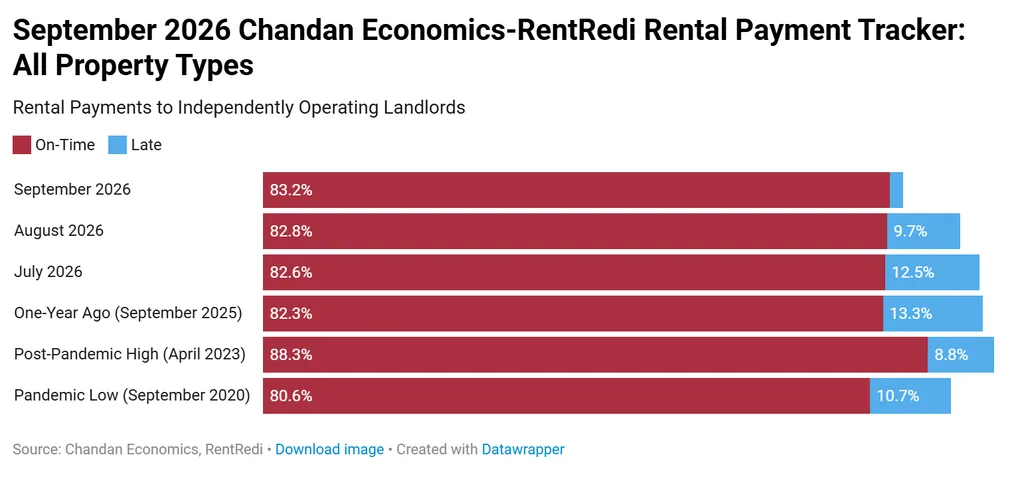
- On-time payments across independently operated rentals rose to 83.2% in September, up from 82.8% in August and 82.6% in July.
- September collections were 91 basis points above a year earlier, the strongest annual improvement since May 2023.
- The forecast full-payment rate reached 96.2%, but late payments remained elevated at 12.6% in the latest observed July reading.
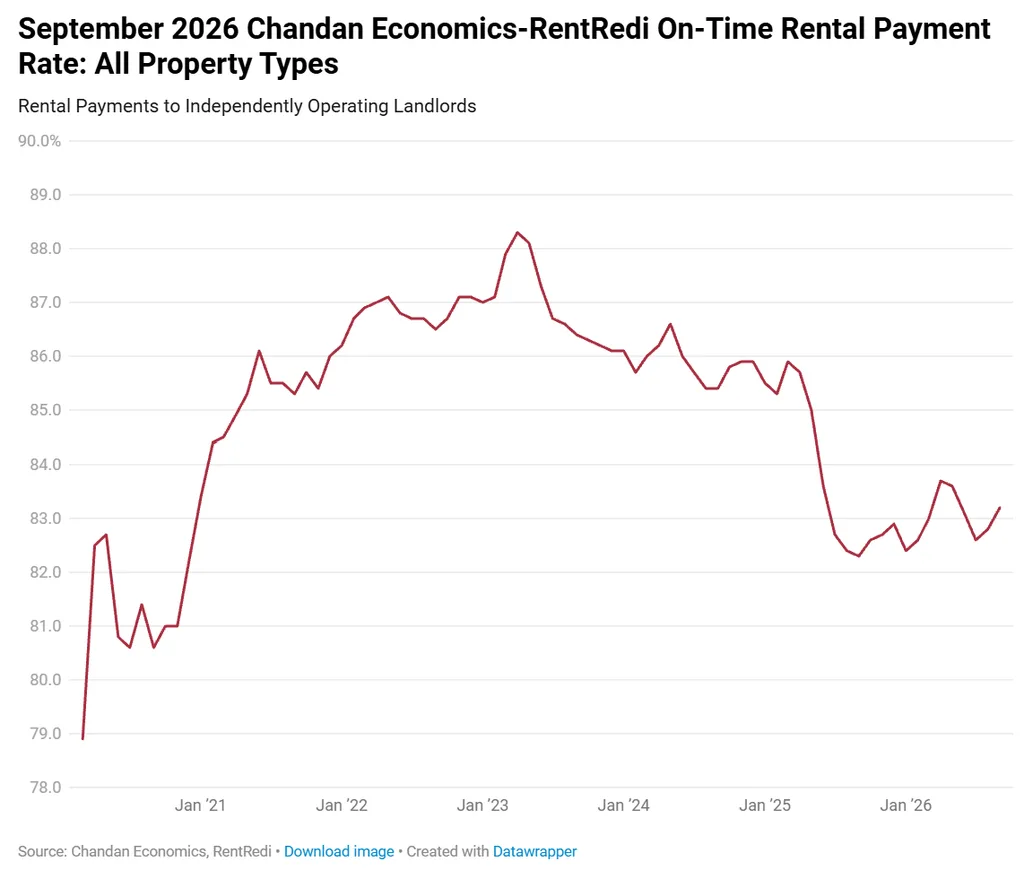
Rent collection performance improved again across independently operated rental properties in September. Chandan Economics’ latest independent-landlord payment data show 83.2% of units paid full rent on time. That was up from 82.8% in August and 82.6% in July. The gain extends a two-month rebound from the summer trough and returns the national rate to roughly its June level.
Get Smarter about what matters in CRE
Stay ahead of trends in commercial real estate with CRE Daily – the free newsletter delivering everything you need to start your day in just 5-minutes
Collections Extend Their Rebound
The year-over-year comparison strengthened as well. September’s on-time payment rate was 91 basis points above September 2025. That was the strongest annual improvement since May 2023 and followed a 48-basis-point gain in August. The change marks a sharp reversal from parts of late 2025 and early 2026. During those periods, annual declines exceeded 300 basis points. Chandan characterizes the recent movement as stabilization after a prolonged deterioration. Even so, current on-time payment rates remain below the stronger levels recorded earlier in the cycle.
The Details
Chandan’s September full-payment forecast includes on-time, late and historically expected late payments. It rose to 96.2% from 95.6% in August. The 2026 year-to-date average through July was 95.8%, slightly below 2025’s 96.0% average but above 2024’s 95.3%. The pattern continues the broader recovery in independent landlord rent collections even though payment timing remains weaker than earlier-cycle norms. The report also notes that early monthly estimates can be revised as more payment data arrive.
Late Payments Stay Elevated
Late payments remain the clearest pressure point. The rate hit a post-pandemic high of 13.5% in January and February 2026, then improved to 12.1% in May. It rose again to 12.4% in June and 12.6% in July. Some summer increase is consistent with historical seasonality. Even so, Chandan noted that rates above 10% were relatively uncommon before 2025. Delayed payments can create cash-flow strain even when tenants eventually cure the balance.
Multifamily Leads the Recovery
All three major rental subsectors improved in September. Multifamily rose 70 basis points from August to 82.8%, the strongest monthly gain. Single-family rentals increased to 83.1%, while two- to four-family rentals rose to 83.4%. Since July, multifamily on-time payments have improved by roughly 160 basis points. That has narrowed the gap with smaller rental formats. Multifamily remains the weakest of the three segments, but it is contributing more to the national rebound.
Regional Results Remain Uneven
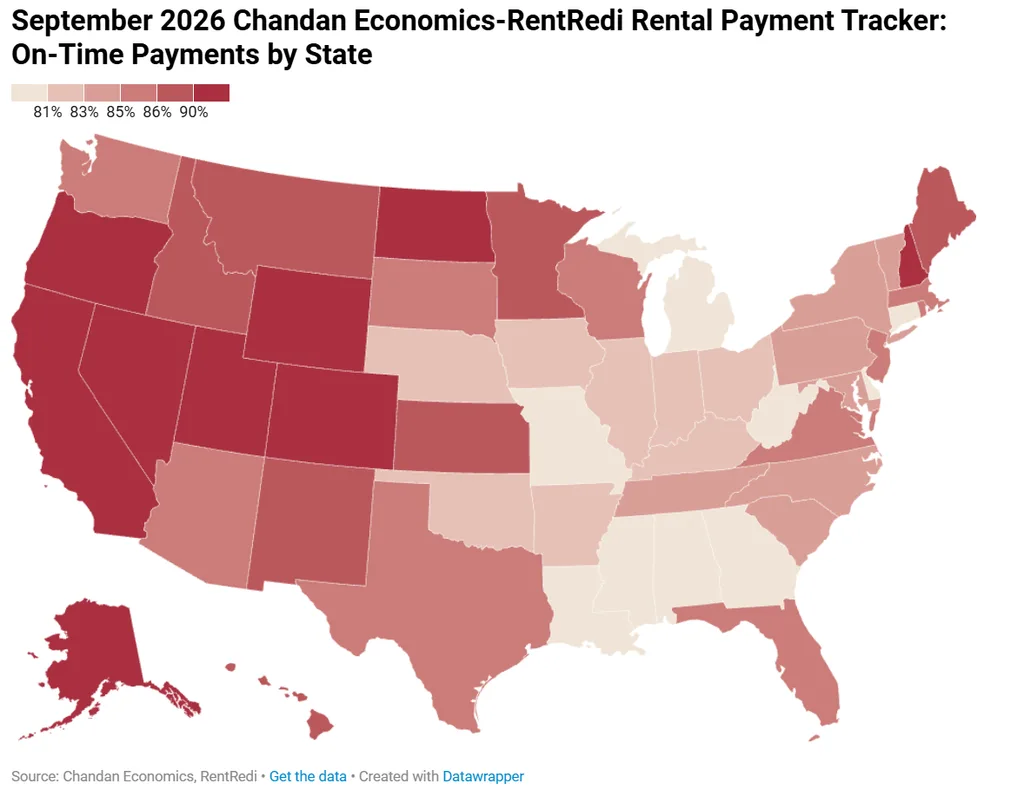
State-level performance remained mixed in September. Alaska posted the highest on-time payment rate at 93.3%, followed by Wyoming at 93.0% and Utah at 92.7%. New Hampshire reached 90.9%, while Nevada posted 90.0%. At the lower end, Mississippi recorded 69.4%, Delaware 71.8% and West Virginia 76.7%. Chandan cautions that individual state readings can move sharply month to month. The broader pattern still shows stronger collection performance across many Western and Mountain states than in parts of the South and Midwest.
Why It Matters
The data suggest stabilization rather than a full return to prior-cycle performance. Most missed on-time payments are still ultimately being cured, helping preserve income realization for smaller landlords. However, elevated late-payment rates can strain owners that depend on timely collections for recurring expenses. The report covers 60,014 units managed through RentRedi. Monthly estimates are reported as a three-month moving average. Charges below $500 and above $10,000 are excluded, along with units lacking recent rental-income payments. That makes the series a focused benchmark for non-institutional rental performance rather than the entire US rental market.
What’s Next
The collection rebound will need to hold as household finances remain constrained. Chandan pointed to weaker real wage growth and a historically low personal saving rate as reasons for caution. The report also noted a higher interest-rate path and persistent inflation. Those conditions can limit renter financial buffers if cost pressures continue. For now, September provides further evidence of improvement, but the source stops short of calling renter finances fully normalized.