



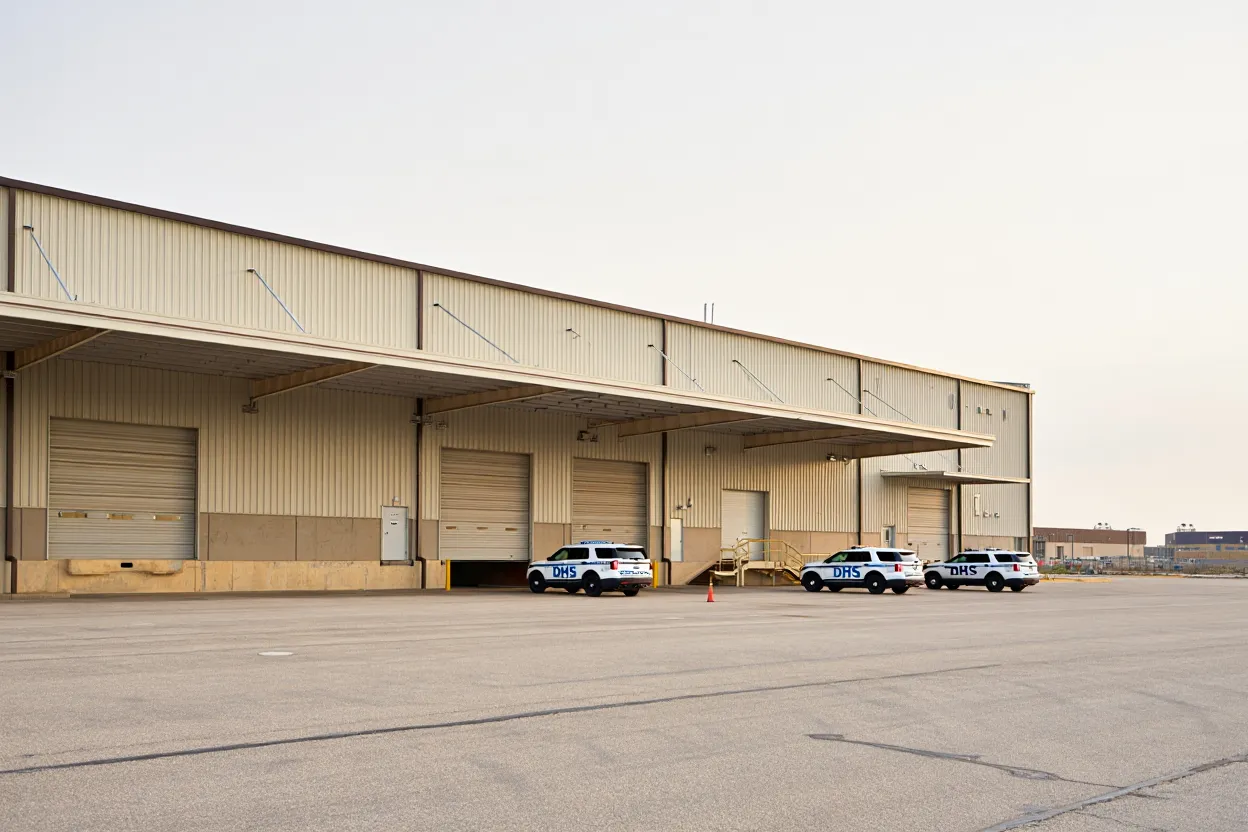
- ICE will not proceed with converting purchased warehouses into migrant detention centers, per Bloomberg News.
- The agency plans to sell or transfer at least seven of the 11 facilities bought for $700M.
- This signals continued reliance on private jail operators and leaves major federal CRE investments in limbo.
From Expansion to Retrenchment
Bloomberg News reports that the Department of Homeland Security (DHS) has halted a controversial project championed by former Secretary Kristi Noem to repurpose industrial warehouses as government-run ICE detention centers. The initiative originally intended to consolidate the patchwork of 200 existing contractor-run and municipal jails into about 34 federally owned mega-sites, with a goal of holding up to 100,000 detainees. Internal documents show DHS is now scrapping most of these warehouse conversions months after Secretary Markwayne Mullin ordered a strategic review. The abrupt policy reversal follows community opposition and lawsuits, forcing ICE back to its legacy model of using contractor and partner facilities.
This reversal is taking place as the $38B ICE Detention Reengineering Initiative—already $1B deep in acquisitions with $1.3B allotted to site conversions—faces an uncertain future. The delay and downsizing echo growing scrutiny of the program’s financial and political viability, especially as high costs and public backlash rack up.
Get Smarter about what matters in CRE
Stay ahead of trends in commercial real estate with CRE Daily – the free newsletter delivering everything you need to start your day in just 5-minutes
The Details
ICE purchased 11 warehouses nationwide for more than $700M, with contracts totaling $1.3B awarded for conversions in Maryland and Arizona alone, according to records cited by Bloomberg News and The New York Times. Of the original set, at least seven will be sold or reassigned to federal agencies; only four projects are proceeding, but their status remains unclear. The Social Circle, Georgia site, planned as a 10,000-bed detention center, will not move forward following strong local opposition. Federal spending includes $10M allocated for the Maryland conversion and $4M on the Arizona site. Meanwhile, DHS is exploring acquiring existing detention facilities from private operators—indicating no wholesale move away from private jail contracts.
Community Resistance Shapes Policy
The warehouse conversion scheme met resistance from both sides of the aisle. Communities in Maryland, New Jersey, Michigan, Utah, and Georgia mounted public opposition, citing infrastructure and safety concerns. Lawsuits argued that environmental impacts weren’t properly reviewed, and in May, the DHS inspector general began an official investigation into whether the warehouse program met operational needs or justified its costs. For Social Circle, Georgia, the city emphasized hope that its warehouse property could return to the tax rolls and support local economic growth. This wave of backlash slowed progress and ultimately triggered the federal pivot outlined this week.
Why It Matters
DHS’s abandoned detention plan shows how quickly major federal CRE investments can fall apart. The collapse leaves $1B in warehouse purchases and costly conversion contracts in limbo. It also highlights the risks of speculative government leasing without lasting political support.
Bloomberg reviewed federal contracting records and found the retreat could leave assets stranded in secondary markets. Rural areas and smaller cities may struggle to attract replacement tenants. The reversal also marks a sharp shift from earlier efforts to build a nationwide network of detention-focused warehouse hubs.
Meanwhile, ICE’s renewed focus on private jails supports demand for contractor-run detention sites. The agency may still buy privately operated facilities. However, as of June 2026, it continues to rely on existing models. The warehouse plan failed because of high costs, operational hurdles, and local opposition. As a result, the effort warns investors against betting on large federal redevelopment projects.
What’s Next
DHS plans to dispose of or transfer at least seven unused warehouses. It will first seek other federal users. If none emerge, the properties could return to the open market.
The status of four warehouse projects remains uncertain. Meanwhile, lawmakers will likely examine the $1.3B already spent on site conversions. Communities such as Social Circle, Georgia, hope the vacant properties return to local tax rolls. CRE investors should watch federal disposition plans for sale opportunities. Still, demand from government tenants for speculative conversions appears limited for now.