






- Trepp’s screen of 306 property-level records in 15 counties finds $3.27B of gross securitized CRE debt tied to Hurricane Isaias, or $2.92B after removing overlapping Freddie Mac records.
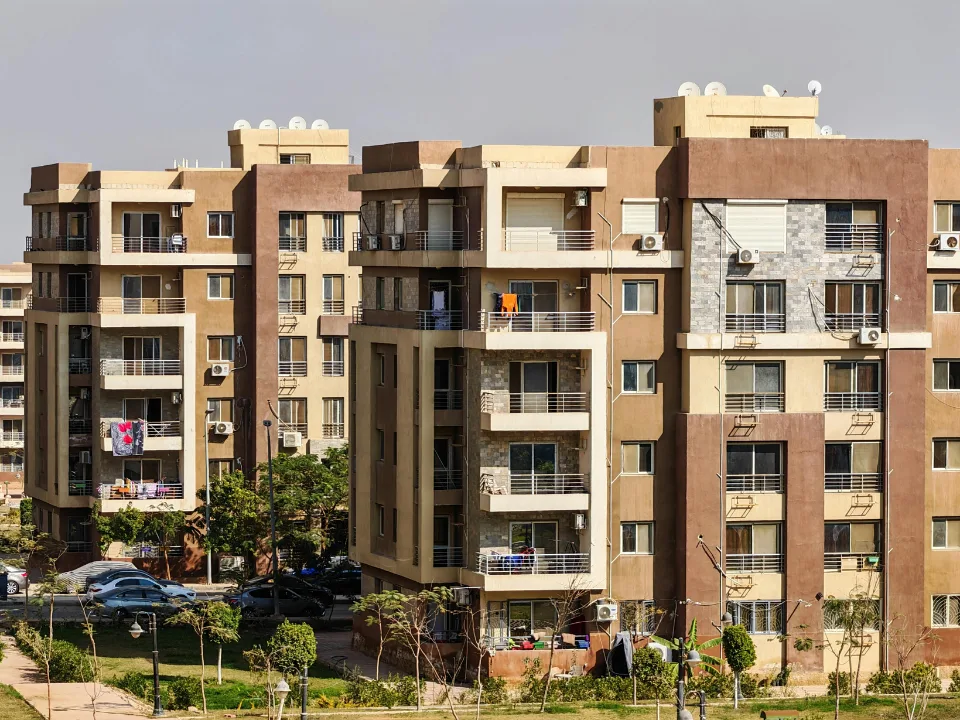
- Multifamily makes up 68.8% of balances and lodging 14.9%, while Leon County alone holds $1.32B and five Panhandle counties add $1.75B, more than half the total.
- Exposure is not damage, so loan performance will hinge on property-level assessments, insurance recoveries and how fast apartments and hotels get back to operating.
Trepp’s first look at Hurricane Isaias exposure finds $3.27B of gross debt in securitized commercial property loans across Florida counties tied to the storm.
Apartments make up nearly 69% of the balances, and five counties along the Panhandle coast hold more than half.
Get Smarter about what matters in CRE
Stay ahead of trends in commercial real estate with CRE Daily – the free newsletter delivering everything you need to start your day in just 5-minutes
The Storm and the Screen
Isaias made landfall near Destin on Friday, Oct. 9, as a Category 2 storm packing 105 mph sustained winds, per the Florida Division of Emergency Management. Trepp stresses that the scale of property damage and credit stress is still unknown.
The geographic boundary follows the counties named in FEMA’s emergency declaration EM-3655-FL. Being on that list does not mean every property inside a county took damage.
How the Exposure Breaks Down
Trepp’s screen counts 306 records, each tied to a property, in 15 counties. They span private-label CMBS, CRE CLOs and Freddie Mac loan and reference-pool data. Twenty-three Freddie Mac records sit in two pools at once, and stripping out roughly $343M of overlap leaves $2.92B of net exposure.
Freddie Mac-related records total $1.48B, or 45.4%. Private-label CMBS adds $1.37B (41.9%) and CRE CLOs $414.3M (12.7%), so private-label paper alone is $1.78B. On a net basis, Freddie Mac falls to $1.14B, or 39%.
By property type, apartments lead at $2.25B. Hotels follow at $485.1M, then retail at $255.0M and self-storage at $165.0M. Trepp says that mix makes rental-unit availability and hotel reopenings the key recovery markers.
Leon County and the Panhandle
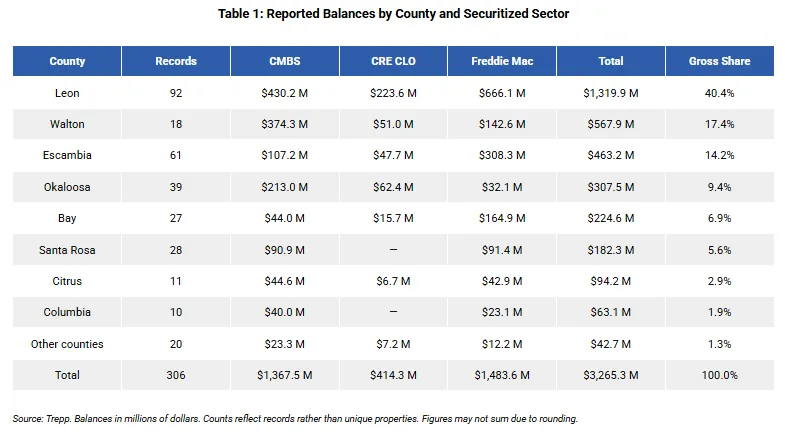
Leon County, home to Tallahassee, carries the biggest balance at $1.32B, or 40.4%. Roughly 86% of that is multifamily, which Trepp says is a reason to watch inland rentals along with coastal assets.
Together, five counties (Walton, Escambia, Okaloosa, Bay and Santa Rosa) account for $1.75B, or 53.5%. Walton leads the group at $567.9M, followed by Escambia at $463.2M, Okaloosa at $307.5M, Bay at $224.6M and Santa Rosa at $182.3M.
Hotel debt in Walton and Okaloosa totals $288.8M, close to 60% of all lodging exposure in the screen.
Net of the Freddie Mac overlap, Leon County drops to $1.13B (38.8%), Escambia to about $400M and Okaloosa to about $301M. Smaller balances sit in Citrus County at $94.2M and Columbia County at $63.1M, with the remaining counties together at $42.7M.
Large Loans to Watch
Two Miramar Beach properties account for $260M of the city’s $290.4M. Silver Sands Premium Outlets backs $140M spread over three 2022 CMBS deals, and Hilton Sandestin Beach Resort backs another $120M.
In Tallahassee, the ACRES 2026-FL4 CLO holds two apartment loans worth $141.2M: Renegade ($89.9M) and Exchange at Blair Stone ($51.3M). Trepp notes that these loans appear because of location and size, not confirmed damage.
Why It Matters
Trepp says lenders and bondholders should focus on how fast properties get operations and cash flow back. Hotels can lose revenue the moment guests cancel or doors close, while damaged apartments leave units offline and interrupt rent collection.
Deductibles, claim timing and borrower liquidity will shape outcomes. Repairs and delayed insurance payments can create funding gaps even where coverage eventually reimburses most of the loss. A separate Bisnow analysis, covered by CRE Daily, put $40.2B of multifamily in the storm’s projected path.
What’s Next
Trepp will keep tracking servicer notes, watchlist additions and payment trends as details emerge. How many units and rooms are usable, when repairs finish, how claims settle and whether reserves get tapped will show if the disruption is brief or lasting.
The storm also feeds the wider debate over climate risk and property values in exposed markets.