


- MSCI said 70% of global data center capacity under construction is in the US, where grid waits average 64 months.
- More than half of US projects under development sit in counties with prior cancellations or data center-specific rules.
- Project values can reach $20B, while insurance capacity has not kept pace with the scale of hyperscale development.
MSCI says the AI infrastructure boom is colliding with power, permitting and community constraints. Its review of US data center development risks maps those pressures across the project pipeline. The firm estimates that meeting projected AI compute demand could require up to $5.2T of data center investment by 2030. With 70% of global capacity under construction located in the US, execution risk is increasingly local.
Get Smarter about what matters in CRE
Stay ahead of trends in commercial real estate with CRE Daily – the free newsletter delivering everything you need to start your day in just 5-minutes
The Details
Power availability is one of the first bottlenecks. MSCI said the average wait for new power projects in regions with data center development is 64 months. At the same time, facility scale has risen sharply. Median data center energy capacity increased from 11 MW in 2016 to 130 MW by June 2026.
Developers can wait for grid access or pursue on-site generation. MSCI said some projects are turning to small modular nuclear reactors, long-duration batteries or new gas plants. Those approaches can bypass interconnection queues, but they introduce technology, equipment and commercial-readiness risks of their own.
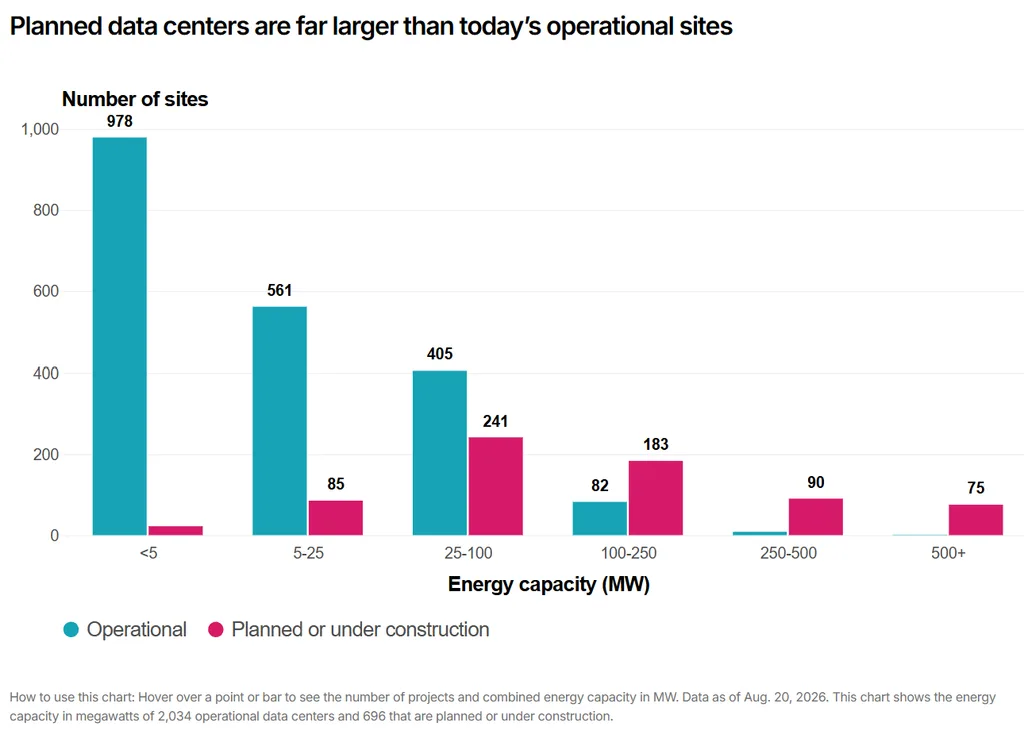
MSCI analyzed 2,034 operating data centers. It also tracked 696 facilities planned or under construction as of August 20, 2026. The planned pipeline is skewed toward much larger facilities than the existing stock. Each successful project therefore needs more power and equipment.
Source: MSCI
MSCI also warned that on-site power strategies do not remove execution risk. First-of-a-kind technologies can face commercial-readiness delays, while conventional alternatives can run into shortages of critical power equipment.
Local Rules Add Another Layer
Community opposition is also accelerating. MSCI counted at least 75 US data center projects delayed or canceled in Q1 2026. That matched the total for all of 2025. The firm found 52% of projects under development in counties with prior withdrawals or data center-specific rules.
Regulatory exposure is broader still. MSCI said about 80% of planned or under-construction US data centers are in jurisdictions with active or pending data center legislation. Pending moratorium decisions affect about 14% of planned locations. Another 12% of planned sites are in jurisdictions with upcoming elections that could influence local rules.
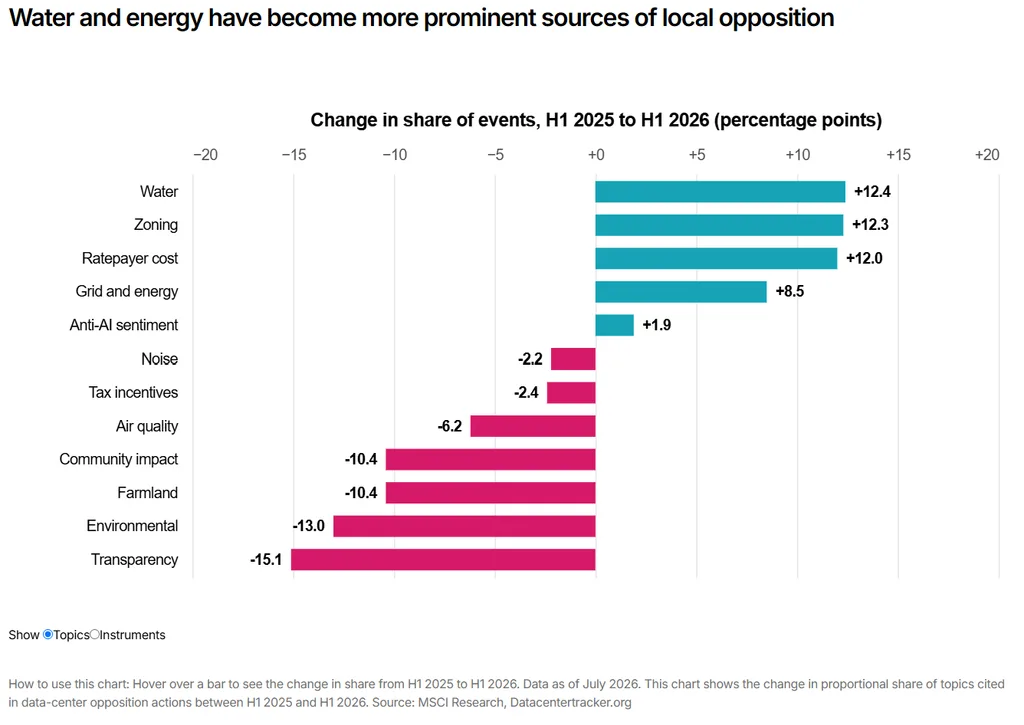
The focus of opposition is changing as well. MSCI found water use, zoning, ratepayer costs and grid impacts gained prominence from the first half of 2025 to the first half of 2026. Broader environmental and community-impact themes became less prominent in the same comparison.
Across 838 US sites under construction, planned or held as development land, MSCI found 35% in counties where opposition had produced legislation or legal action. Another 17% were in counties where an earlier project had been canceled or voted down. The remaining 48% were in areas without a major successful opposition effort.
Why It Matters
Securing power does not fully de-risk a project. MSCI identified 365 planned or under-construction data centers near rivers and found 50, or 14%, had elevated exposure to both water scarcity and low river flow. Those projects were concentrated in Texas, Illinois, Oregon and Georgia.
Insurance gaps can magnify data center development risk when project values outgrow available coverage. MSCI said project values have risen from about $150M to as much as $20B for hyperscale campuses. When coverage is incomplete, lenders and developers can retain more exposure to catastrophes, outages and major construction delays.
What’s Next
Institutional investors and lenders will need to evaluate project risk at the site level rather than treating power access as the only gating factor. MSCI highlighted energy procurement, local relationships, water exposure, physical hazards and insurance as overlapping diligence items.
The scale of planned AI infrastructure means these constraints can directly affect delivery schedules. Projects that solve one bottleneck may still face delays from permitting, equipment shortages, opposition or coverage gaps. The growth opportunity remains large, but execution depends on managing several location-specific risks at once.