








- The national CMBS distress rate eased to 10.9% in August from 11.5% a year earlier, with preliminary September data near 10.8%, per CRED iQ, but Chicago’s rate rose 4.7 points to 25.3%.
- Office holds 45.5% of distressed balance with a 16.0% distress rate, and it leads distress in eight of 11 playoff metros.
- New York improved 2.9 points to 9.6% after $6.1B of loans cured, while Midwestern office cores keep deteriorating and some healthy metros hinge on a few assets.
The national CMBS distress rate eased to 10.9% in August from 11.5% a year earlier, according to CRED iQ, with preliminary September data near 10.8%.
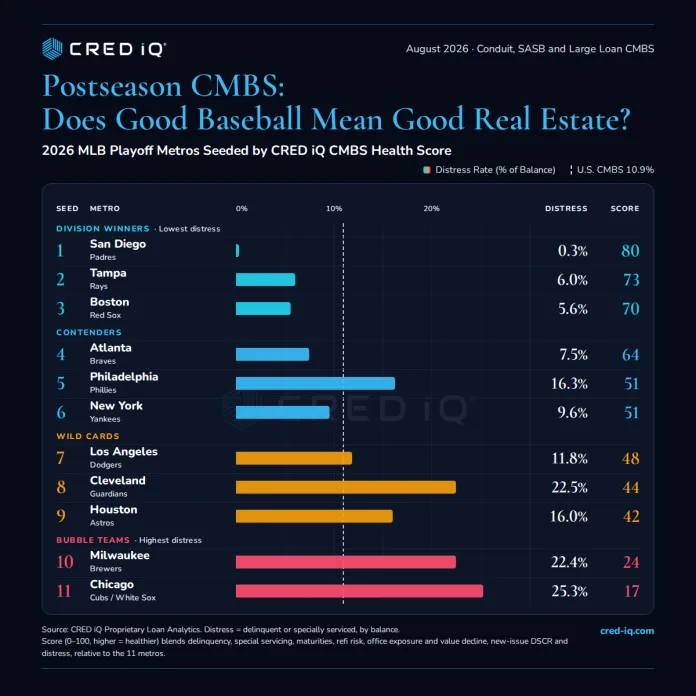
CRED iQ broke the figures out for the 11 metros with teams in the baseball playoffs, and the spread is wide. San Diego sits at 0.3% while Chicago reaches 25.3%. CRED iQ defines distress as balance that is late on payments or with a special servicer.
Get Smarter about what matters in CRE
Stay ahead of trends in commercial real estate with CRE Daily – the free newsletter delivering everything you need to start your day in just 5-minutes
Distress Splits the Playoff Metros
San Diego has the lowest rate at 0.3%, followed by Boston at 5.6%, Tampa at 6.0% and Atlanta at 7.5%. Atlanta’s rate dropped from 14.2% after a $580M hotel portfolio loan was paid off.
New York stands at 9.6% and Los Angeles at 11.8%. Houston is at 16.0% and Philadelphia at 16.3%, while Milwaukee (22.4%), Cleveland (22.5%) and Chicago (25.3%) are worst. Chicago’s rate is up 4.7 points in a year.
Aon Center Shows the Damage
Chicago’s Aon Center is the clearest example. Its $536M loan matured in July without being repaid. The tower was appraised at $824M at the time the loan was packaged into a securitization and is now valued at $195M, and the servicer’s notes record that the owner’s request for three more years was turned down.
Office Drives the Stress
Office holds 45.5% of distressed balance, and its distress rate has risen to 16.0%. It leads in eight of the 11 metros.
Cleveland has $414M of troubled debt around Progressive Field, anchored by Key Center, a loan with its servicer since 2020. Milwaukee’s problems center on Southridge Mall, down 74% in value. Philadelphia’s Market Street West loans, $779M in all, account for two-fifths of the metro’s distress.
Houston rose 3.3 points when the $470M loan on One & Three Allen Center, a complex that is 71% leased, went to a special servicer and six apartment loans also became distressed this summer. In Los Angeles, the $1.1B ICON/Hollywood Media Portfolio loan moved to special servicing before it matured, and 20 loans totaling $2.5B became distressed over the summer.
New York Offers a Contrast
New York improved by 2.9 points as $6.1B of loans cured, including 1211 Avenue of the Americas at $1.035B and One New York Plaza at $810M. Worldwide Plaza, with a 74% drop in value, is still the biggest problem.
In the healthiest metros a few assets decide the score. Tampa’s Westfield Countryside mall, 27% occupied, makes up 62% of the metro’s distress, and Boston’s figure comes mostly from one life-science loan that is still paying.
What’s Next
CRED iQ’s conclusion is that the national rate averages very different markets, so for lenders the question is which loans come due next. Watch Midwestern office loans as maturities arrive, a stress already visible in office CMBS special servicing at record levels.