




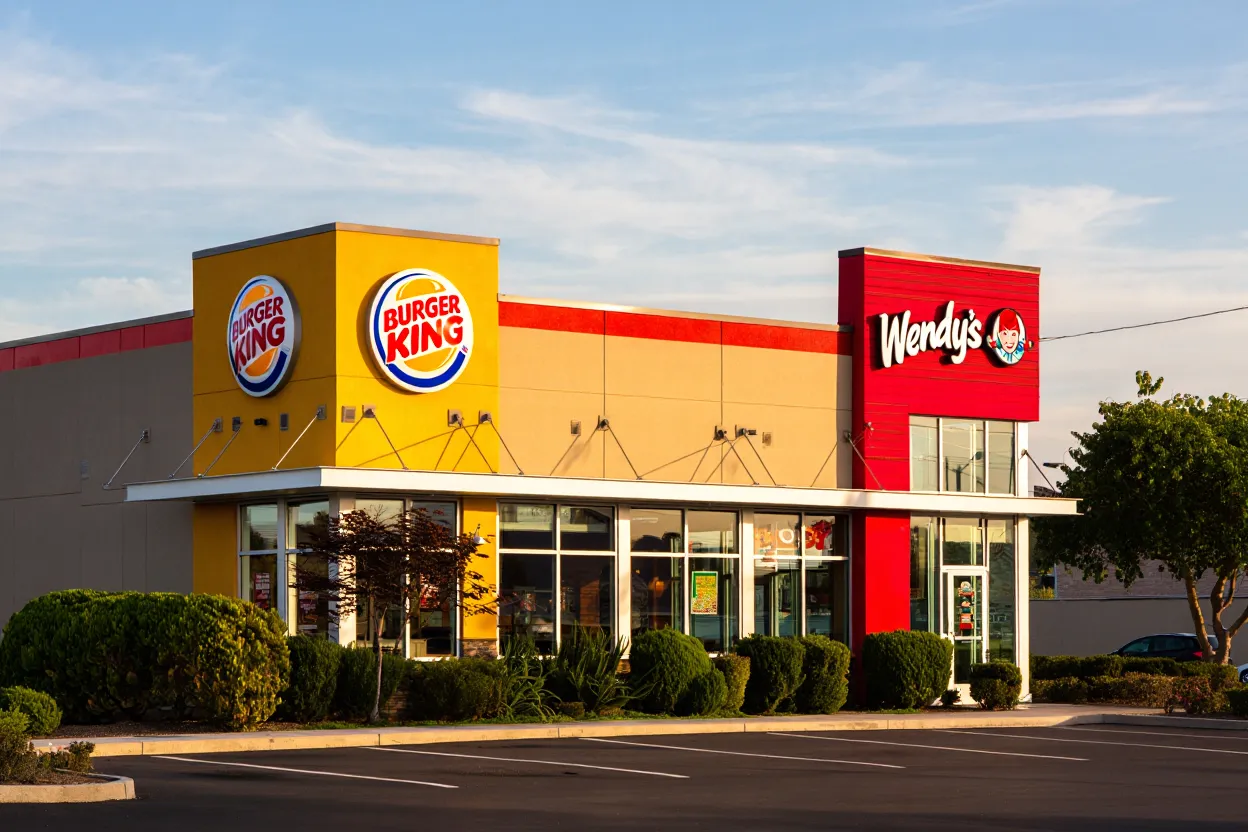
- Burger King overtook Wendy’s as the second-largest burger chain in the US, powered by strong sales growth and shifting competitive dynamics.
- Wendy’s faced declining same-store sales and negative net unit growth, raising concerns about franchisee economics and long-term tenant appeal.
- The shake-up underscores the need for net lease investors to look beyond brand recognition and assess real operating fundamentals in restaurant deals.
A Burger Hierarchy Turns Upside Down
Burger King has edged past Wendy’s to claim the No. 2 spot among US burger chains, per Nation’s Restaurant News and Technomic, as reported by Globe St. For quick-service restaurant net lease investors, this is more than a headline. Burger King’s 8.2% year-over-year global sales growth and 8.5% US comp sales rise stand in sharp contrast to Wendy’s sales declines and pressure on franchisee profitability in Q2 2026.
McDonald’s, with $55.06B in sales (2025), remains atop the category. But for those betting on ground-leased QSR real estate, this changing of the guard highlights how rapidly tenant strength can shift — and why underwriting can’t rest on old rankings.
Get Smarter about what matters in CRE
Stay ahead of trends in commercial real estate with CRE Daily – the free newsletter delivering everything you need to start your day in just 5-minutes
The Details
Burger King reported global sales growth of 8.2% and US comparable sales up 8.5% for Q2 2026, ending the quarter with 6,992 global units even as net global restaurant growth was negative 0.8%, per company earnings. Wendy’s, which narrowly led Burger King with $11.9B in 2025 US sales, now trails after registering a 6.5% decline in global sales and 8.2% drop in US sales year-over-year.
US same-store sales at Wendy’s dropped 7%, and the company experienced a net decline of 245 units, even after opening 44 new US restaurants. Meanwhile, Dunkin’ posted 5.1% sales growth and leapfrogged Wendy’s as well, exposing further weakness in Wendy’s competitive position.
Franchisee Economics Under Scrutiny
Behind the numbers are diverging fortunes for franchisees, a pivotal concern for CRE investors in the net lease market. That pressure extends across the restaurant sector, where mounting closures and operator takeovers are exposing fragile franchisee economics. During Wendy’s August 7 earnings call, CEO Robert Wright cited continued pressure on franchisee profits and declining customer traffic.
He argued that the brand’s differentiation and operating standards had slipped, directly impacting store-level economics, which Wright called “the heartbeat of the business.” By contrast, Burger King’s stronger top-line performance is boosting franchisee economics, at least for now, but the chain still faces flat-to-shrinking net unit counts. For investors, the message is clear: sustainable real estate returns rely on tenants whose operators can afford improvements and growth, not just a familiar sign on the street.
Why It Matters
The power dynamic shift is a wake-up call for those active in single-tenant restaurant net lease — a sector that’s attracted billions in investment due to perceived stability but is not immune to brand-specific risks. According to Globe St., historically, investor underwriting in the QSR segment has focused heavily on national brand cachet and top-line system sales.
But as Wendy’s 2026 slide and Burger King’s surge show, a good name alone does not guarantee a solid lease. Investors now face a landscape where unit-level profitability and operator capitalization outstrip name recognition for relevance. Franchisee health is directly tied to rent payments, reinvestment in stores, and ongoing development, all of which underpin the marketability and stability of these assets. Dunkin’s 5.1% sales gain and new position ahead of Wendy’s further underscore how fast rankings — and underlying tenant risk — can move.
Looking ahead, this reset in the burger category could inform net lease cap rates and buyer diligence across the broader QSR landscape. Wendy’s plans to release a turnaround plan in Q3 2026, addressing menu, marketing, operations, digital, and unit growth, but execution risk remains front and center. Meanwhile, Burger King’s positive same-store performance is encouraging but tempered by net unit attrition. For now, the new chain rankings will prompt both lenders and investors to revisit assumptions about QSR tenancy strength — and remind the market that what’s under the sign matters just as much as the sign itself.
What’s Next
Wendy’s is set to detail its turnaround strategy in the third quarter, focusing on menu improvements, brand refresh, operational enhancements, digital upgrades, and a renewed push for domestic unit growth. Investors will be watching closely for signs that these steps can reverse traffic and sales declines, sustain franchisee profitability, and restart positive net expansion.
Meanwhile, Burger King faces its own challenge in translating sales momentum into new store openings and retaining its newfound ranking. For net lease investors, ongoing volatility in tenant health may prompt stricter diligence, more granular underwriting, and a renewed emphasis on four-wall economics for QSR sector deals in 2027 and beyond.