



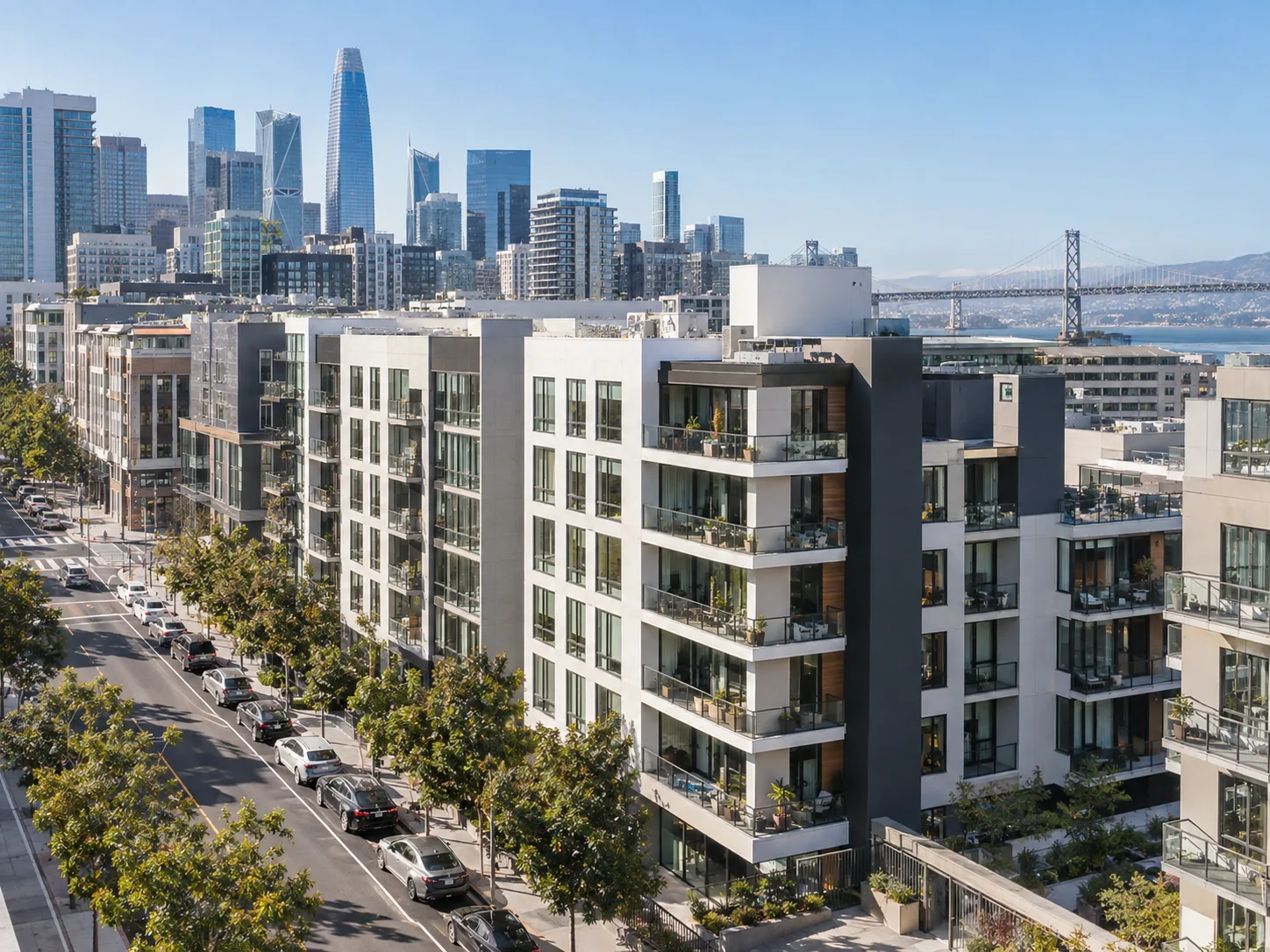
- San Francisco multifamily occupancy reached 97.6% in Q2, while San Jose reached 97.4%, according to Colliers.
- San Francisco effective rents rose 10.6% year over year to $3,938, while San Jose rents increased 6.1% to $3,538.
- Low supply and AI-linked employment growth are drawing pension funds, private investors, family offices, and other buyers into the market.
Bisnow reports that tight supply and strong leasing are pulling investors back into Bay Area apartment deals. San Francisco tied Honolulu for the nation’s highest Q2 multifamily occupancy at 97.6%, while San Jose reached 97.4%.
Get Smarter about what matters in CRE
Stay ahead of trends in commercial real estate with CRE Daily – the free newsletter delivering everything you need to start your day in just 5-minutes
Supply Constraints Lift Rents
Both San Francisco and San Jose rank among the bottom 10 major US markets for apartments under construction, according to Colliers. San Jose is projected to add just 150 units in 2026, equal to 0.1% of inventory.
Effective rents in San Francisco reached $3,938 in Q2, up 10.6% from a year earlier. San Jose reached $3,538, a 6.1% increase. Investors see the limited pipeline as a sharp contrast with Sun Belt markets that absorbed a large wave of postpandemic apartment construction.
The Bay Area missed much of the postpandemic construction surge that added inventory across Sun Belt metros. Sack Capital Partners Managing Partner David Feinberg said local supply was effectively cut off for years. Creating a stronger setup for rent growth as demand returned. The region’s lengthy planning process can also make existing apartments more attractive than ground-up development.
The Details
Bay Area sales activity is increasing alongside the stronger fundamentals. San Francisco recorded 63 multifamily deals in Q2, up from 59 a year earlier and 56 in Q2 2024. Total sales volume rose to $347M from $285M in Q2 2025.
Notable second-quarter acquisitions included Holland Partner Group’s $105M purchase of 218 units near downtown San Jose. And Bedford Affordable Housing’s $87M acquisition of 262 San Jose units.
In the South Bay, institutional capital increased 20% year over year. And represented about 60% of investor activity for the 12 months ending March 30, according to Marcus & Millichap.
Sunnyvale, western San Jose, and Campbell recorded the most institutional transactions in the South Bay. Private investors were more active in downtown and south San Jose, where entry pricing can be more accessible. The split shows that different buyer types are targeting different submarkets rather than competing for identical assets.
Sack Capital’s recent Fremont acquisition was a 122-unit garden-style value-add property completed through a joint venture with LEM Capital. The firm’s Bay Area holdings extend from Sonoma County through Fremont and San Jose.
Why It Matters
The buyer pool now spans pension funds, real estate companies, private investors, and family offices. Investors are responding to high occupancy, accelerating rents, and limited new construction rather than relying on a single buyer category.
AI and robotics growth is also supporting apartment demand near employment centers. The resurgence adds to a broader multifamily investment recovery as capital follows markets with stronger supply-demand conditions.
Colliers Vice Chair Dustin Dolby described the Bay Area as one of the hottest US multifamily markets and said demand now spans the investment community. Strong apartment fundamentals are developing alongside renewed office activity from AI, robotics, and technology companies. Which are backfilling space from San Francisco south toward San Jose.
What’s Next
Sack Capital Partners has acquired six Bay Area multifamily assets over the past 18 months. Including a 122-unit Fremont value-add deal with LEM Capital. Managing Partner David Feinberg expects constrained supply and high homeownership costs to support stability.
Average home prices exceed $1.4M in San Francisco and $1.3M in San Jose, according to Zillow. Feinberg said the rent-versus-own gap in San Jose is the widest in the country. Reinforcing rental demand even if some AI valuations weaken.
Feinberg expects both primary and tertiary Bay Area markets to benefit from the AI economy. He described San Francisco as the center of agentic AI and north San Jose. And Fremont as important to physical AI. The main constraint remains housing supply, which he expects to support apartment fundamentals over an extended period.