






- AvalonBay Communities and Equity Residential agreed to an all-stock merger valued at roughly $69B, creating a combined portfolio of 180,000 apartment units nationwide.
- The transaction would surpass the 2022 Prologis-Duke Realty deal as the largest REIT merger on record, with the companies targeting $125M in annual synergies.
- The merger highlights a broader push toward scale across CRE as multifamily owners navigate elevated costs, slower rent growth, and tighter capital markets.
AvalonBay Communities and Equity Residential are merging in a landmark multifamily deal that would create the largest apartment REIT in US history, reports Bisnow. The all-stock transaction combines two of the country’s biggest publicly traded landlords into a 180,000-unit platform with an enterprise value of roughly $69B.
The merger comes as apartment REITs face mounting pressure from elevated operating costs, slower rent growth, and a wave of new supply that weighed on fundamentals through 2025. Executives from both firms framed the deal as a scale play designed to lower costs, improve operational efficiency, and strengthen access to capital.
Get Smarter about what matters in CRE
Stay ahead of trends in commercial real estate with CRE Daily – the free newsletter delivering everything you need to start your day in just 5-minutes
A Record-Setting REIT Deal
According to REIT research firm Hoya Capital, the AvalonBay-Equity Residential merger will be roughly 50% larger than the previous record-holder, Prologis’ $26B acquisition of Duke Realty in 2022. The combined company will overtake other institutional apartment owners in size, including Greystar, which the National Multifamily Housing Council said owned 122,545 units at the end of 2025.
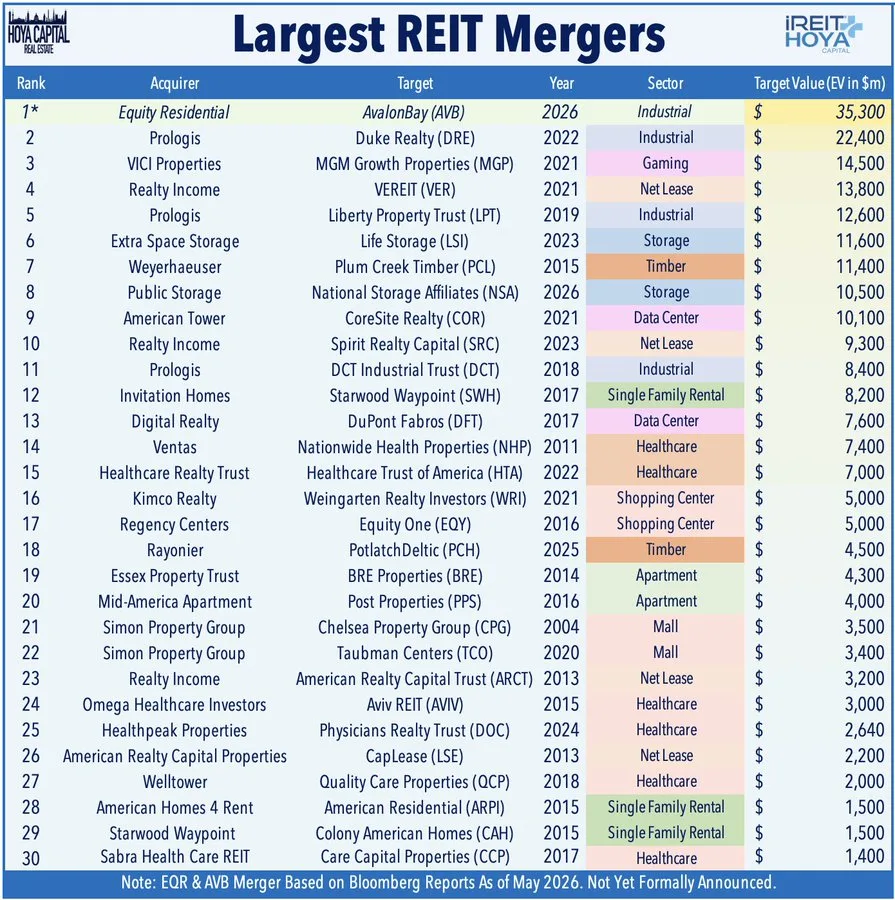
The new company has not announced a name yet, but it will maintain dual headquarters in Arlington, Virginia, and Chicago. AvalonBay CEO Benjamin Schall will lead the combined REIT, while the board will initially include seven trustees from each company.
The Deal Terms
AvalonBay shareholders will receive 2.793 shares of Equity Residential stock for each share they own, giving AvalonBay investors about 51.2% ownership of the combined entity. Both boards unanimously approved the merger, which the companies expect to close before the end of 2026.
The firms project approximately $125M in annual net synergies, including $50M from corporate overhead reductions and $65M tied to property management efficiencies. According to an SEC presentation, the combined company should generate roughly $2B in annual cash flow, providing significant internal funding capacity for future development and acquisitions.
Together, the REITs currently have 10,800 apartment units under construction representing about $4.4B in investment. Leadership said the larger balance sheet should create a lower cost of capital and more flexibility to pursue long-term growth opportunities.
Shares of both companies traded lower following the announcement, with each REIT falling more than 1.5% in early Thursday trading.
AI And Scale Take Center Stage
One notable theme in the merger announcement was operational technology. Both companies have used leasing and property management platform EliseAI since 2019 and said AI now supports roughly 90% of their prospect workflows.
According to the companies’ investor presentation, the combined portfolio processes approximately 2.5M annual customer interactions through AI-enabled systems. Executives argued that greater scale will allow the merged platform to accelerate investment in automation, operational analytics, and centralized leasing functions. That push mirrors broader adoption of AI tools across CRE, as landlords use automation to streamline leasing and reduce operating costs.
The announcement did not address potential staffing reductions, though corporate consolidation typically creates overlap in administrative and operational roles.
Why Apartment REITs Are Consolidating
The merger lands during a broader consolidation wave across commercial real estate. Higher interest rates and constrained capital markets have pushed firms to pursue larger platforms that can spread costs, improve bargaining power, and access cheaper financing.
Multifamily landlords also spent much of 2025 dealing with record apartment deliveries in Sun Belt markets, softer rent growth, and rising insurance and labor costs. Larger operators have increasingly leaned on technology and centralized operations to protect margins.
According to the companies, the merger creates “one of the most efficient operators in the industry.” Equity Residential CEO Mark Parrell said the larger platform would give investors access to “world class scale” and support accelerated growth through operational innovation and self-funded development.
Per industry transaction data, CRE firms completed roughly $28B in acquisitions during Q1 2026, signaling that institutional consolidation remains active despite market volatility.
What’s Next
Investors and analysts will now focus on integration planning, regulatory approvals, and whether the combined REIT can successfully deliver the promised cost savings. Market watchers will also be monitoring whether the deal sparks additional consolidation among large apartment owners and publicly traded REITs.
The merger could raise pressure on mid-sized multifamily operators that lack the balance sheet strength or technology scale of larger peers. If capital markets remain expensive and operating costs continue climbing, more REIT combinations may follow as firms prioritize efficiency and internal growth capacity over standalone expansion.