




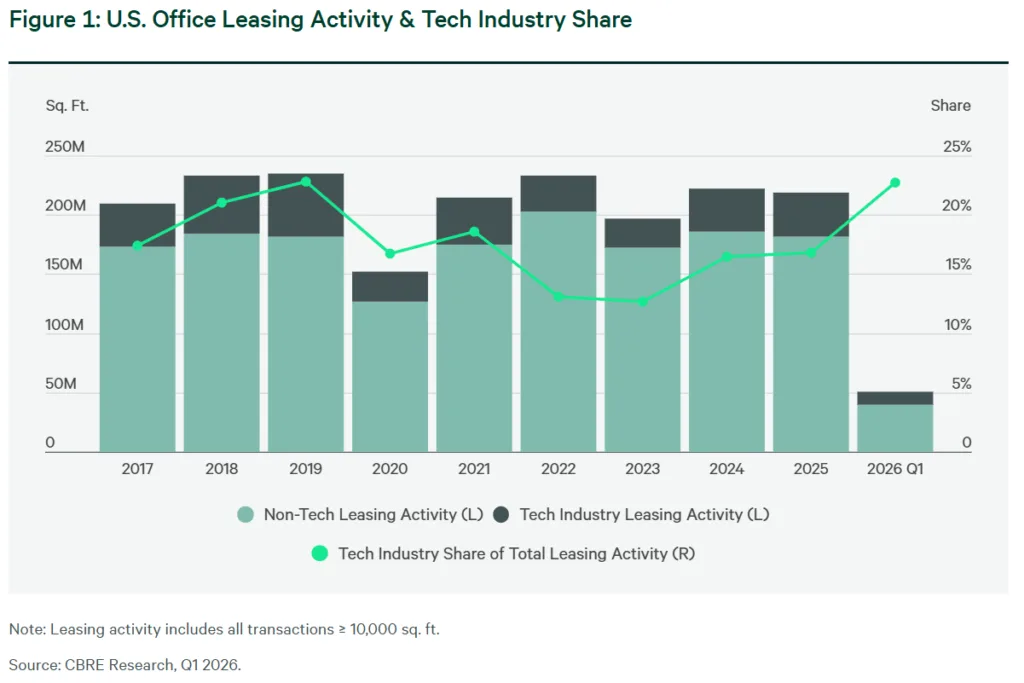
- AI firms dramatically increased office leasing activity in 2025 and Q1 2026, pushing tech’s share of US office leasing to nearly 23%, according to CBRE.
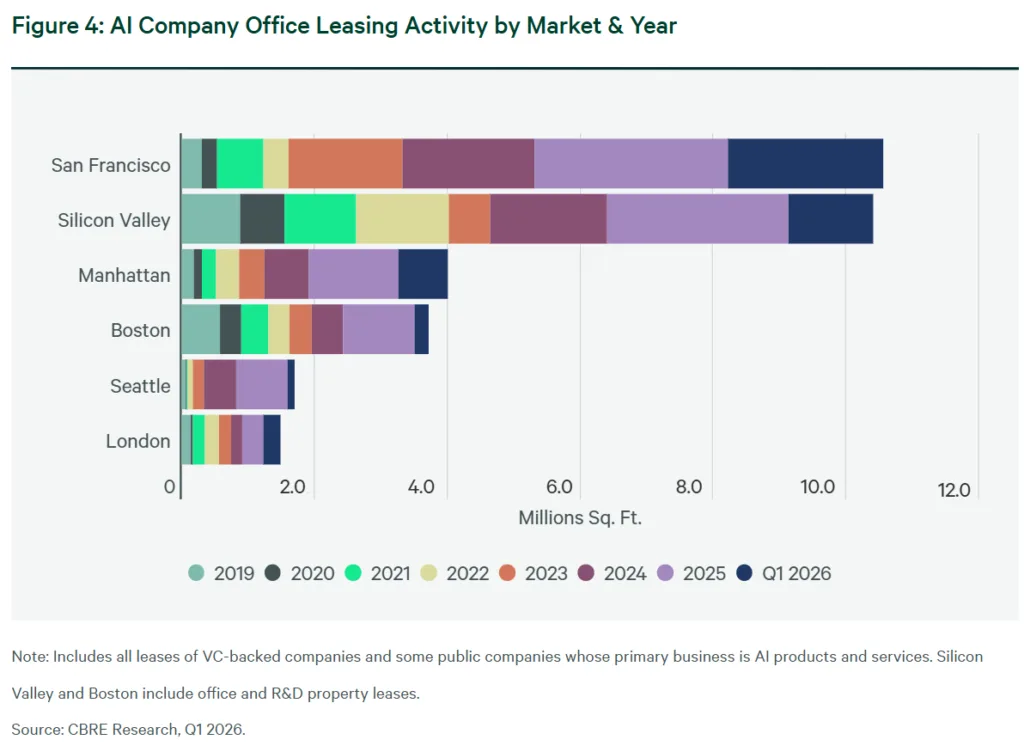
- San Francisco and Silicon Valley remain the dominant AI office markets, accounting for two-thirds of AI leasing volume since 2019 and leading current tenant demand.
- Investors and landlords are increasingly targeting high-quality office assets in talent-rich tech corridors as AI infrastructure spending and venture capital investment accelerate.
AI is quickly becoming the office sector’s biggest growth story. CBRE’s latest “Tech Gateway Office Markets” report shows AI companies are driving a fresh wave of leasing activity across major innovation hubs, helping stabilize select office markets after years of sluggish demand.
The recovery remains highly concentrated. San Francisco, Silicon Valley, Manhattan, Boston, Seattle, London, and Paris captured the bulk of AI-related leasing and venture capital investment, reinforcing a widening divide between top-tier tech ecosystems and the broader office market.
Get Smarter about what matters in CRE
Stay ahead of trends in commercial real estate with CRE Daily – the free newsletter delivering everything you need to start your day in just 5-minutes
AI Fuels a New Office Demand Cycle
CBRE tracked strong momentum across both traditional tech firms and AI startups as venture funding and infrastructure spending surged. US-based AI startups raised $578B in venture capital between 2020 and Q1 2026, with roughly 80% flowing into the San Francisco Bay Area, according to CBRE and PitchBook.
At the same time, major hyperscalers poured roughly $1.1T into AI infrastructure between 2021 and 2025, primarily for data centers, chips, and computing capacity. Bloomberg estimates that spending could reach $3.7T over the next five years.
That capital is now translating into office demand. Tech companies leased 36.7M SF of office space in the US during 2025, representing 16.8% of all leasing activity, per CBRE. In Q1 2026 alone, the sector accounted for 22.7% of total US office leasing volume, up sharply from 15.3% a year earlier.
The Details
Silicon Valley led all markets with 9.7M SF of tech leasing in 2025, followed by Manhattan at 5.6M SF and San Francisco at 4.6M SF.
AI-specific leasing was even more concentrated. Since 2019, San Francisco logged 10.6M SF of AI leasing while Silicon Valley recorded 10.4M SF, together accounting for roughly 66% of activity across the six largest AI office markets. Manhattan followed with 4M SF, while Boston reached 3.7M SF.
CBRE also identified 8.1M SF of active AI tenant demand currently in the market across the five largest US tech gateway cities. San Francisco and Silicon Valley each surpassed 5M SF of active tech tenant requirements at year-end 2025.
The impact is beginning to show up in fundamentals. Manhattan and San Francisco each reduced office vacancy by roughly 300 basis points between 2023 and 2025, according to CBRE. Net absorption exceeded 3% of total inventory in both markets last year, among the strongest performances nationally. That leasing momentum is also starting to feed investor appetite for San Francisco office assets tied to the AI growth cycle.
Still, the recovery remains uneven. San Francisco’s office vacancy rate was still elevated at 32.8% in Q4 2025 despite strong AI demand.
Where Landlords Are Winning
The biggest gains are concentrated inside premium submarkets and Class A product rather than across entire metros.
CBRE highlighted strong leasing and rent growth in San Francisco’s Mission Bay and downtown districts, Silicon Valley’s Sunnyvale and Palo Alto corridors, Manhattan’s Flatiron and Madison Square districts, and Bellevue near Seattle.
Landlords with modern, highly amenitized buildings appear best positioned to capture AI tenants, many of which are competing aggressively for specialized engineering talent and prefer centrally located offices.
The trend is also spreading internationally. London and Paris have emerged as Europe’s primary AI office hubs, supported by government investment, research universities, and growing startup ecosystems.
In London, AI companies accounted for roughly one-third of all tech leasing in 2025, with many clustering around the Elizabeth Line transit corridor and King’s Cross. In Paris, firms increasingly gravitated toward Station F and the city’s northern business districts as France expands its AI and data center ambitions.
Why It Matters
The AI boom is arriving at a critical moment for the office sector. While many US office markets still struggle with hybrid work and elevated vacancy, AI firms are creating a new category of expansion demand concentrated in high-talent urban hubs.
For investors, the trend reinforces the growing bifurcation between commodity office assets and premium buildings located near tech talent clusters. Trophy and well-located Class A assets in gateway innovation markets are increasingly attracting both leasing velocity and pricing power.
The report also suggests AI may ultimately generate more office demand than many expected. The 15 largest VC-backed AI firms expanded their combined workforce from roughly 7,500 employees in 2020 to 48,000 in 2025, according to CBRE and PitchBook.
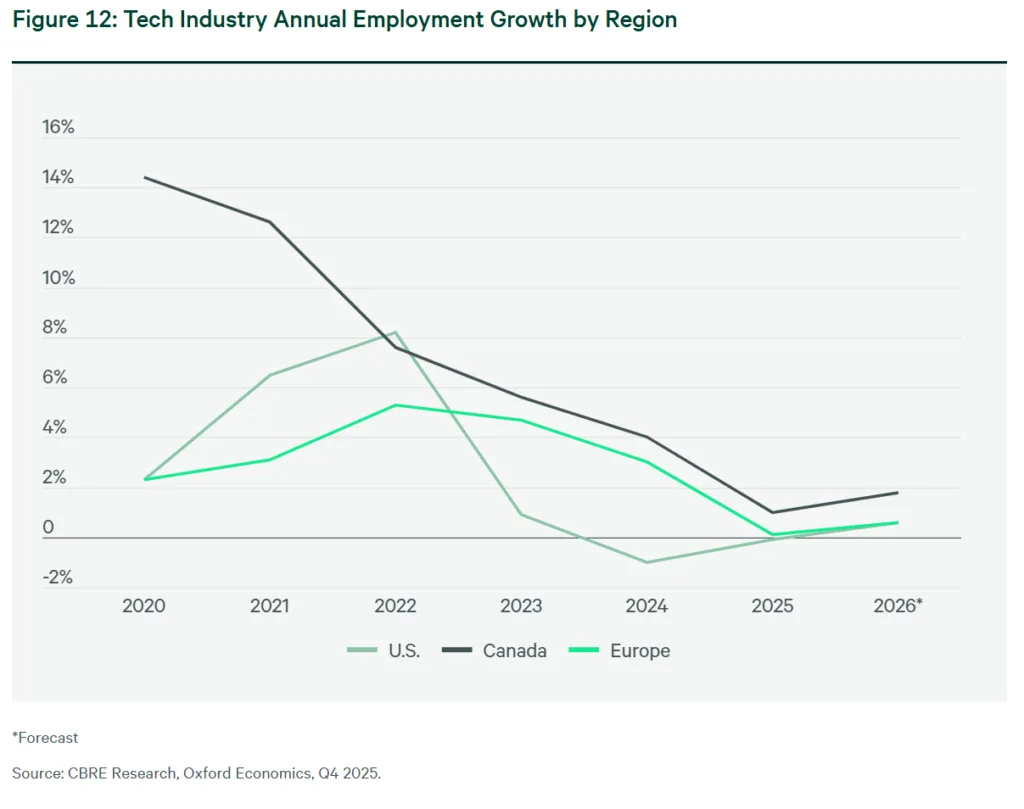
Even so, AI’s labor impact remains complicated. Challenger, Gray & Christmas reported that 4.5% of US job cuts in 2025 were AI-related, rising to 12.7% of layoffs in Q1 2026. Many tech firms are simultaneously reducing headcount while reallocating spending toward AI development.
What’s Next
CBRE expects AI to remain a major office demand driver over the next decade, particularly in markets with deep engineering talent pools and established venture ecosystems.
The next phase of growth will likely depend on whether AI adoption expands broadly across industries and whether startups can sustain current funding levels. Venture capital investment already hit a record $411B across the US, Canada, and Europe in 2025, with AI companies accounting for 55% of that total, according to CBRE.
For office owners, the near-term opportunity appears increasingly clear: highly amenitized buildings in top tech ecosystems are positioned to outperform as AI companies continue scaling operations. Markets lacking those talent advantages may see far less benefit from the sector’s rapid growth cycle.