




- August 2026 brings $5.49B in CMBS hard maturities, nearly double July’s total, with office loans dominating non-performing balances.
- Refinance risk is widespread: $3.04B in loans carry debt yields below 8%, and $996M fall below 6%—levels likely to drive further defaults.
- Office sector faces the sharpest strain, with most delinquency and special servicing activity concentrated in just a few large exposures.
Refinancing Pressure Intensifies As Debt Yields Slip
Trepp reports $5.49B in private-label CMBS hard maturities for August, more than double July’s $2.55B total. Office properties account for $1.81B, or nearly 33% of upcoming maturities. They also represent every non-performing loan in the cohort.
Trepp also expects $76.6B in CMBS hard maturities throughout 2026, exceeding both 2024 and 2025 totals. Meanwhile, many loans remain below lender debt yield thresholds, raising refinancing risks if capital markets stay tight.
The concern extends beyond current defaults. About 36% of 2026 loans carry debt yields below 8%, a level that historically limits refinancing. Many properties no longer generate enough income to qualify under current underwriting standards.
Office assets face the greatest pressure, while large retail and mixed-use properties also remain exposed. Several major loans still perform today but could become delinquent as maturity dates approach.
Get Smarter about what matters in CRE
Stay ahead of trends in commercial real estate with CRE Daily – the free newsletter delivering everything you need to start your day in just 5-minutes
The Details
August’s CMBS cohort includes 130 loan pieces across 119 whole loans. Five office loan pieces, totaling $136.6M, are non-performing. The remaining $5.36B continues to perform, but refinancing challenges continue to build.
Trepp found that $3.04B, or 55% of the cohort, carries debt yields below 8%. Nearly $1B falls below 6%, a range that often requires restructuring or principal paydowns. Although still current, $962M of those loans could default at maturity.
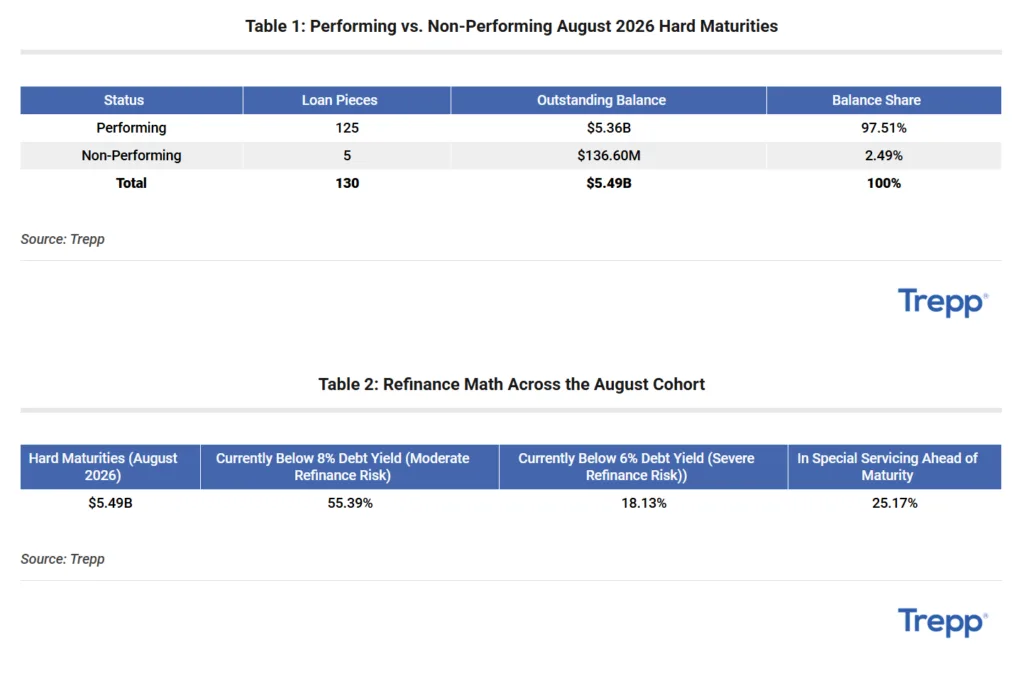
The five largest loans total $2.89B, representing 52.65% of the cohort, up from 48.37% in July. Consequently, a few large loans now shape overall market performance. Meanwhile, special servicing has climbed to $1.38B, led by office and retail assets.
Maturity Bunching Heightens Office Sector Worries
The larger August maturity wave and crowded 2026 calendar increase refinancing pressure, especially for office properties. Trepp reports that 39% of 2026 hard maturities will arrive during Q4. At the same time, 36% of loans remain below the 8% debt yield threshold.
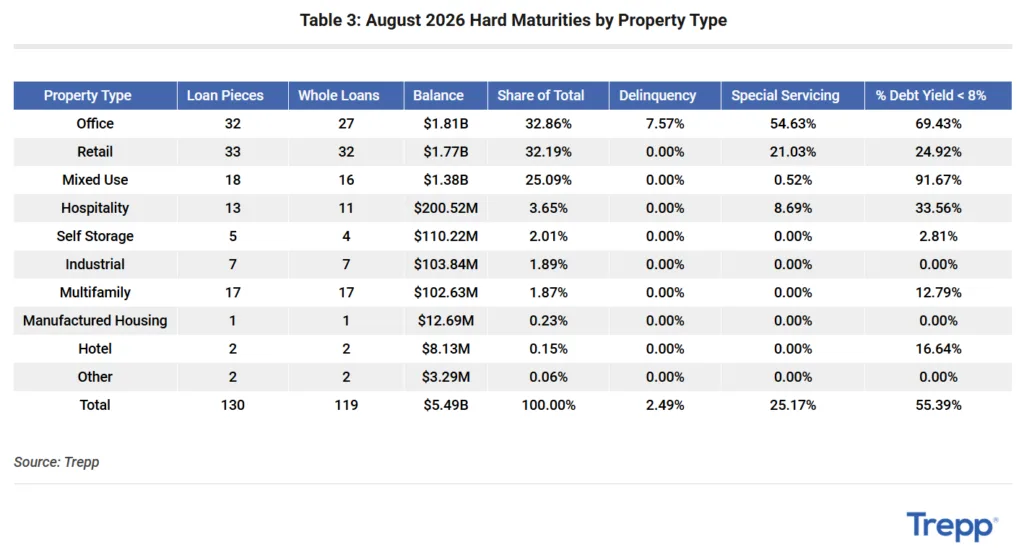
Office loans account for $986.5M in special servicing, representing 54.6% of office balances and 71% of all special-serviced loans. That pressure already appears in Manhattan, where a defaulted office loan recently entered the market, highlighting refinancing challenges for aging office assets. Retail also carries meaningful exposure, with $1.77B in maturities and $372M in special servicing. However, it has not reached office distress levels.
The largest mixed-use maturity consists mainly of a single Los Angeles portfolio, limiting broader sector comparisons. Meanwhile, non-performing loan pieces increased from one in July to five in August. Every new non-performing loan belongs to the office sector.
Why It Matters
August’s surge in CMBS maturities increases refinancing pressure for borrowers and lenders. Office remains the weakest sector, holding most non-performing and special-serviced balances. Additionally, $962M of severely impaired loans still perform, increasing future delinquency risks.
Debt yield remains the primary refinancing hurdle. About 36% of 2026 maturities fall at or below the 8% threshold. Many borrowers may need principal paydowns or accept value losses to secure new financing. If lending conditions remain tight, retail and mixed-use loans could face similar stress.
Concentration risk also continues to grow. The five largest loans represent more than half of August’s maturity pool. Even one major default could create broader market disruption. Borrowers with hard maturities also have few alternatives beyond refinancing, restructuring, or default.
As more loans mature during 2026, liquidity pressures could intensify and distressed sales could increase. Institutional investors, lenders, and servicers may face their toughest workout environment since the last CRE credit cycle.
What’s Next
The coming months will test refinancing demand and lender risk appetite through late 2026. Trepp expects $76.6B in CMBS hard maturities this year, with 39% arriving during Q4. Consequently, many borrowers will soon face critical refinancing decisions.
Watch for more restructurings, discounted payoffs, and forced sales as older office and retail assets mature. Trepp will continue tracking individual loan performance, which will likely shape market sentiment. If debt yields and underwriting standards remain unchanged, expect special servicing and distressed transactions to keep rising, especially across the office sector.