




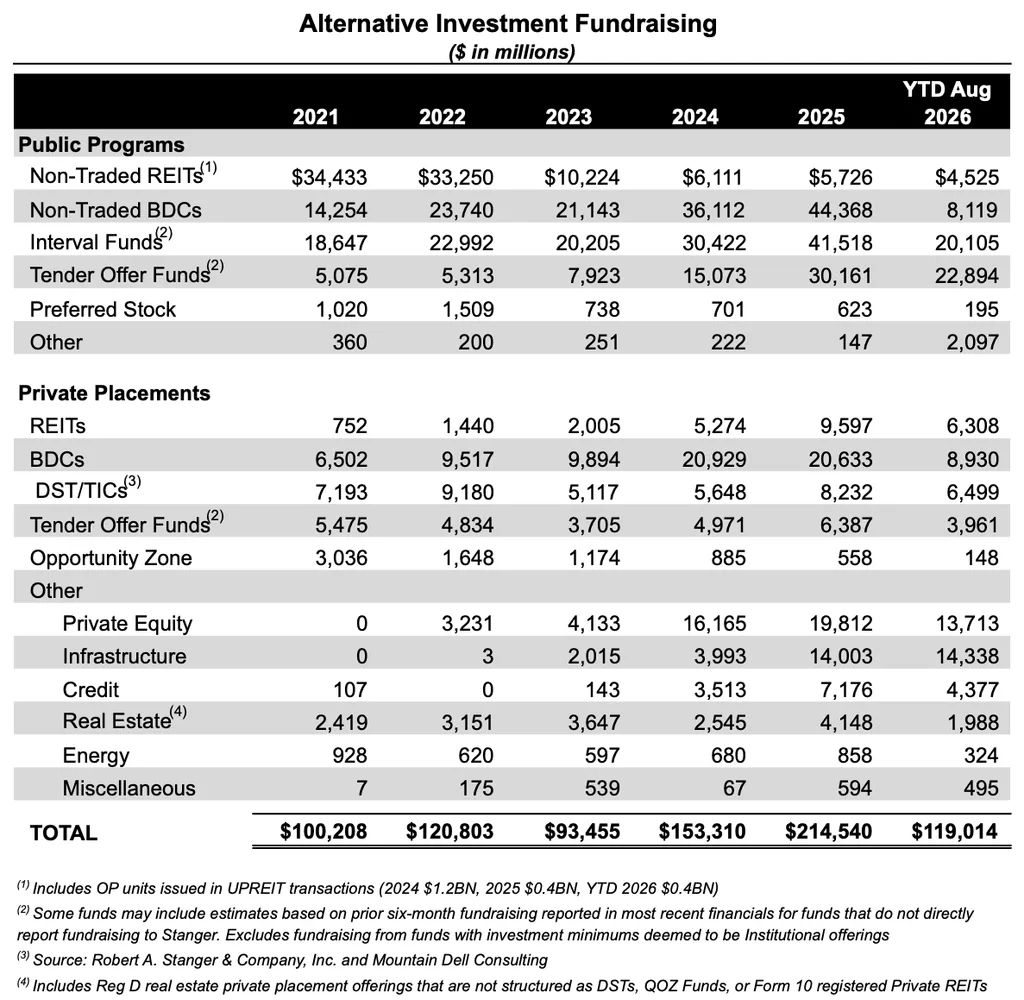
- Alternative investment fundraising reached $119B through August, down 13% year over year but up 14.1% from July.
- Real estate and infrastructure raised $38.9B combined, narrowly surpassing the $38.7B raised by credit strategies.
- Private placements captured 51% of year-to-date fundraising as publicly registered programs and BDC fundraising declined.
AltsWire reports that alternative fundraising through August 2026 totaled $119B, according to Robert A. Stanger & Co. That was 14.1% above the previous month but 13% below the $137.3B raised during the same period of 2025. The headline decline masks a sharp rotation inside the market. Credit strategies weakened, while real estate and infrastructure drew more capital.
Get Smarter about what matters in CRE
Stay ahead of trends in commercial real estate with CRE Daily – the free newsletter delivering everything you need to start your day in just 5-minutes
Hard Assets Move Ahead of Credit
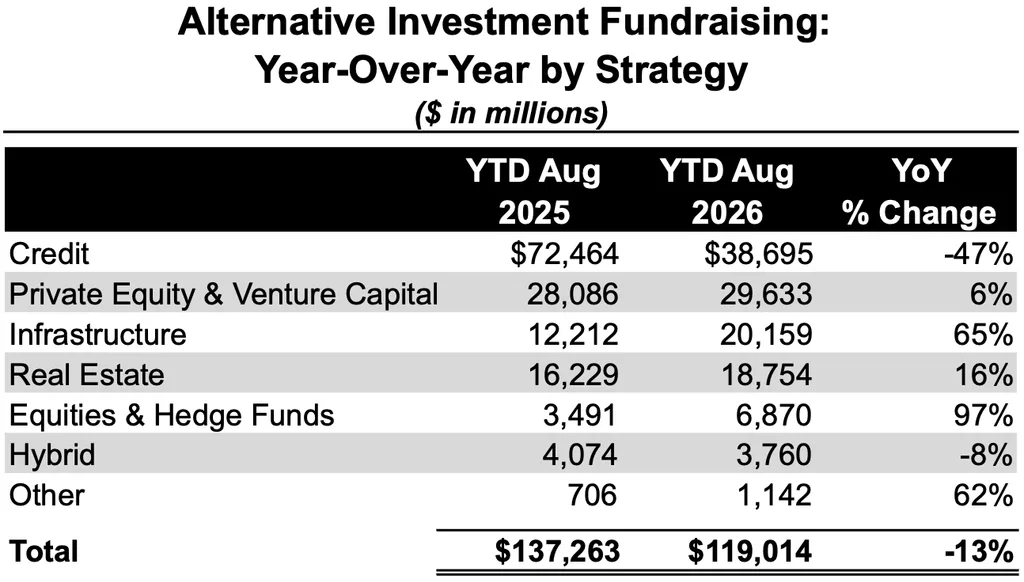
Stanger’s HALO category, which combines real estate and infrastructure as hard assets with low obsolescence, raised $38.9B through August. That total was up 37% from $28.4B a year earlier. Infrastructure led with $20.2B, a 65% annual increase. Real estate strategies raised $18.8B, up 16%.
Source: AltsWire
The combined hard-asset total edged past credit fundraising of $38.7B. Credit was down 47% from $72.5B in the same 2025 period. Excluding credit entirely, alternative fundraising rose 24% year over year to $80.3B. Stanger Chairman and CEO Kevin T. Gannon said hard assets have now outraised credit for five consecutive months.
The Details
Business development companies account for the largest portion of the credit decline. Publicly registered and private-placement BDCs raised $17B through August, down 60% from $43B a year earlier. Nontraded publicly registered BDCs raised $8.1B, down 74%. Private-placement BDCs raised $8.9B, down 22%.
The access channel is shifting at the same time. Private-placement vehicles raised $61.1B through August, up 12% from $54.6B in 2025. Public programs raised $57.9B, down 30% from $82.6B. As a result, private placements represented 51% of total year-to-date fundraising, compared with 40% a year earlier.
Sponsor Concentration Remains High
The top five sponsors captured a large share of year-to-date fundraising. Blackstone led with 14% market share, followed by Ares Management at 9%, KKR at 7%, StepStone Private Wealth at 6%, and Cliffwater at 5%.
The source also points to Blackstone Real Estate’s first Delaware statutory trust under its BXREX program. The $175.6M offering was fully subscribed and holds two Class A Sun Belt multifamily properties totaling more than 600 units. That example fits the broader pattern of investors allocating through private structures tied to real assets.
Why It Matters
The 2026 numbers show a reallocation within alternatives rather than a broad exit from the category. A year earlier, credit had raised more than two-and-a-half times as much as real estate and infrastructure combined through August. Now the totals are nearly even. Private placements now account for 51% of alternative fundraising, reinforcing the shift toward private-market capital channels.
For CRE, the important change is the relative momentum of real estate and infrastructure. Real estate fundraising is up 16%, while infrastructure has risen much faster. Together, those strategies are offsetting part of the pullback in credit and changing the mix of capital flowing through the alternatives market.
What’s Next
The key question is whether the hard-asset crossover holds through the rest of 2026. Stanger described the margin over credit as narrow but the underlying rotation as persistent since April. The same monthly data will also show whether private placements keep taking share from public programs and whether BDC fundraising stabilizes after its steep year-over-year decline.