






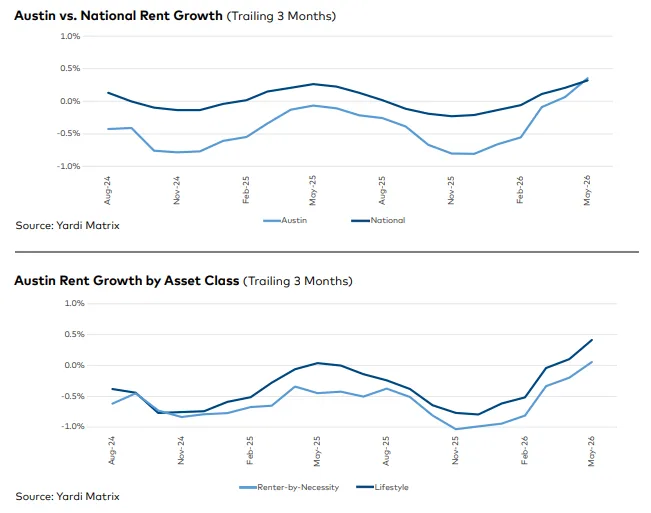
- Austin asking rents rose 0.1% over three months to $1,514, a fifth straight monthly gain, but remain down 2.5% year over year, the weakest result among Yardi Matrix’s top 30 markets.
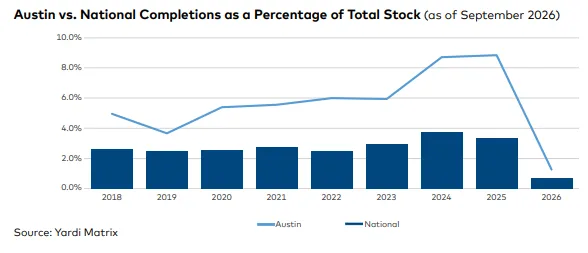
- Occupancy in stabilized assets held at 92.4% and the metro added 23,800 jobs, third-best among major markets, even after a record 30,719 apartment deliveries in 2025.
- Starts fell 27% to 5,629 units and sales dropped 22.8% to $833 million, so Austin is recovering from its supply peak while investors mostly stay on the sidelines.
Austin apartment rents are still down 2.5% from a year ago, the weakest showing among major U.S. markets, according to Yardi Matrix’s November report.
The direction is improving, though. September marked a fifth straight monthly gain, with rents up 0.1% over the trailing three months to $1,514.
Get Smarter About What Matters in Texas
Subscribe to our free newsletter covering the biggest commercial real estate stories across Texas — delivered in just 5 minutes.
A Turnaround Still Underwater
The streak follows a 0.7% decline in January. The U.S. average is $1,775, up 0.7% from a year ago.
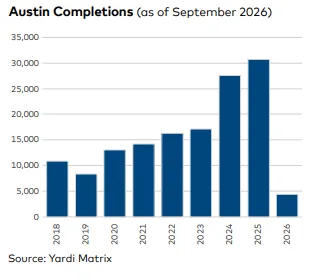
Lifestyle rents gained 0.1% to $1,627, while Renter-by-Necessity rents held flat at $1,168 for a second month after a long run of declines.
Only 16 of Austin’s 44 submarkets posted annual gains. Bastrop’s rent is now $1,347, up 4.5%, and Georgetown-East’s is $1,503, up 4.3%. Eubank Acres-South sank 8.8% to $1,040. Downtown-North remains the priciest area at $2,891.
Occupancy Is the Bright Spot
Stabilized occupancy was unchanged at 92.4% in August, even after a record 30,719 units arrived in 2025. Lifestyle properties gained 0.1 points of occupancy, reaching 93.4%.
Build-to-rent did better. Single-family rents climbed 0.6% to $2,193, and occupancy jumped 160 basis points to 94.3%.
Jobs Stay Strong
Employment grew 1.2% through July, third among major markets and far ahead of the 0.1% national gain, though down from 2.3% a year earlier. The metro added 23,800 jobs, and business services (9,200 jobs) plus construction (5,200) delivered roughly 60% of the gain.
Unemployment sat at 3.9% in August, under both the Texas rate (4.4%) and the national rate (4.1%). Amazon’s multibillion-dollar robotics plant in East Austin should add 300 to 500 engineering and factory jobs.
Defense tech is part of the draw too. Doodle Labs, a maker of long-range connectivity gear for drones, is moving its U.S. headquarters from the Los Angeles area to the metro, as we covered.
The Supply Peak Passes
Austin completed 8,739 units spread over 30 properties through September. That is 2.5% of existing stock, above the 1.5% national rate, but far below 2025’s record. Another 21,121 units are under construction across 75 properties.
Three submarkets hold nearly a third of the active pipeline: San Marcos/Kyle at 2,417 units, Dessau at 2,169 and Daffan at 2,114. Daffan also led deliveries, with 2,265 units.
Starts fell 27% to 5,629 units from 7,744 a year earlier. Matching 2025’s full-year 9,231 would take a sharp fourth-quarter pickup.
The largest delivery was The Travis, a 414-unit, 50-story tower in Downtown-North from Genesis Real Estate Group and PGIM Real Estate. JPMorgan Chase provided $173.4 million of construction financing in 2022.
Investors Wait
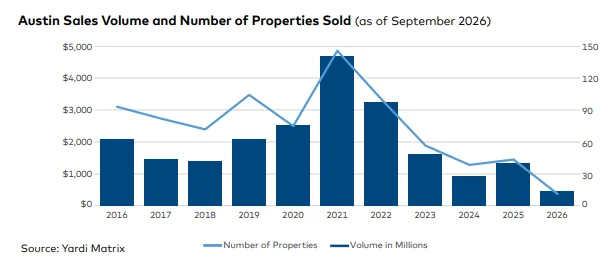
Buyers spent $833 million through September, a 22.8% decline, on 29 properties holding 8,201 units. Forty-one properties traded a year earlier. Nine months in, volume has reached under two-fifths of the $2.1 billion a year the market averaged from 2016 to 2025.
Price per unit averaged $182,256, up 5% from full-year 2025 and still below the national $196,108.
Dessau was the busiest submarket over the past 12 months at $145 million, followed by St. Edwards Park at $96 million and Pershing at $91 million. Lifestyle assets made up 16 of this year’s deals and 75.9% of the volume.
In July, Providence Management Co. bought the 576-unit Beck at Wells Branch from Electra America for $88 million, its first Austin deal. Greystar originated a $66 million loan, and Providence intends to upgrade amenities and landscaping at the 1998-vintage community.
Why It Matters
Austin shows how long a supply hangover can last. Full buildings haven’t translated into rent growth, and income feels it.
CRED iQ’s loan data we covered found Austin apartment revenue down 5.1% and net operating income down 10.8%, with loans below 1.0x debt service coverage nearly doubling.
What’s Next
Watch fourth-quarter starts and whether a fifth straight monthly rent gain becomes a sixth. The longer pipeline is still deep, with 108,000 more units in planned and prospective stages.