







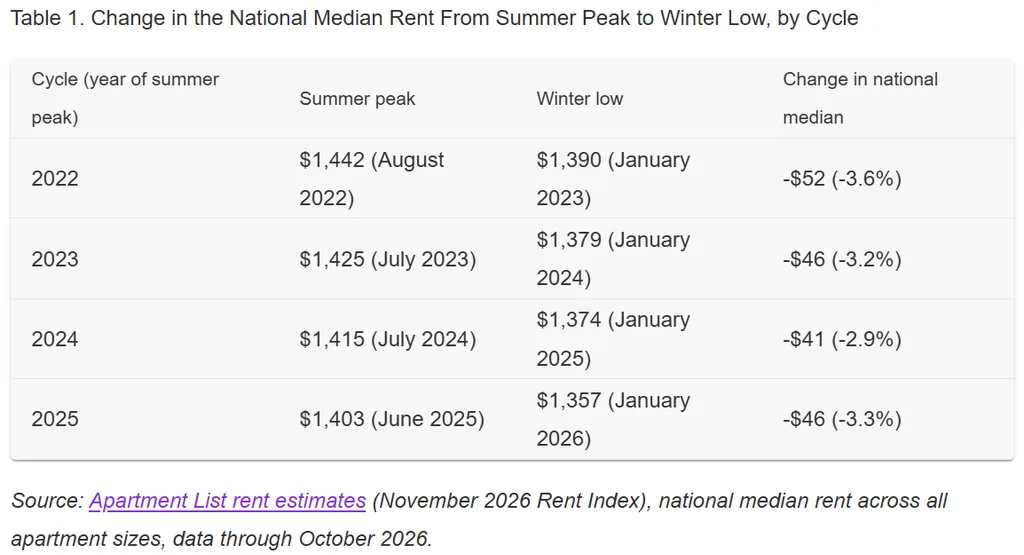
- January had the lowest national median rent within the November-to-March window in all four completed cycles, 2.9% to 3.6% below the prior summer peak.
- The national median was $1,384 in October 2026, down 0.3% from September, with the steepest average monthly decline coming from October to November at 0.8%.
- Boston, Seattle, New York, Austin and Denver see the largest seasonal swings, while 90 of the 100 largest cities saw rents fall from summer to winter in all four cycles.
Rent is cheapest in winter, and the pattern has held four years running: the national median in January sat $41 to $52 below the prior summer high, according to Apartment List research.
That works out to 2.9% to 3.6% each time. January 2026 hit $1,357, down from a June 2025 high of $1,403.
Get Smarter about what matters in CRE
Stay ahead of trends in commercial real estate with CRE Daily – the free newsletter delivering everything you need to start your day in just 5-minutes
The Four-Cycle Pattern
The cycle that peaked in August 2022 lost $52, or 3.6%. The next three lost $46, $41 and $46. January was the bottom every time.
This fall is tracking the pattern: October’s $1,384 was 0.3% under September and $6 under August in the November index.
When Rents Move
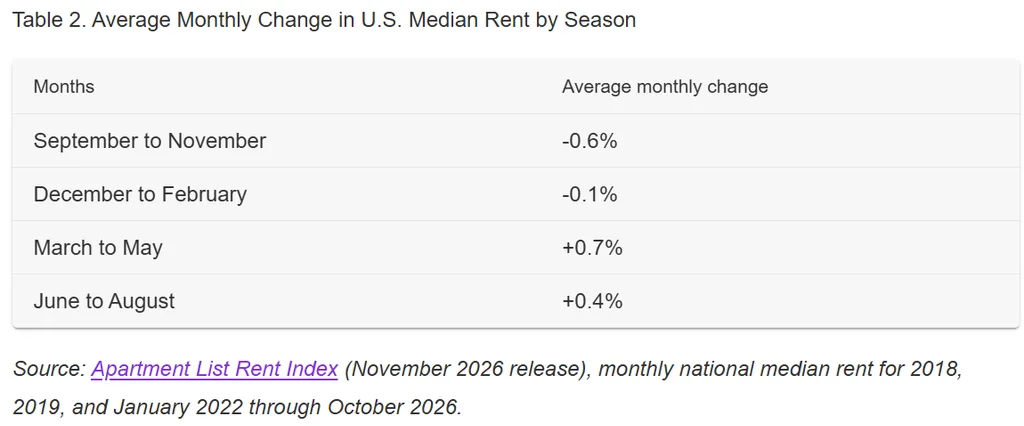
The steepest slide comes in fall, averaging 0.6% a month from September to November, before rents flatten from December through February. It climbs 0.7% a month from March to May and 0.4% from June to August.
October to November is the steepest single step, with a 0.8% average decline. The seasonal averages use seven years of data and exclude 2020 and 2021.
Where the Swing Is Biggest
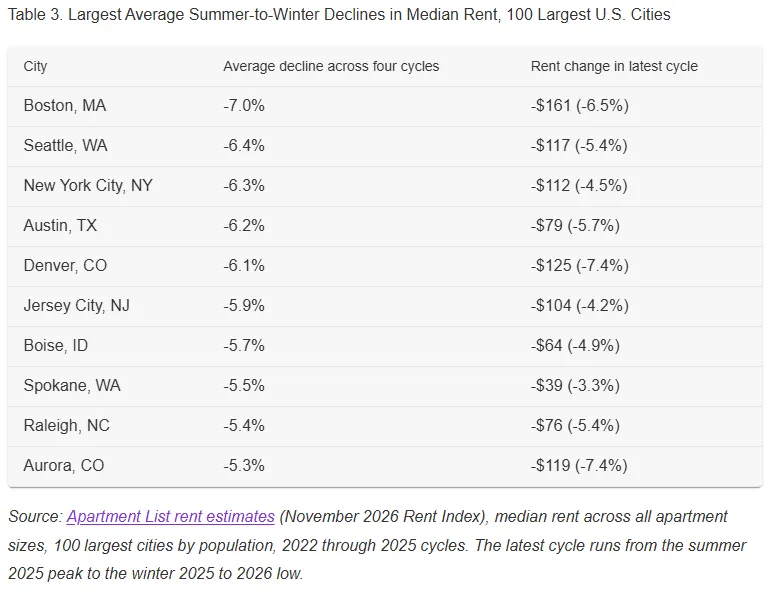
Among the 100 largest cities, 90 saw median rent fall from summer to winter in all four cycles, and 72 averaged declines of 3% or more.
Boston led at 7.0%, followed by Seattle (6.4%), New York (6.3%), Austin (6.2%) and Denver (6.1%). Madison, Wisconsin, barely moves, with a 0.3% average drop.
Why It Matters
These figures track new-lease rents, which is why they can differ from other gauges. Yardi’s separate index showed apartment rents at $1,777 with growth at a three-year high.
For owners, seasonal softness lines up with what REITs describe: renewals carry results while new-lease pricing lags.
What’s Next
Apartment List will know the winter low once March data arrives. If the pattern holds, January is the month to watch.