







- Across U.S. counties, local officials are split on data centers, while public sentiment is more cautious.
- La Porte, Indiana (75.3 out of 100) and Cartersville, Georgia (69.3) top GatherGov’s ranking of municipalities most open to new data center development.
- Texas places two cities in the top four for development opportunities, and the most open markets pair approvals with clear terms on taxes, power and water.
GatherGov has released a national dataset tracking how local governments regulate data centers, drawn from 10,000+ hours of public meetings across thousands of jurisdictions. A year of meeting records shows a clear split between how local officials and the public view data centers. But a small group of places stands out as open to new development—key jurisdictions for developers to watch.
Get Smarter about what matters in CRE
Stay ahead of trends in commercial real estate with CRE Daily – the free newsletter delivering everything you need to start your day in just 5-minutes
Officials Split, Public More Cautious
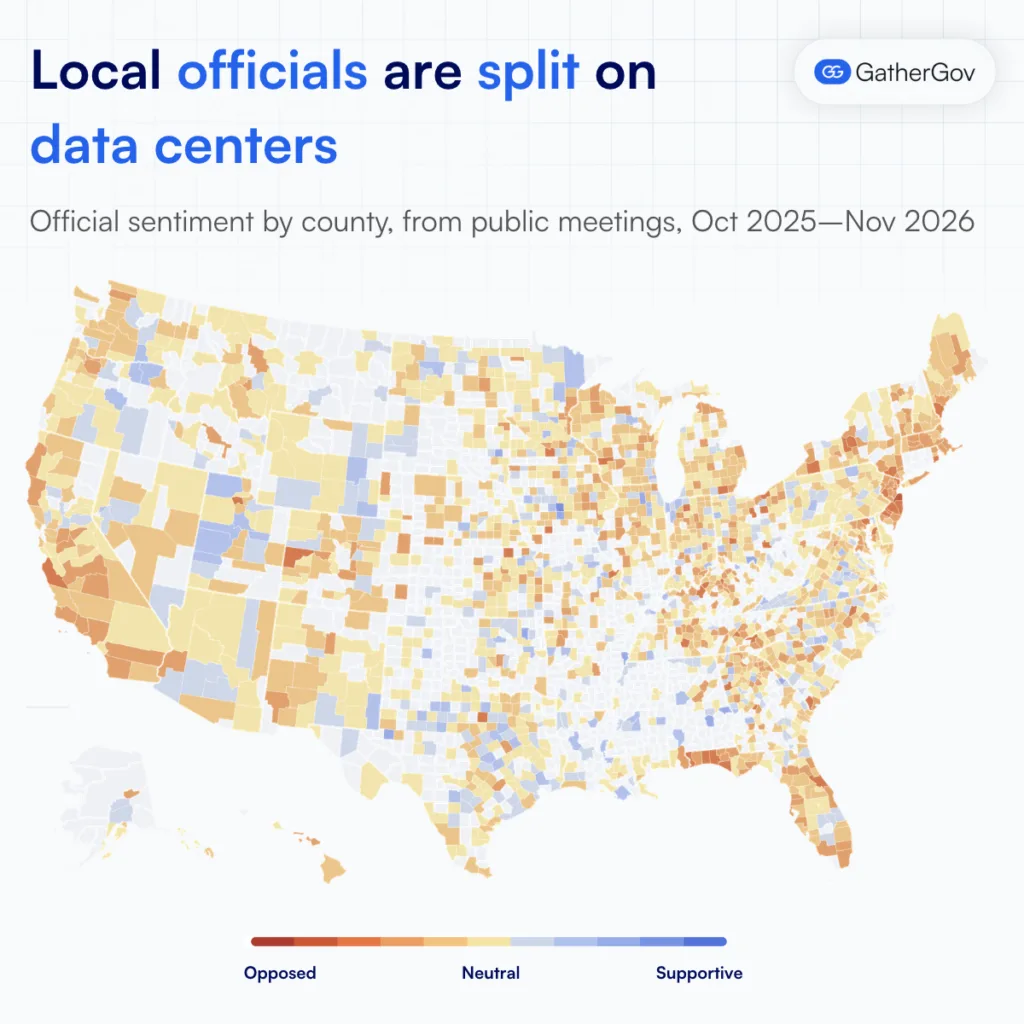
Between October 2025 and November 2026, officials’ sentiment was mixed. More restrictive counties cluster along the coasts and in parts of the Midwest and Southeast, while many counties are neutral or supportive, particularly across the Mountain West, Plains and parts of Texas.
Public sentiment leans more cautious. Speakers at public meetings most often raise water, power and noise, and counties where public sentiment is clearly supportive are fewer.
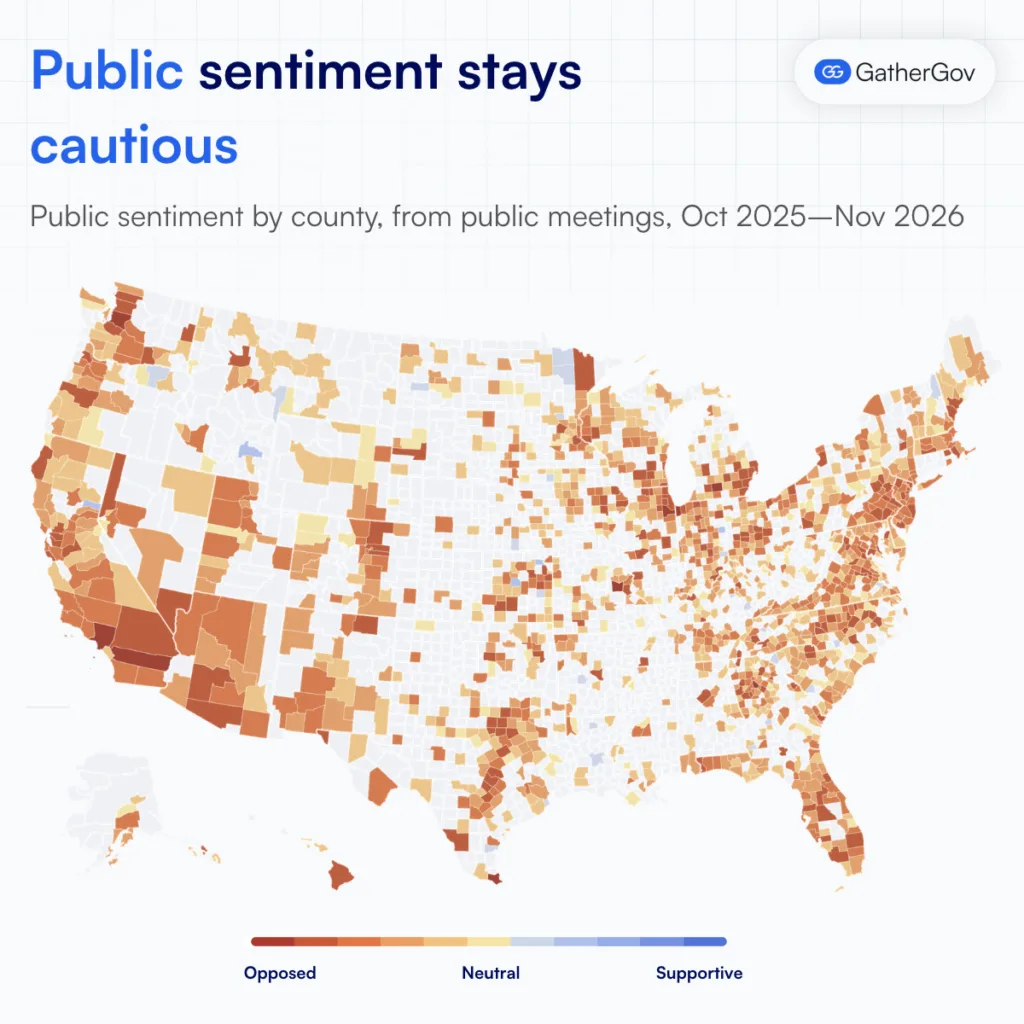
Where Development Is Moving
GatherGov scores each municipality from 0 to 100 on seven factors recorded in public meetings: moratorium status, project decisions, official sentiment, public sentiment, operational incentives, utility agreements and review process. Scores update as new meetings are recorded, and GatherGov refreshes its top 50 ranking and opportunity map every week, so the list of most open markets shifts as local governments act.
Based on meetings from October 2025 through mid-November 2026, La Porte, Indiana (75.3) and Cartersville, Georgia (69.3) rank highest. Both are established data center markets. Microsoft is building in La Porte and won unanimous approval for a second campus in May. In Cartersville, home to a Switch data center campus, the city council also unanimously approved DataBank’s application in September 2026 to rezone about 69 acres on a former chemical and soap factory site from heavy industrial to technology use for a new data center.
The rest of the top 10 points to where the next opportunities are. Texas has two of the top four, Midlothian (69.3) and Hutto (68.6), followed by markets in Missouri, Arizona and Iowa.
What the leading markets share is regulatory clarity. La Porte has a tax agreement under which Microsoft pays its full property taxes, with 15% going to local schools. Cartersville ties occupancy to confirmed power availability, and surrounding Bartow County has adopted data center standards covering cooling, buffers and noise.
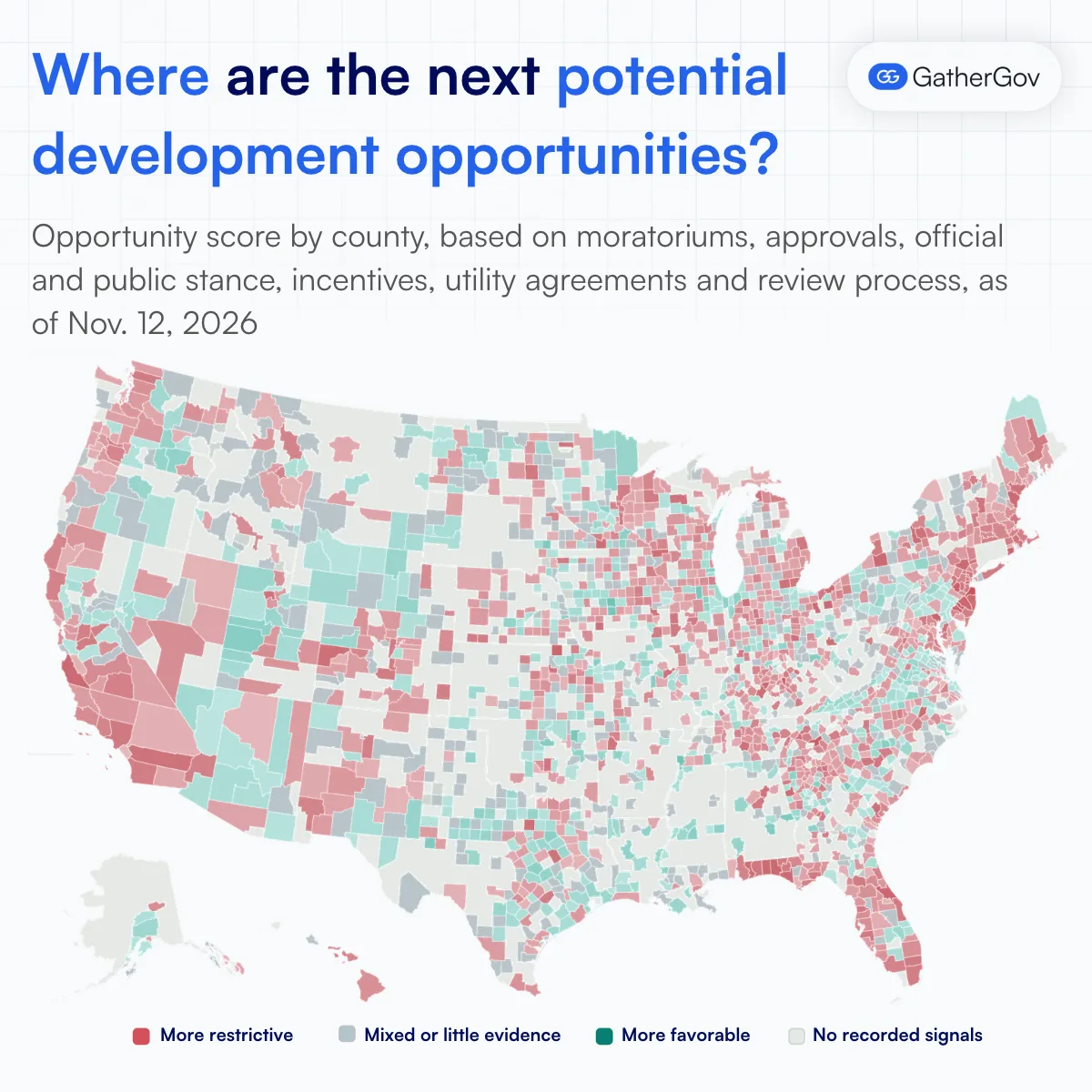
Development opportunity score by county, Oct. 14, 2025–Nov. 12, 2026. Updated weekly as new meetings are recorded. Source: GatherGov.
Trends over time
Alongside scoring jurisdictions on their opportunity, GatherGov’s analysis also helps identify data center policy trends across time and the primary motivations that drive these conversations.
One such policy is moratoriums, which have grown in interest through 2026. In Texas, meetings with a proposed moratorium rose from none in late 2025 to 26 in August 2026, including proposals in Austin, Lubbock and New Braunfels. The leading topic in these discussions is regulatory readiness, making sure local governments have the right policy in place to govern data centers. In Texas alone, regulatory readiness came up alongside moratorium talk in 129 meetings across 59 locations. In Virginia, the largest data center market, it was raised in 60 locations in the latest month, up from 47.
Other topics of interest vary by region. Water and sewer is the most widespread data center topic in Texas, raised in 65 locations in the latest month, up from 56, and in Arizona, where it reached 23 locations. Grid capacity is particularly relevant in Arizona, from 13 to 18 locations, and in New Jersey, from 26 to 30, as data center discussion there jumped from near zero in early 2026.
Why it matters
The data center market is highly sensitive to local decisions, and a single meeting can change the risk appetite for the location. Official support and public sentiment don’t always line up, and conditions on taxes, power and water are increasingly part of approvals. Tracking changes meeting by meeting allows developers and investors to spot headwinds early.
What’s Next
Watch whether more local governments adopt data center standards rather than moratoriums, and whether open markets like La Porte and Cartersville keep public sentiment on side as new campuses come online.