







- Trepp tested 309 CMBS office loans worth $18.2B that mature by September 2027. About 75% of the Class A loans would need fresh equity to refinance, versus 61% of Class B/C.
- Structure drives the split: roughly 80% of maturing Class A loans never amortize, and 84% of interest-only loans fall short at refinancing, compared with 40% of amortizing loans.
- Income growth is unlikely to close the gap. Taking out half the balance after a two-year extension would take 18% annual NOI gains, while the 2020 to 2025 median was 0.6%.
Office refinancing looks hardest for the buildings you’d expect to be safest. Trepp’s Q3 2026 Quarterly Data Review finds that three of every four maturing Class A CMBS office loans would need new equity to be taken out at current rates.
Trepp tested 309 office loans worth $18.2B that come due by September 2027. Among Class B/C loans, the share needing a cash infusion is 61%.
Get Smarter about what matters in CRE
Stay ahead of trends in commercial real estate with CRE Daily – the free newsletter delivering everything you need to start your day in just 5-minutes
Structure Beats Building Class
Debt yields barely separate the two groups, at 10.2% for Class A and 10.9% for Class B/C. What differs is how the debt was built.
Roughly four in five maturing Class A loans never amortize, compared with 55% of Class B/C exposure. Those interest-only loans are the problem. Of them, 84% fall short at refinancing, while only 40% of amortizing loans do.
Principal paydown gives a borrower a cushion. The Class B/C loans in the sample are also smaller, at $33M on average.
Why Income Can’t Fill the Hole
Take half the maturing balance, extend it two years, then refinance at par. Trepp says that would demand 18% annual growth in net operating income. Median NOI growth between 2020 and 2025 ran just 0.6%.
Trepp’s illustration shows the rate math. A property with $10M of NOI and a $100M interest-only loan pays $6M a year at 6% and $7M at 7%, which strips $1M of cash flow.
Financing costs aren’t helping. The 10-year Treasury hit 5.23% on Oct. 9, 135 basis points above its February level, and the 5-year sits near 5%. A Fed cut wouldn’t necessarily pull those yields down, since they reflect inflation expectations and federal borrowing, not just the overnight rate.
The climb has been building. CRE Daily reported that the 10-year yield reached 5.3% on Oct. 1, its highest since 2002, and that lenders at a Bisnow finance event expected lower leverage and fewer extensions.
Two Madison Avenue Loans
Two Midtown loans maturing this month show that a low debt yield doesn’t dictate the outcome. Hartz Mountain Industries refinanced 667 Madison Avenue with a $254M loan from M&T Bank that closed Oct. 6, per city records.
The 80% occupied building’s coverage ratio had dropped to 1.06x from 1.34x in a year, yet the new loan equaled the old debt stack.
60 Madison is the contrast. Its $100M loan moved to special servicing in July ahead of an expected maturity default. Occupancy is 58%, and NOI fell to $5.7M from $8.4M when the building was 88% leased in 2023. That works out to a 5.7% debt yield, with no resolution confirmed.
A $78B Hard Maturity Wall
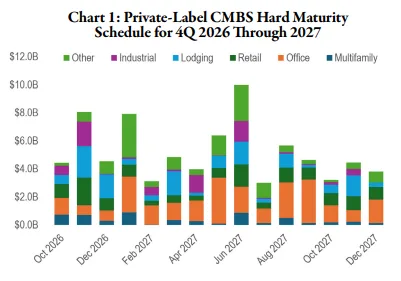
Trepp counts $78.1B of private-label CMBS loans reaching hard maturity, the point where extension options are gone, from October 2026 through 2027. Of that, $17.0B lands in Q4 and $61.1B in 2027. The monthly peak is nearly $10B in June 2027.
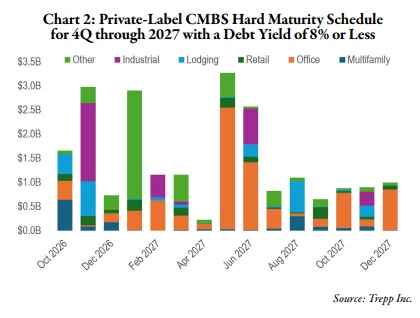
Office makes up $22.2B of the 2027 slice. And $22B of the overall total, or 28%, has a debt yield of 8% or below, a rough screen for loans likely to struggle.
Why It Matters
Borrowers short of proceeds can inject equity, negotiate an extension or modification, or accept a loss. CMBS loans 30-plus days late climbed to $48.65B through September, 8.02% of the $606.58B Trepp tracks and up 11.64% since January.
Newmark’s recent numbers point the same way: about 78% of fixed-rate securitized debt due through 2028 carries a coupon far below today’s 10-year yield.
What’s Next
The marquee test is 245 Park Avenue. SL Green’s $1.2B loan is current and the tower is 97% occupied, but $568M of mezzanine debt pushes the June 2027 payoff to $1.77B.
SL Green had called refinancing a 2026 priority, and a JPMorgan-led group marketed a $2B single-asset CMBS deal on a new loan against the building in October. Trepp’s takeaway: outcomes will differ loan by loan rather than by maturity month.